
Lest we forget: The Krugersdorp men who never came home
As the world marks 108 years since the Armistice, the Krugersdorp Heritage Association reflects on the town's wartime sacrifices and the importance of protecting its historic memorials.
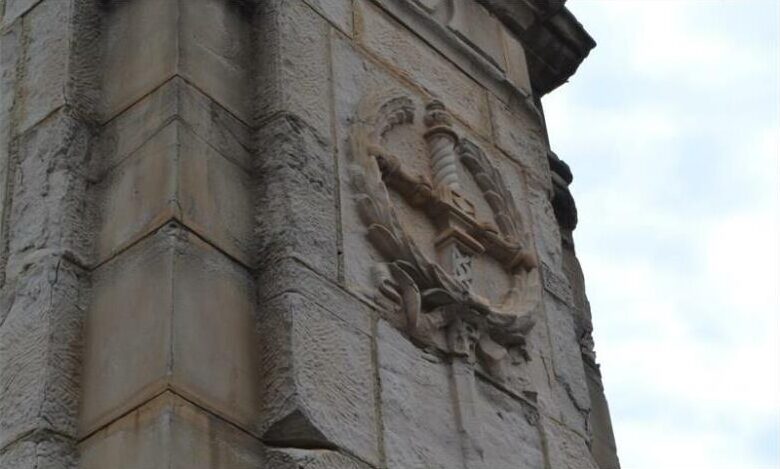
At 11:00 on November 11, 1918, the guns along the Western Front fell silent, bringing an end to the fighting of the First World War. Known as Armistice Day, the date is commemorated annually in remembrance of those who lost their lives and the families and communities left behind.
For Krugersdorp, the occasion carries a local significance. Young men from the mining town left to serve in distant battlefields, with some never returning home. Their sacrifice was later commemorated in memorials, church records and school honours that continue to form part of the town’s heritage.
In the 32nd edition of Echoes of Krugersdorp, produced in partnership with the Krugersdorp Heritage Association (KHA), co-founder Jaco Mattheyse reflects on the town’s contribution to the Great War, the lives lost and the importance of preserving the memorials dedicated to them.
A young town drawn into a world war
When war broke out in Europe in August 1914, Krugersdorp was still a relatively young town.
Founded in 1887 following the discovery of gold on the West Rand, it had developed into an important mining and commercial centre. However, beneath its progress lay the recent memories of another devastating conflict.
The Anglo-Boer War had ended in 1902, leaving deep divisions between English-speaking and Afrikaans-speaking communities. The Union of South Africa was also only four years old when Britain declared war on Germany.
As a self-governing dominion within the British Empire, South Africa was drawn into the conflict, although participation was not universally supported. For some English-speaking residents, joining the war effort demonstrated loyalty to Britain, while sections of the Afrikaner population opposed fighting alongside their former enemy so soon after the Anglo-Boer War.
These tensions contributed to the South African Rebellion of 1914. Nevertheless, South Africans from different communities became involved in the war, serving in military and supporting roles across several theatres of conflict.
From the West Rand to distant battlefields
South African forces participated in campaigns in German South West Africa, German East Africa, the Middle East and Europe.
The campaign in German South West Africa began in 1914 and ended with the surrender of German forces in July 1915. South African troops subsequently served in East Africa, where disease, difficult terrain and harsh conditions proved as deadly as enemy action.
On the Western Front, soldiers encountered the full horror of industrial warfare. Artillery bombardments, machine-guns, poison gas and flooded trenches transformed the battlefields into landscapes of destruction.
One of the defining chapters in South Africa’s military history was the Battle of Delville Wood in July 1916. During the Battle of the Somme, the South African Infantry Brigade was ordered to capture and hold the wood near the French village of Longueval.
For six days, the soldiers endured relentless bombardment and repeated German attacks. The wood was almost destroyed, and the brigade suffered catastrophic casualties.
For families back home, news from the front arrived through letters, official telegrams and casualty reports. Some received the devastating news that a loved one had been killed, died of wounds or was missing in action. In many cases, there was no nearby grave to visit.
The war’s impact on Krugersdorp
The First World War affected Krugersdorp beyond the loss of its servicemen.
As part of the Witwatersrand mining economy, the town experienced the effects of disrupted international trade, economic uncertainty and wartime pressure on labour, transport and the availability of goods.
However, the greatest consequences were human. Those who returned sometimes carried lasting physical injuries, illness or psychological trauma, while families who had lost loved ones continued to bear the grief.
The war also exposed the inequalities of South African society. Black South Africans served in military labour and support organisations, including the South African Native Labour Contingent. Their contributions were indispensable, although racial discrimination shaped both their service and the recognition they received.
The sinking of the troopship SS Mendi in the English Channel on February 21, 1917, with the loss of more than 600 members of the South African Native Labour Contingent, remains one of the country’s greatest wartime tragedies.
These experiences highlight how the war’s sacrifices extended across racial and social boundaries, even though contemporary memorials did not always recognise every community equally.
The men behind the memorial
The sacrifice becomes more personal when the names of individual servicemen associated with Krugersdorp are recovered.
Among those buried in Krugersdorp Cemetery are Private James Reid Munro of the South African Infantry, who died on April 5, 1918, aged 29, and Private Petrus Wilhelm Harmse, also of the South African Infantry, who died on October 20, 1918, aged 27.
Harmse died just 22 days before the Armistice brought fighting on the Western Front to an end.
Another serviceman, Sergeant Smith of the South African Mounted Engineers, died on December 19, 1918, more than a month after the Armistice.
The precise circumstances of their deaths, their family connections and whether their names appear on the Krugersdorp War Memorial remain to be established.
Their graves nevertheless provide a tangible connection between the Great War and the town, reminding residents that behind the history of battles and military campaigns were individual lives that deserve to be remembered.
Young men who had once attended Krugersdorp High School and other local schools exchanged their schoolbooks for military uniforms. Some were barely out of their school years when they left for service, unaware of the hardships awaiting them.
Their absence would have been felt in their families, schools and churches. Memorial plaques and Rolls of Honour preserved the names of those who served and those who never returned.
The old Methodist Church in Krugersdorp is one such place where their memory has been preserved. Together with school records and the town’s civic War Memorial, these memorials provide a record of the lives affected by the conflict.
Memorial Avenue: Where the trees remembered the fallen
Another reminder of Krugersdorp’s wartime sacrifice can be found in Memorial Avenue, where trees were planted in honour of servicemen who never returned.
Each commemorative tree was accompanied by a plaque bearing the name of a fallen soldier, creating a living memorial within the town’s everyday landscape.
Unlike stone monuments, the trees grew and changed with the generations, serving as enduring reminders of lives cut short.
However, most of the individual name plaques have since disappeared, having been stolen or removed over the years. Although the trees remain, the loss of the plaques has diminished much of the avenue’s original commemorative meaning.
Mattheyse believes the missing names should not be allowed to disappear from the town’s history.
Each plaque represented a serviceman whose life an earlier generation had deliberately chosen to remember. Together with the War Memorial, church memorials and school records, Memorial Avenue formed part of a network of remembrance established by the community.
Restoring the missing plaques and recovering the identities of the men commemorated there would help preserve this important part of Krugersdorp’s heritage.
A memorial rises from a community’s grief
In the years following the Armistice, communities throughout South Africa began erecting memorials to honour those who had died during the Great War. Krugersdorp was among them.
Through public subscriptions, funds were raised to establish a permanent memorial to the servicemen from Krugersdorp and the surrounding district who had lost their lives.
The chosen site was the landscaped gardens in front of the Krugersdorp Town Hall, completed in 1908. Situated at the end of Monument Street, the memorial occupied a prominent position in the town’s civic centre.
The architectural firm Solomon & Marshall was commissioned, with Harold Wolseley Spicer responsible for the final design.
On May 6, 1922, the foundation stone was laid by Lieutenant General Sir Jacob Louis van Deventer, a distinguished South African military commander.
A veteran of the Anglo-Boer War, Van Deventer had served on the Boer side before becoming a senior commander in the Union Defence Force during the First World War. He led South African forces in German South West Africa and later commanded British Imperial forces in East Africa.
Tragically, he died on August 17, 1922, only a few months after laying the foundation stone.
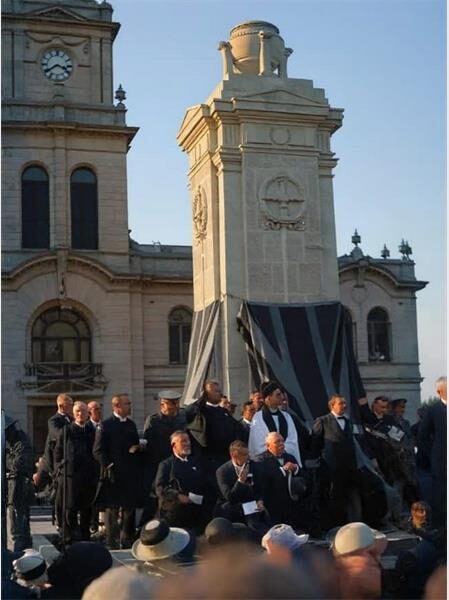
The completed Krugersdorp War Memorial was formally unveiled on July 15, 1922, by Sir Abraham Bailey, a prominent mining magnate, politician and philanthropist.
Bailey had previously contributed to the development of Krugersdorp, including donating the Town Hall clock in 1908 and contributing towards the Methodist Church façade in Burger Street in 1910.
The memorial’s inscription reads: ‘Sacred to the memory of our gallant dead who fell in the Great War 1914–1918.’
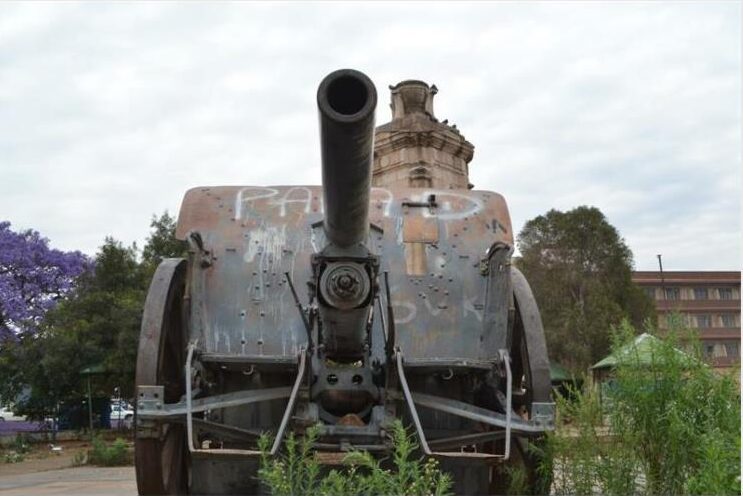
A German field gun was also placed near the monument. The South African Military History Society identifies the surviving weapon as a German 7.7cm FK 16 field gun.
The memorial later became associated with the remembrance of those who died during the Second World War, extending its significance to another generation.
From a place of honour to a forgotten monument
For many years, the War Memorial occupied a dignified position within Krugersdorp’s town centre, framed by the Town Hall gardens and aligned with Monument Street.
However, changes to the town centre eventually altered its original setting. A section of Monument Street was closed to traffic and incorporated into a pedestrian and parking area near the public library.
The memorial and its historic cannon were relocated to the upper end of the street, severing their original relationship with the Town Hall and civic gardens.
Over the years, neglect and vandalism have further diminished the landmark.
Mattheyse said the memorial’s current condition raises questions about how the town values its own history.
Once the subject of public contributions and solemn ceremonies, the monument was erected to ensure that the fallen would never be forgotten. More than a century later, it has itself become vulnerable to neglect.
Armistice Day: More than a moment of silence
Every year on November 11, people around the world observe Armistice Day, also widely known as Remembrance Day.
At 11:00, a traditional two-minute silence honours those who died in war and acknowledges the suffering endured by those who survived.
Mattheyse said the tradition has a particularly meaningful South African connection. Sir Percy FitzPatrick, the South African author and public figure, proposed the observance of a two-minute silence to commemorate the fallen. His suggestion helped establish the tradition that continues internationally today.
The first minute was intended to remember those who had died, while the second honoured those who had survived the war.
For Krugersdorp, the occasion offers an opportunity to reflect on the experiences of an earlier generation and recognise the importance of preserving the historic places that connect the town to its past.
Lest we forget
On Wednesday, November 11, the world marks 108 years since the Armistice brought the fighting on the Western Front to an end.
For the KHA, preserving Krugersdorp’s historic monuments is about more than protecting old buildings and structures. It is about safeguarding the stories, sacrifices and shared memories that form part of the town’s collective heritage.
Mattheyse said the Krugersdorp War Memorial remains a physical link to the families who gathered in grief after 1918, the townspeople who contributed towards its construction and the generations who believed remembering the fallen was a solemn responsibility.
As the 11th hour approaches, the message remains as relevant as ever: peace should never be taken for granted, and the names and stories of those who sacrificed their lives should not be allowed to fade from history.
“At the going down of the sun and in the morning, we will remember them. Lest we forget,” he concluded.