
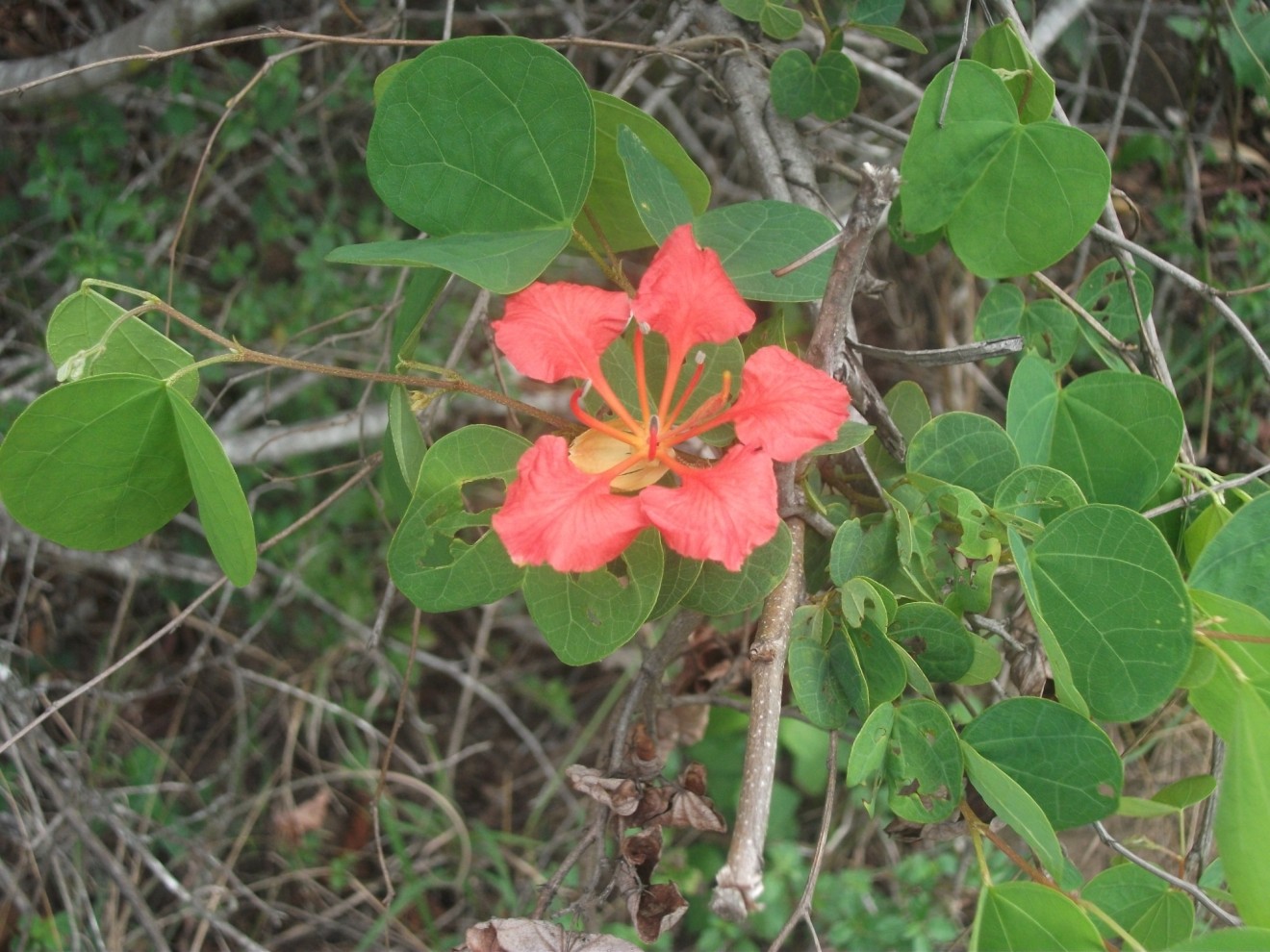
The woodland habitat has many species of climbers and epiphytes. It makes sense, because why stand on your own legs when there are so many trees to lean on?
Although its not easy to find information about them, we have a wealth of climbers in our area. Some like the pride of de Kaap (Bauhinia galpinii) and potato bush (Phyllanthus reticulatus) grow like a shrub before scrambling up a tree.
Others like the forest grape (Rhoicissus tomentosa) start as a single winding stem, immediately in search of a plant to support it. These are the more professional climbers which often have climbing tendrils! Tendrils are specialised thread-like stems, spiraling out to grab and coil around a supporting plant.
Climbers range in size from small and delicate, like the black- eyed Susan (Thunbergia alata), to huge and robust, like the thorny rope (Dalbergia armata). The thorny rope grows very old and the stem grows so thick and the spines so enormous that one can only wonder about their evolutionary function. Maybe it is to ward off elephants or to keep monkeys from swinging on the ropes!
Many climbers like the grape vine and cucumber vines bear edible fruit, but some, like bobbejaangif (Adenia digitata) are poisonous. As with all other living things, we also have alien species.
The balloon vine is an aggressive invader along streams and rivers. The potato creeper and yellow granadilla (guavadilla) are alien species that have become naturalised in our woodland. The pretty red berries of the potato creeper are probably spread by birds, while guavadillas are eaten by monkeys.
Epiphytes have found a different use for trees. They dont lean on them, they grow on them, in a non-parasitic way. The strangler fig (Ficus petersii) has chosen to grow in the fork of a tree, instead of on a rock, like some of its relatives. After germinating in the fork of a tree, the small tree sends down long roots to the ground. As the roots grow stronger and the tree bigger, it eventually, after many years strangles and replace the host tree.
Our tree orchids are also epiphytes, with special clinging roots to secure themselves to a host tree, as well as aireal roots. They obtain moisture and nutrients from their surroundings, without harming the host.
The mistletoe, however is a parasite which grows on the branches of trees, attached by a root claw. With invasive roots it taps into the sap of the host. Despite being a parasite, it an important part of our ecosystem. The yellow fronted tinkerbird favours the fruit, sunbirds feed on the flowers and the larva of the common dotted border buttterfly feed on the leaves.