
5 ways Google Health is using AI in Africa
Google is working with partners across the continent to research and explore new AI-powered healthcare tools.
While many people in Africa turn to Google products like Search, YouTube, and Fitbit for daily insights about their health and well-being, many do not know that the company is also researching how artificial intelligence (AI) can help improve healthcare outcomes.
Google says it is empowering its partners to deliver better health services, from improving maternal health outcomes to building useful digital tools for healthcare workers.
Coinciding with the Africa HealthTech Summit recently held in Rwanda – which brought together digital health innovators and public health experts – the company is working with partners across the continent to research and explore new AI-powered healthcare tools.
Searching for skin conditions using images
Describing skin rashes or moles accurately using words alone can be challenging.
Since earlier this year, users in the United States and Japan have been able to use Google Lens to search for information about skin conditions using images instead of text. The feature is now being expanded to cover the continent.
People can simply capture a photo, upload it to Lens, and discover visually similar matches.
The feature works well if you do not know how to describe something on your body, such as a bump on your lip, a line on your nails, or hair loss on your head.
Improving maternal health outcomes in Kenya
Ultrasounds are effective in identifying potential issues in early pregnancy, but capturing and interpreting an ultrasound is a complex medical imaging technique that requires years of training and experience.
Due in part to a shortage of experts, up to 50% of pregnant women in low-resource settings do not receive ultrasound screenings during pregnancy.
In a paper published last year, Google showed that AI models can make ultrasounds more accessible to lightly trained ultrasound operators in under-resourced settings. It’s now working with Jacaranda Health, a Kenyan non-profit organisation focused on improving health outcomes for mothers and babies in government hospitals, to validate the use of AI in clinical settings.
Through the partnership, it will conduct research to understand the current approach to ultrasounds in Kenya and explore how new AI tools can support point-of-care ultrasound access for pregnant women.
Using Open Health Stack to build apps for healthcare workers
Across Africa, frontline healthcare workers form a critical link between a community and the healthcare system.
Unfortunately, they often face challenges around care co-ordination and data quality.
To build mobile-first, technology-based healthcare solutions that enable better care, healthcare developers in Africa can now use Google’s Open Health Stack to build next-generation digital health tools. These tools make it easier to adopt the HL7 FHIR, a standard for healthcare data exchange.
To help upskill local developers, the company partnered with Kabarak University and IntelliSoft Consulting to host its first Open Health Stack bootcamp in Kenya.
Screening for tuberculosis using AI
According to the World Health Organisation, tuberculosis (TB) is the ninth leading cause of death worldwide, with over 25% of TB deaths occurring in Africa.
While TB is treatable, it requires cost-effective screening solutions to help catch the disease early and reduce community spread.
This year, Google partnered with an AI-based organisation headed by Right to Care, a not-for-profit entity with extensive experience in TB care in Africa, to make AI-powered screenings widely available across Sub-Saharan Africa.
Its partners have committed to performing 100 000 free AI-powered TB screenings during the collaboration.
Supporting access to emergency obstetric care in Nigeria
According to recent estimates, though only 0.06% of annual global births occur in Nigeria, the country disproportionately contributes 28% of global maternal deaths every year, and evidence shows that long travel times play a part in negative maternal outcomes.
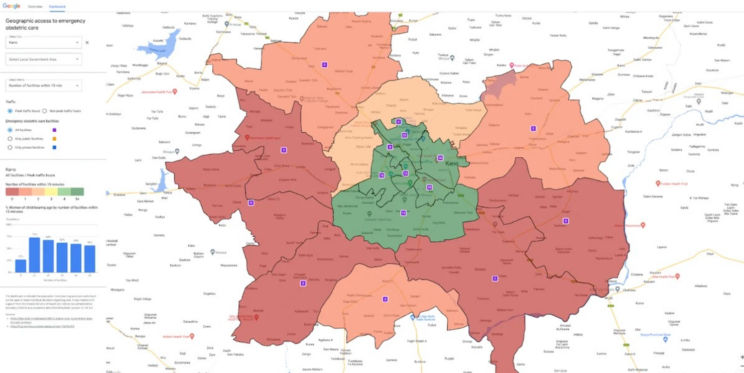
Google recently released a tool in Nigeria, developed in collaboration with the OnTime consortium, to help governments and public health organisations address challenges around accessing emergency obstetric care.
By using Google’s internal directions application programming interface (API), the same API that powers navigation in Google Maps, decision-makers can see data around average travel times to the nearest emergency obstetric facilities for different regions, which helps them better understand where expectant mothers may have limited geographic access to life-saving care.
Read original story on www.citizen.co.za

