
Concern over Covid-19 spreading rapidly into rural areas: WHO
Globally, nearly 1,5 million confirmed cases of Covid-19 have now been reported to the World Health Organisation, and more than 92 000 deaths.
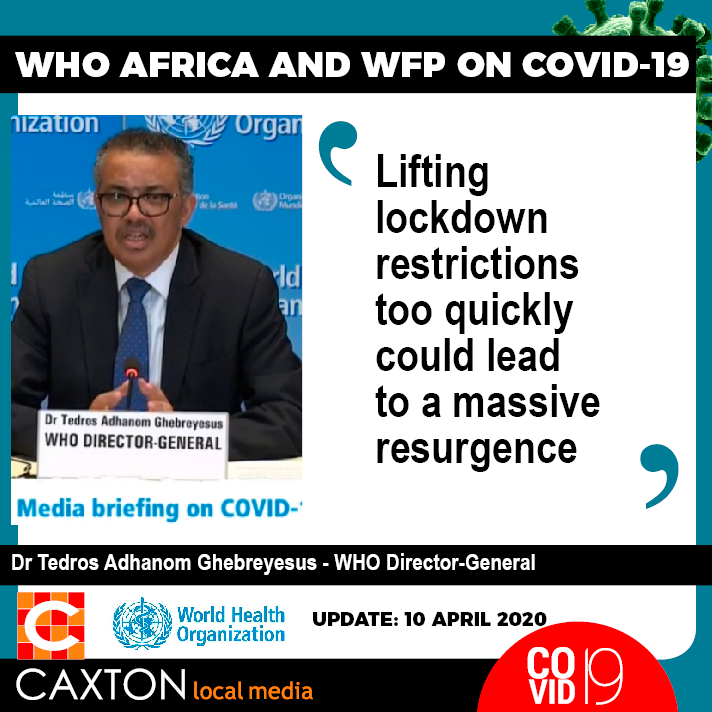
This was earlier tonight confirmed by Dr Tedros Adhanom Ghebreyesus, the WHO Director-General, during a WHO Africa and WFP briefing on the Covid-19 pandemic.
“In the past week, we’ve seen a welcome slowing in some of the hardest-hit countries in Europe, like Spain, Italy, Germany and France. At the same time, we’ve seen an alarming acceleration in other countries,” he said.
The Director-General made specific reference to Africa, saying the organisation has noted the spread of Covid-19 to rural areas. “We are seeing clusters of cases and community spread in more than 16 countries. We anticipate severe hardship for already overstretched health systems, particularly in rural areas, which normally lack the resources of those in cities.”
He referred to Dr Moeti, the WHO Regional Director for Africa, who yesterday said this means that countries need to localise their response by urgently strengthening the existing public health and primary health care infrastructure in countries.
The recent meeting of the G20 countries expressed strong support for Africa, which must be expedited even though the numbers in Africa are still relatively small but accelerating, Adhanom Ghebreyesus said.
He added that some countries are planning the transition out of their stay-at-home (lockdown) restrictions.
“The WHO wants to see restrictions lifted as much as anyone. At the same time, lifting restrictions too quickly could lead to a deadly resurgence. The way down can be as dangerous as the way up if not managed properly. WHO is working with affected countries on strategies for gradually and safely easing restrictions.”
He mentioned the following as important factors to consider:
First, that transmission is controlled;
Second, that sufficient public health and medical services are available;
Third, that outbreak risks in special settings like long-term care facilities are minimized;
Fourth, that preventive measures are in place in workplaces, schools and other places where it’s essential for people to go;
Fifth, that importation risks can be managed;
And sixth – and I cannot over-emphasize this point – that communities are fully aware and engaged in the transition.
Every single person has a role to play in ending this pandemic, he said.
“We are particularly concerned by the large numbers of infections reported among health workers. In some countries there are reports of more than 10 percent of health workers being infected. This is an alarming trend. When health workers are at risk, we’re all at risk,” Adhanom Ghebreyesus commented.
Evidence from some countries suggests that health workers are actually being infected outside health facilities, in their homes or communities.
“Within health facilities, common problems are the late recognition of COVID-19, or lack of training or inexperience in dealing with respiratory pathogens. Many health workers are also being exposed to large numbers of patients in long shifts with inadequate rest periods. However, the evidence also shows that when health workers wear personal protective equipment the right way, infections can be prevented,” he commented.
He said this made it so much more important that health workers are able to access the masks, gloves, gowns and other PPE they need to do their jobs safely and effectively.
To support countries, WHO has launched three tools to help managers and planners calculate the health workers, supplies and equipment that will be needed for the increase in COVID-19 patients.
“On Wednesday I mentioned the new United Nations Supply Chain Task Force, to coordinate and scale up the procurement and distribution of personal protective equipment, lab diagnostics and oxygen to the countries that need it most.”
The initiative will be coordinated by WHO and the World Food Programme, building on existing collaboration between multiple partners from within and outside the UN.
This system will consist of hubs in Belgium, China, Ethiopia, Ghana, Malaysia, Panama, South Africa and the United Arab Emirates, he said.
They estimate this supply chain may need to cover more than 30% of the world’s needs in the acute phase of the pandemic.
“Every month, we will need to ship at least 100 million medical masks and gloves; up to 25 million N95 respirators, gowns and face-shields; up to 2.5 million diagnostic tests; and large quantities of oxygen concentrators and other equipment for clinical care.”
Adhanom Ghebreyesus urged donors to support this system and to support the World Food Programme.
Notice: Coronavirus reporting at Caxton Local Media aims to combat fake news
Dear reader,
As your local news provider, we have the duty of keeping you factually informed on Covid-19 developments. As you may have noticed, mis- and disinformation (also known as “fake news”) is circulating online. Caxton Local Media is determined to filter through the masses of information doing the rounds and to separate truth from untruth in order to keep you adequately informed. Local newsrooms follow a strict pre-publication fact-checking protocol. A national task team has been established to assist in bringing you credible news reports on Covid-19.
Readers with any comments or queries may contact National Group Editor Irma Green (irma@caxton.co.za) or Legal Adviser Helene Eloff (helene@caxton.co.za).
Read original story on reviewonline.co.za

