
Fake videos and AI audio stir up anti-migrant tension
A fact-checking organisation has found that viral videos and an AI-edited interview were falsely presented as being connected to a march against illegal immigrants.
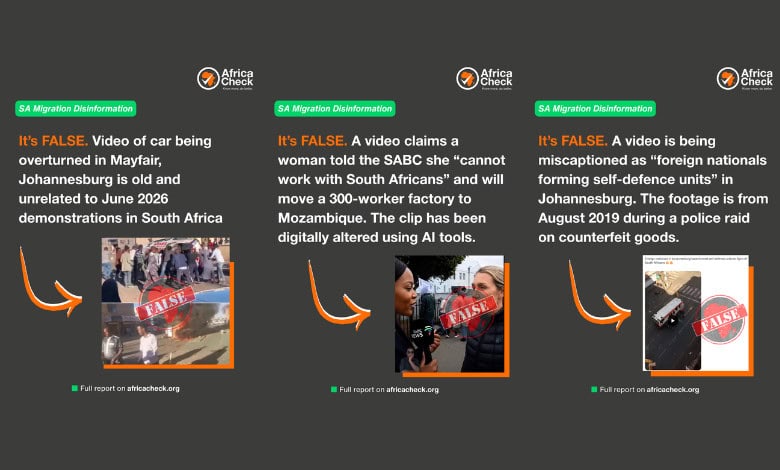
Africa Check has debunked several false claims circulating online, including AI-manipulated content and old videos shared out of context as the March and March-led protests continue across South Africa.
The fact-checking organisation said the first video circulating online shows a large crowd throwing stones at a police vehicle, with claims that it depicts ‘foreign nationals’ in Johannesburg who have formed ‘self-defence units to fight off South Africans’.
However, Africa Check said the clip of the armoured police vehicle retreating from the crowd was actually filmed in August 2019.
“News reports from the time explain that the video was filmed during a police raid on shops thought to be selling counterfeit goods in Johannesburg’s central business district. Shop owners retaliated, and the resulting protest was captured in the video. But it is unrelated to migration-related protests and was filmed long before June 2026,” the organisation said.
The clip was previously debunked after being shared out of context with false claims in April 2020.
Another video circulating online claims to show foreign migrants attacking South Africans in Mayfair, Johannesburg, after a private security vehicle was overturned by a group of demonstrators.
Again, Africa Check said the claims are false.
Reverse image search
Using a reverse image search of key frames from the video, the organisation said it found multiple versions of the clip circulating on social media, labelled as taking place in Mayfair but posted in early May 2020.
“A news article published on May 2, 2020, reported on the incident, saying that, according to eyewitnesses, an escalated confrontation between police, the security company ASARS and residents led to the car being overturned and set alight. The article included a street address. We looked at this location on Google Maps and confirmed that what is seen in the video matched imagery of the area.”
The organisation said the confrontation was linked to restrictions on movement in public spaces during the Covid-19 lockdown.
“It was unrelated to tensions between South Africans and migrants in the country.”
AI
Africa Check also investigated a video made to appear as an SABC interview, in which a woman says she ‘cannot work with South Africans’ because ‘they are very rude’ and claims she is moving her factory of 300 workers to Mozambique.
Africa Check said the clip had been edited using artificial intelligence (AI) tools.
The organisation found that the original video was posted on TikTok by DW Africa, the African news and programming division of Deutsche Welle (DW), Germany’s public international broadcaster.
“The woman being interviewed speaks much more slowly. While she does express sadness at ‘what is happening’ and says that she has employed people from Zimbabwe, she does not say anything about not being able to work with South Africans, nor does she say she is moving her business,” Africa Check said.
The organisation explained that in the edited version, the woman’s voice is sped up and her accent is different.
“Her speech doesn’t always match her mouth movements. An SABC-branded microphone has been added, whereas the original interview was conducted by DW,” it said.
Also read: Warning over fake R250 reward post before June 30 protests
Breaking news at your fingertips… Follow Caxton Network News on Facebook and join our WhatsApp channel.
Nuus wat saakmaak. Volg Caxton Netwerk-nuus op Facebook en sluit aan by ons WhatsApp-kanaal.
Read original story on www.citizen.co.za

