
Increased rhino killings at the start of 2025 mock last year’s poaching decline
While rhino poaching declined in 2024, challenges persist in the ongoing battle against wildlife trafficking.
The number of rhinos poached in South Africa decreased last year compared with 2023. Despite this, however, wildlife trafficking remains a significant global challenge and requires intense efforts to disrupt criminal networks.
This is according to Minister of Forestry, Fisheries and the Environment Dion George, who released the 2024 rhino poaching statistics to the media yesterday.
His concerns were emphasised in a gruesome way when it was announced that 35 rhinos were killed in the Kruger National Park (KNP) in the first seven weeks of this year.
George, who attended a ranger course at the Southern African Wildlife College at the beginning of the year, says it helped him to better understand the ‘scourge of poaching’ and how difficult rangers’ work is on the frontline.
“As we intensify the fight against wildlife poaching, it is encouraging to see that the work of the rangers; the Department of Forestry, Fisheries and the Environment (DFFE); and other key role players is steadily gaining momentum,” he said.
According to George, from January to December 2024, 420 rhinos were poached in the country. Of these, 320 were killed on state properties and 100 in private parks, reserves or farms.
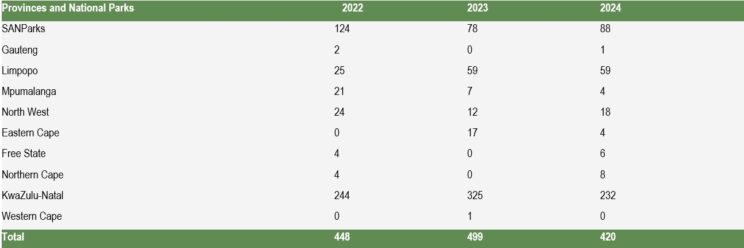
“There was a decrease of 79 rhinos poached in 2024, compared with 499 in 2023,” George confirmed.
The hardest hit rhino poaching province was KZN, with 232 rhinos killed. “This is a notable decline from the 325 that were lost in 2023. The significant reduction can largely be attributed to the Ezemvelo KZN Wildlife Dehorning Programme that was implemented in Hluhluwe-iMfolozi Park from April to October 2024. The World Wide Fund for Nature-funded programme had an immediate impact, with monthly poaching numbers dropping from 35 in April to less than 10 per month between May and September 2024,” said George.
He added that in October, however, poaching syndicates adapted their tactics and started targeting dehorned rhinos, leading to a sudden spike in poaching incidents in Hluhluwe-iMfolozi Park. “In that month alone, the province lost 27 rhinos.”
The provincial anti-rhino poaching team responded swiftly, intercepting the new syndicate and preventing further losses. “The considerable efforts resulted in the province ultimately achieving a 67% decline in rhino poaching over the eight months,” George confirmed.
The KNP reported that 88 rhinos were poached last year.
“This is 10 more than the 78 that were reported for KNP during the same period in 2023. Up until the end of November, rhino losses reported in the KNP stood at 67, but a significant escalation in rhino poaching activities was experienced in December (21) and January (17). This escalation is of great concern,” said George.
Bail for suspected poachers
While numerous rhino poaching cases have resulted in lengthy prison sentences for some, George said that the amount of time it takes to finalise cases is of concern.
“When suspects are released on bail, the data tells us that a large number of them continue to commit crimes (often relating to rhino poaching and/or horn trafficking). Accordingly, expediting these cases through our courts and vigorously opposing bail will no doubt result in safeguarding more rhinos,” he added.
Successful prosecutions
Several poachers are behind bars after successful prosecutions.
Francis Kipampa (50) was sentenced to 18 years in prison in January, of which eight were suspended for five years.
In April 2022, a search warrant was obtained by the Nelspruit Serious Organised Crime Investigation unit to search premises in Kabokweni in Mpumalanga, where six rhino horns were recovered.
This led to the registration of Project Blood Orange, dealing with corruption and money laundering in the illegal wildlife trafficking of rhino horns. A multi-disciplinary team was established and a dedicated prosecutor was appointed.
As a result, 16 people, including Kipampa, were arrested. Downloads of cellphone data and a financial investigation identified Kipampa, a Congolese citizen, as a major roleplayer in Gauteng who was buying rhino horns.
In December 2022, search-and-seizure operations were conducted in Limpopo, Mpumalanga and Gauteng. Kipampa’s home was searched and DNA swabs were obtained from equipment, exhibits in the house and the vehicle, says George.
CCTV footage also contained valuable evidence in the case.
“The DNA swabs were analysed and contained DNA of white rhinos. Analysis of the cellphones provided critical evidence, including facial identification analysis,” says George.
Kipampa was arrested in February 2023, and his bail was successfully opposed.
In January this year, after reaching a plea agreement with the state, he pleaded guilty to the following charges:
- Contravening sections 18(2)(a) of the Riotous Assemblies Act 17 of 1956: Conspiracy to commit crime, to wit contravening section 57(1) of the National Environmental Management Biodiversity Act 10 of 2004: Dealing in horns of rhinoceros.
- Contravening section 4 of the Prevention of Organised Crime Act 121 of 1998: Money laundering – approximately R1m generated from illegal rhino horn deals which was invested in acquiring properties, which were subsequently resold, and the profits reinvested to acquire more properties.
- Contravening section 43 of the Immigration Act 13 of 2002: Staying in South Africa illegally.
Apart from his effective sentence of 13 years behind bars, a confiscation order was obtained in terms of Section 18 of the Prevention of Organised Crime Act 121 of 1998 to the value of R5m, as derived from his unlawful activities, said George.
The 15 remaining accused are awaiting trial on several charges.
George said Kipampa’s lengthy sentence ‘sends out a strong message. “Not only are we focusing on arresting those involved in poaching our rhino and trafficking the horn, but we are disrupting the higher-up levels in the value chain.
“This project is an excellent example of the integrated and multi-disciplinary approach to investigating organised crime linked to wildlife and ensuring that we target corruption, money laundering and the financial crimes associated with these activities. More of these focused investigations are needed as we continue to implement the National Integrated Strategy to Combat Wildlife Trafficking,” he said.
The strategy is in its second year of implementation.
Field rangers sentenced
According to George, in January 2019, information was received that Lucky Mkanzi and Joe Sihlangu – KNP field rangers at Crocodile Bridge – were involved in the transporting of suspects in the Godlene area of the Crocodile Bridge Ranger section.
The carcasses of two white rhinos were also found in the section and analysis of the automatic vehicle location fitted to the official vehicle placed the field rangers in the vicinity at the time the animals were killed.
Both men later made admissions and R41 800 was recovered from Sihlangu’s room. He had received the money as payment for his involvement in the crime.
Both accused were convicted in September last year, on charges falling under the National Environmental Management: Biodiversity Act 10 of 2004 (illegal hunting of rhinos) and under the Riotous Assemblies Act 17 of 1956 (conspiracy to commit a crime).
They were each sentenced to an effective 20 years in prison.
Gauteng duo to spend 15 years behind bars
George said in August 2018, Ntsako Miaas Maluleke and Phanuel Vutivi Chabalala were arrested at OR Tambo International Airport while en route to Vietnam with two boxes containing 27 rhino horns weighing 29.47kg.
They were charged and appeared in the Kempton Park Regional Court.
Both faced eight counts of contravening sec 57(1) of the National Environmental Management: Biodiversity Act, including receiving, possession, conveying and export of the 27 rhino horns.
Both were found guilty on May 9. Each one’s total sentence was 20 years, of which five years were suspended for five years on condition that they are not convicted of contravening the act during this time. Both were also declared unfit to possess a firearm.
Countering poaching in hotspot areas
SANParks and Ezemvelo KZN Wildlife continue to implement initiatives to counter poaching threats in hotspot areas.
In the KNP, this includes polygraph testing staff. George said the Skukuza SAPS Stock Theft and Endangered Species Unit and the Mpumalanga Hawks assist with investigations. As a result, disciplinary action has been taken against two employees in Ranger Services.
Information about rhino poaching crime scenes and modus operandi has been shared with the DFFE’s Environmental Enforcement Fusion Centre to determine links between poaching incidents across the country.
In addition, co-operation with various stakeholders was strengthened to alert customs and law enforcement officials in transit and destination countries to be on the lookout for illegally traded horns during December and January, when poaching increased in the KNP.
Ezemvelo KZN Wildlife implemented its Rhino Guardianship Strategy in August, which has helped to reduce poaching in the province; its Integrity Implementation Plan was completed and approved for implementation; integrity assessments of Hluhluwe-iMfolozi Park staff by an independent service provider commenced; the Hluhluwe-iMfolozi Park Integrity Management Plan was completed and approved for implementation; and 55 Ezemvelo rhino reserve managers and 58 field staff were polygraphed.
“We remain committed to the fight against rhino poaching and I believe that a renewed strengthening of our agreements and operational protocols with key countries should be our focus for 2025,” said George.
Hotline
Members of the public can report any suspicious activity about wildlife to the environmental crime hotline on 0800 205 005 or to SAPS on 10111
Breaking news at your fingertips… Follow Caxton Network News on Facebook and join our WhatsApp channel.
Nuus wat saakmaak. Volg Caxton Netwerk-nuus op Facebook en sluit aan by ons WhatsApp-kanaal.
Read original story on www.citizen.co.za