
John Hume: Last throw of the dice to save his rhinos
The world’s biggest rhino farm goes on auction tomorrow, with the owner – a former billionaire who has run out of money – hoping against hope that his life’s work will be saved by a fellow philanthropist.
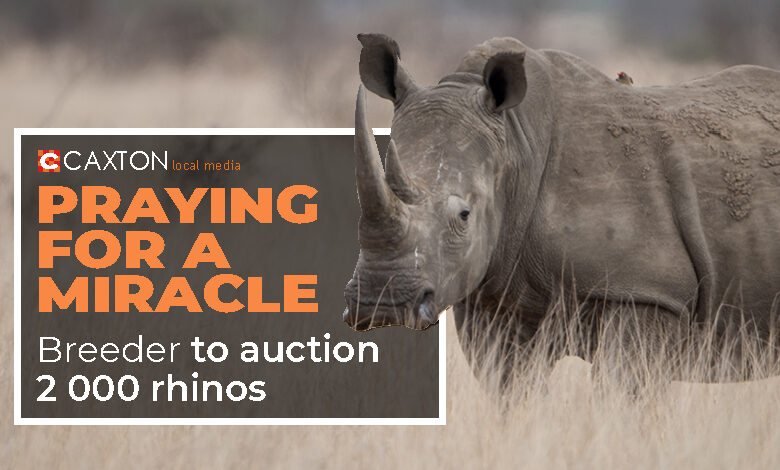
Rhino breeder John Hume’s Platinum Rhino Conservation Auction starts tomorrow and ends on May 1, which is International Save the Rhino Day.
When he announced the auction of his 2 000 rhinos in February, it was billed as a ‘unique opportunity to own the most important population of southern white rhino in the world’. The starting bid for the 8 500ha farming operation in the North West is $10m (around R182m).
Hume told Business Maverick at the time that if the auction fails, the ‘project will be closed down, the rhinos will be sold piecemeal, the land will be sold for cattle grazing or maize cultivation and the 100 employees will be let go – this unique conservation project that is actively saving the southern white rhino from extinction will be lost’.
It is not the first time that 81-year-old Hume has tried to secure a lifeline for his rhino breeding operation that began nearly 30 years ago. In 2018, he said he was on the verge of bankruptcy and pleaded with investors to come forward. A year later, he attempted to raise the necessary funds with the auction of another property near the Kruger National Park. A plan to release 100 of his rhinos per year into the wild, with the help of funding partners, was then announced by Hume last year. There were no takers for any of these efforts.
When Caxton Local Media contacted Tammy Hume, John Hume’s daughter-in-law and spokesperson for the auction for comment, she did not want to divulge any further information.
At the beginning of April, an article on the National Geographic website stated the following: “A spokesperson for the Department of Forestry, Fisheries and the Environment, Albi Modise, says the agency is ‘committed to a meeting’ with Hume ‘to get a sense of this matter and explore possible options’.”
The department responded to a request for more information from Caxton by saying: “The Department and Mr Hume have agreed in principle to a meeting. No date has been agreed on as yet.”
Apart from the Kruger National Park, where there are now estimated to be fewer than 3 000 white rhinos, Hume’s crash is the largest in South Africa.
Gerhard Heyneke, chairman of Wildlife Ranching South Africa, told Caxton Local Media “If this auction is to be the end of this rhino conservation project, it will be a tragedy not only for the rhino, or for Africa, but for the whole world. John Hume will always be known as the person who had the greatest success story in the conservation of this endangered species.”
Carmela D’Arrigo, a rhino custodian from Limpopo, says she believes Hume contributed greatly to the genetic diversity and population growth of rhinos.
“It is heartbreaking that someone who has dedicated his life to the rhino has to end it like this. It would be wonderful if a philanthropist could purchase these animals and put them on a reserve where they would be able to walk freely and in the wild. But a lot of money would be needed to achieve this.”
According to Dr Sam Ferreira, a member of the African Rhino Specialist Group, Hume’s Platinum Rhino project has contributed to offsetting declines elsewhere.
“Since 2015, southern white rhino numbers in Africa decreased from 20 378 to 15 942 by 2021. Within South Africa, southern white rhino numbers were 18 796 in 2010 and declined to 12 968 in 2021. The contribution of southern rhinos owned privately to South Africa’s national population increased from 25% in 2010 to 53.4% in 2021. Platinum Rhino made a significant contribution to the private contribution, and this increased over the last decade.”
Regarding the feasibility of rewilding Platinum project rhinos, Ferreira says there is a significant conservation value.
“Retaining Platinum Rhino as a captive breeding organisation for rewilding, however, can only be fully assessed if consideration is paid to trade-offs against the purchase costs of the rhinos sourced from Platinum Rhino, the costs and constraints in rewilding semi-intensively bred rhinos, and the opportunity costs pertaining to other rhino conservation opportunities that may involve similar annual expenditure.”
Ferreira adds that the effect of captive rearing on the adaptive capacity of rhinos is uncertain.
“Platinum Rhino provides approximately half of the rhinos’ food source – particularly through the dry season. Removing experience to adapt to seasonal variations and constraints through the dry season may result in less behaviour adaptive capacity to harsh veld conditions should the rhinos be left to fend for themselves in the wild.
“At present, no formal assessment exists of the immediate and lag effects of rhinos produced through a captive breeding approach and re-introduced into former ranges or existing populations.
“These points highlight that the costs and complexities of rewilding animals may outstrip the costs and complexities of a similar in situ investment.”
Read original story on rekord.co.za

