
July unrest: Police are no better equipped to deal with unrest now than they were in 2021
Security experts are of the opinion that security structures, including the police, are not well enough prepared to handle riots and looting.
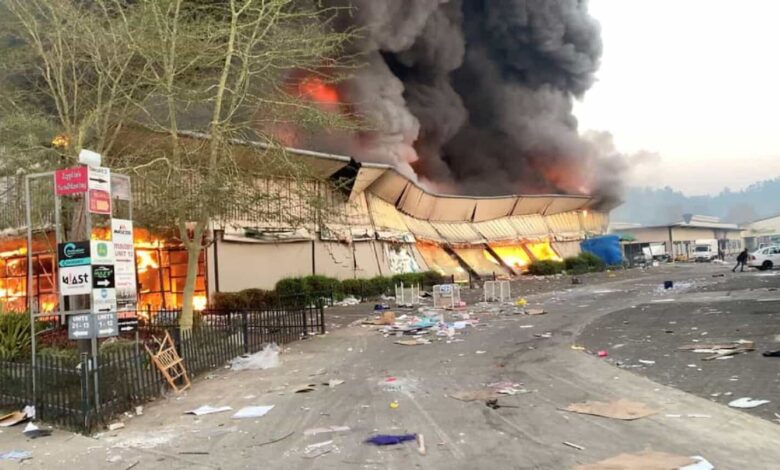
The SAPS are not better equipped now to handle threats to national security than they were during the July 2021 unrest, opposition parties have said.
The parties said that after the unrest, which left a trail of devastation in parts of KwaZulu-Natal and Gauteng, security experts found police and intelligence leadership structures had been dysfunctional and unprepared to handle the riots and looting.
IFP spokesperson on community safety and liaison, Blessed Gwala, said they have on numerous occasions questioned the effectiveness of the provincial crime intelligence unit (CIU). He said the unit has a responsibility to be on the ground, gathering information to prevent atrocities from taking place, and to arrest those who plan to commit these crimes.
“However, on numerous occasions, criminals appear to be streets ahead of the unit. It is shocking that our communities have lost trust in the police, but prefer to report crime to crime-fighting organisations such as isiKebhe [a rural group that fights against stock theft]. Police must be given stronger powers and protection, even if it calls for a constitutional amendment. We believe that if the CIU is not equipped enough, police will not be able to deal with another unrest.”
He said the 2017 World Internal Security and Police Index (WISPI) ranked South Africa 89 out of the 127 nations covered, making it the 39th worst police force globally.
The WISPI measures the ability of the police and other security forces to keep a country and its people safe. The assessment looked at four main categories, which are the capacity, process, legitimacy and outcomes of a security and police force.
“This is an indictment on the government as the SA Constitution has weakened the police service compared to other countries. It is a fact that our justice system favours criminals more than the police and ordinary citizens, especially crime victims. Noting President Cyril Ramaphosa’s own admission about incompetence on the part of government, the IFP believes that the government is to blame for the death of people in Phoenix,” said Gwala.
He said according to several witnesses, police refused to intervene when the riots broke out, even after they had been told that criminal acts were being committed not far away from the police station.
The DA’s Bradley Singh said the police were incompetent and unprepared to deal with the situation — they were nowhere to be found during the height of the unrest from July 12 to July 18 2021.
“There was an unequivocal failure of the country’s police and intelligence service. Crime intelligence had no clue of what was going on. State security agencies weakened public safety, as shown by crime statistics. We’ve seen a decline in public safety over the years.
“Between 2012 and 2021, murders increased by 37%. Crimes such as armed robberies, house robberies and car hijackings all increased by 43%. We’ve seen a growth in organised crime, rampant corruption, and people are less safe. This means you are more likely to be attacked now than nine years ago, due to the failures of these agencies caused by political interference,” said Singh.
The police minister and police commissioner took decisions independent of each other and they, along with others in President Cyril Ramaphosa’s cabinet, must be held accountable for July 2021, he said.
“South Africa can hopefully avoid a repeat of the events of July 2021. But that calls for a recalibrated security sector which is effective, responsive, accountable, and serving the country’s democracy and not the interests of a few who manipulate them for personal or partisan gain,” he said.
The Institute for Security Studies (ISS) said the government has taken a step towards boosting the police service.
Independent researcher on the police and a consultant for the ISS, David Bruce, said to date, an additional 4 000 public-order policing (POP) members have been trained and deployed to various provinces to address crowd management.
“Government has taken steps to bolster the number of POP. This fits within a pattern in terms of which government treats all problems as problems of resources. The approach from the government is that policing problems mainly need to be addressed by increasing funding and the number of police.
“The current framework for POP is based on dealing with protests rather than an attempt to destabilise the country leading to mass looting.
“This requires tactical innovation that would include better systems of command, and other alternative strategies.
“Government and the SAPS are not doing the kind of analysis and introspection that would enable more effective responses to possible unrest of this kind in the future,” said Bruce.
Read original story on www.citizen.co.za