
Professor Dire Tladi opens up about his recent appointment as ICJ judge
Tladi hopes that his election will show South Africans, especially those in Ga-Rankuwa and Mahikeng where he is from, that whoever you are, nothing is beyond reach.
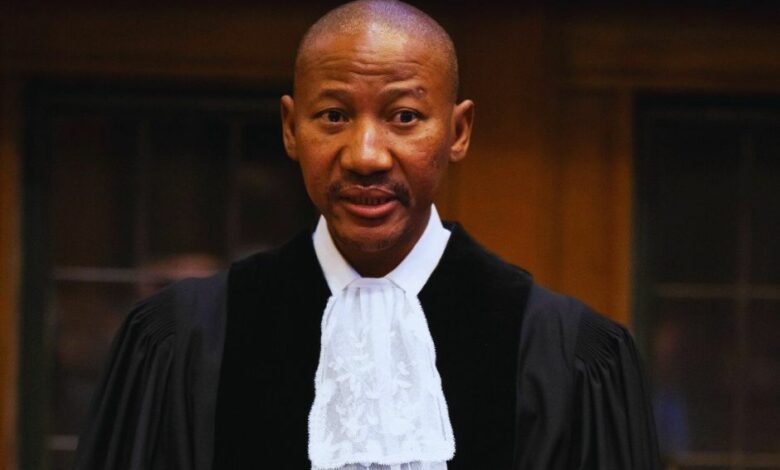
Pretoria Rekord recently sat down with Professor Dire Tladi (48), a former University of Pretoria professor who has been appointed a permanent judge of the International Court of Justice (ICJ).
Tladi is the first South African judge to be appointed to the ICJ.
President Cyril Ramaphosa recently said that Tladi’s election to the ICJ is an outstanding personal achievement in which the nation shares with great pride.
“We appreciate the confidence expressed by the United Nations in Tladi’s capabilities. He becomes the newest member of a fraternity of South Africans globally who are in positions of service to the international community and making important contributions to the better world we seek to build.”
SANews.gov.za reported that the ICJ is the principal judicial organ of the UN and one of the six principal bodies of the UN.
The court’s role is to settle, in accordance with international law, legal disputes submitted to it by states and to give advisory opinions on legal questions referred to it by authorised UN organs and specialised agencies.
The court comprises of 15 judges who are elected for terms of office of nine years by the United Nations General Assembly and the Security Council.
Tladi is a leading international law scholar whose accomplishments span different areas of the field, including academic, government service, diplomatic and practice.
Here is what Tladi had to say:
How are you feeling about being appointed judge in the International Court of Justice?
I am obviously ecstatic. But, at the same time, I feel grateful and honoured. So many have contributed to making this possible. In addition to that, and perhaps most importantly, I also feel the weight of the responsibility that this election means. My election to the court comes at a time when the court is extremely busy with the most weighty issues of our time – the Middle East, Ukraine, US/Iran issues, climate change and so on. So, I feel excited, grateful and also a sense of responsibility.
How will the appointment affect you on a personal level?
Well, it means I have to move – which I have now done, for a period of nine months. I am currently looking for a home. I am away from my comfort zone, but I realise it means I need to create another comfort zone.
What keeps you motivated? What allowed you to achieve what you have so far?
In many ways, I have been lucky. Don’t get me wrong, I have worked very hard and was prepared, but I also realise that there are many others that may have been deserving but never made [it]. I have of course achieved a lot in international law, and have many accomplishments which all opened the pathway to this position. But even those were through a combination of luck and hard work. I also was helped in this path by many. I am forever grateful to my late mother who made me what I am and instilled in me the values that keep me going, even if I falter from time to time. The support of my family and friends.
For the election in particular, I am grateful to people like John Dugard, who probably should have been South Africa’s first permanent judge. But he put my name forward to the government. I am grateful to government, which had on the list of nominees other names and I am grateful that out of those names, it was my name that was chosen. People have no idea how much the Minister of Department of International Relations and Cooperation (Dirco) and the President worked to make the election a success, so I am extremely grateful to them.
But so many people at Dirco in Pretoria and other stations across the world – I couldn’t possibly list them all. Three people I have to mention by name, Jaymion Henricks, Romo Brammer and Masotsha Mnguni.
It’s a long answer, but appropriately so.
As someone born in Ga-Rankuwa, what would you say to a child from the township who one day would like to see himself/herself in your shoes?
I hope this election shows people, South Africans, that whoever you are, wherever you come from, nothing is beyond reach. I was born in Ga-Rankuwa and grew up in Mahikeng. Both of those places are my roots. By the way, the first four years of my life were spent in Mabopane before I was hauled off to Mahikeng. But most importantly, I am a child of South Africa and what I owe is not only to the places that directly gave to me, but to all of South Africa.
I intend to give of my time speaking to children from rural backgrounds across the country whenever I am back home. I was incidentally home at the beginning of March and I spent a day at a township school in eMalahleni.
What are your hobbies?
I read. I write novels. I have two novels, Sins of the Father and Blood in the Sand of Justice. I am looking for a place I can shoot basketball hoops in the Hague. I have a hoop in my backyard in SA, but I am looking for a place here where I can play.
Read original story on www.citizen.co.za