
Project Cheetah finally makes paw prints in India
In ‘the world’s first inter-continental large wild carnivore translocation project’, local cheetahs have finally completed the next leg of their journey.
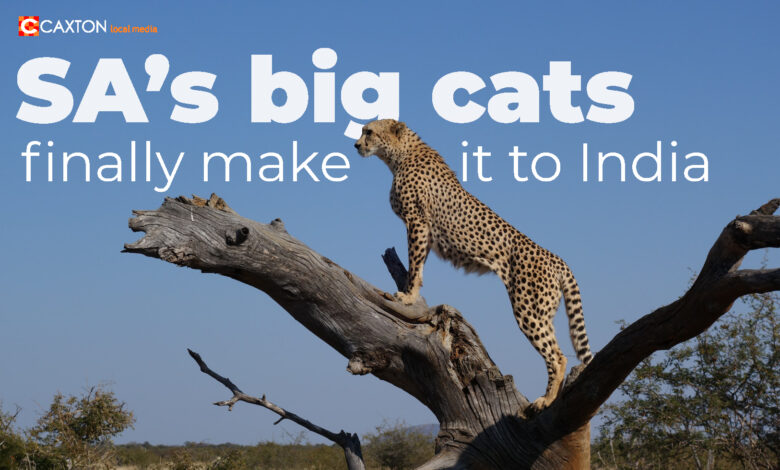
There was no rush in this cheetah chase but after many months, 12 South African big cats will now call India home as part of Project Cheetah.
The Department of Forestry, Fisheries and the Environment (DFFE) on Friday confirmed in a statement that the cheetahs had departed to their new habitat in an attempt to ‘expand the cheetah meta-population and to reintroduce cheetahs to a former range state following their local extinction due to over hunting and loss of habitat in the last century’.
The species is used to open spaces and is known for its speed, but before jetting off for India, the 12 captured cheetahs had to endure a stay of more than six months in enclosures in Limpopo and KZN while the red tape surrounding the project was dealt with. Critics slammed the project as a ‘political stunt’.
Eyebrows were raised at the lack of urgency in signing the memorandum of understanding (MoU) between SA and India, which conservationists feared could result in a lack of conditioning in the animals.
Caxton Local Media reported in October 2022 that five conservationists from five countries were opposed to the translocation.
At the time, they published a letter in the Nature Ecology & Evolution journal that stated: “The current action plan is ecologically unsound, costly and may serve as a distraction rather than help global cheetah and other science-based conservation.”
Caxton Local Media in January sought an update on the project but was sent from pillar to post as no one was willing to comment either on or off the record.
Although many conservationists remain unhappy about the project’s approach – with highly regarded predator researcher Dr Gus Mills recommending ‘the cheetah action plan be radically revised, using a fully science-based approach’ – the cats are no longer living in limbo. While they are yet again being housed in enclosures for a quarantine period, they will ultimately be let loose in the 748km² Kuno National Park.
MoU with India
“Earlier this year, the governments of South Africa and India signed a MoU on co-operation on the reintroduction of cheetah to India. The MoU facilitates co-operation between the two countries to establish a viable and secure cheetah population in India; promotes conservation and ensures that expertise is shared and exchanged, and capacity is built, to promote cheetah conservation. This includes human-wildlife conflict resolution, capture and translocation of wildlife and community participation in conservation in the two countries,” read Friday’s DFFE statement.
Forestry, Fisheries and the Environment Minister Barbara Creecy hailed ‘South Africa’s successful conservation practices’ as a reason why they have been approached to participate in this project.
The statement adds that the 12 selected cheetahs were the ‘best possible’ mammals for this tricky task.
“All 12 cheetahs are wild born and have grown up among competing predators, including lion, leopard, hyena and wild dogs. They are considered predator savvy and should respond appropriately when they encounter a new predator guild in India that includes tigers, leopards, wolves, dholes, striped hyenas, and sloth bears.
“The cheetahs were kindly made available by Phinda Game Reserve (three), Tswalu Kalahari Reserve (three), the Waterberg Biosphere (three), Kwandwe Game Reserve (two) and Mapesu Game Reserve (one) and their translocation is in line with IUCN [International Union for Conservation of Nature] guidelines for reintroductions and other conservation translocation and in accordance with international veterinary standards and protocols.”
According to the department, its partners in the multi-disciplinary international programme include the Department of International Relations and Cooperation; the South African National Biodiversity Institute; SANParks; the Cheetah Metapopulation Initiative; the faculty of veterinary science of the University of Pretoria; the Endangered Wildlife Trust; the Ministry of Environment, Forest and Climate Change of India; the High Commission of India; the National Tiger Conservation Authority; the Wildlife Institute of India and the Madhya Pradesh Forest Department.
Read original story on lowvelder.co.za

