
R89.9b needed to fix SA’s water crisis
Pietermaritzburg is grappling with inadequate and failing water supply infrastructure, leaving many residents to endure disruptions for days, weeks and even years.
South Africa needs R89.9b over the next decade to address its crumbling water infrastructure.
This is according to a parliamentary response from the Minister of Water and Sanitation, Pemmy Majodina, to Build One South Africa deputy leader Nobuntu Hlazo-Webster.
“These projections are for capital requirements needed to address water infrastructure backlogs over the next 10 years.
“The funds will go towards the refurbishment and renewal of ageing infrastructure, upgrades to support rising service demands and new installations for expanding human settlements and economic areas,” Majodina said.
Northern Areas Residents and Ratepayers Association chairperson Jimmy Naidoo said some wards and suburbs, such as Willowfontein, lacked water infrastructure altogether, forcing residents to rely on river water to meet their needs.
“As much as residents in the northern areas are frustrated, there are areas that don’t even have water infrastructure,” Naidoo said.
Naidoo said the municipality has ‘failed ratepayers and residents’ by being quick to cut off services and issue bills, even when residents go without water and electricity for extended periods.
He expressed concern that residents, already burdened by the city’s failing infrastructure, are growing increasingly frustrated, and he believes a protest at City Hall may be inevitable.
“We as residents must understand the power we have. If we protest, it must be like Mahatma Gandhi’s – a peaceful shutdown of the city.”
Melanie Veness, the CEO of the Pietermaritzburg and Midlands Chambers of Business, stressed the urgent need to address failing infrastructure.
“It’s extremely disheartening, given that infrastructure failure, particularly of electricity and water, is undoubtedly the main impediment to economic growth and job creation in this region. It is imperative that failing infrastructure be addressed urgently to avoid disinvestment and job losses,” she said.
Anthony Waldhausen, the CEO of the Msunduzi Association of Residents, Ratepayers and Civics, said the city is not meeting the recommended standard for repair and maintenance funding.
According to the Co-operative Governance and Traditional Affairs guidelines, repair and maintenance funding should be at 8% of the budget, but it is currently only half that percentage.
The city has a R9.75b budget for 2024/25, of which R824m is allocated for capital expenditure, R520m for repairs and maintenance, and R8.4b for operations.
“We have ageing infrastructure, but what has been done to address this?” Waldhausen said.
He added that the city is relying on 30% of residents to pay for municipal services, while 70% do not, a point also echoed by Naidoo.
Waldhausen said that if revenue could be collected from the remaining 70% of residents, businesses and government departments, ‘we will reach 100% of revenue collection, of which 8% can be used towards repairs and maintenance of infrastructure’.
However, he warned that no meaningful progress will be made without political will, experienced leadership, and qualified personnel, and that the city will continue to decline and deteriorate.
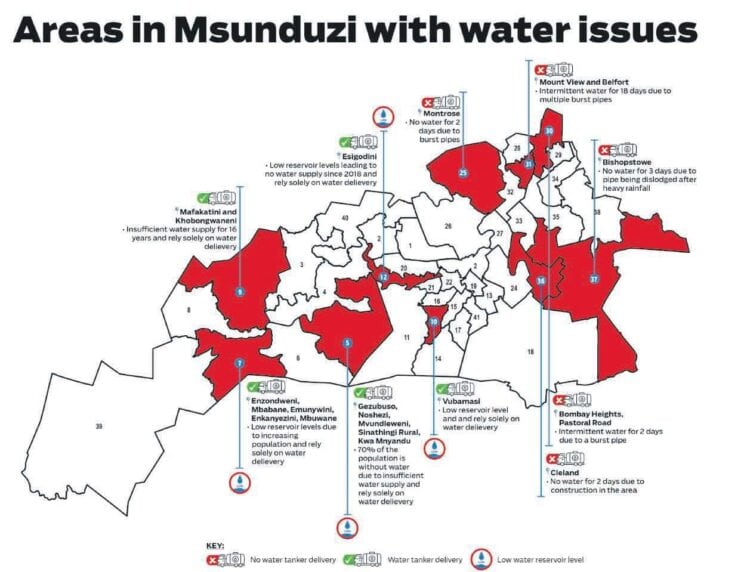
Meanwhile, residents in the northern areas continue to suffer prolonged water outages that have been ongoing for almost a month, due to ageing infrastructure.
Affected areas include Northdale, Raisethorpe, Newholmes Way and Esigodini. Residents suffer with weekly outages, lasting up to three days at a time as repairs are completed.
Last weekend, Raisethorpe residents were again left without water due to a burst pipe.
Rachel Soobiah said the outage affecting residents on Ishwari and Benny Road was due to a burst water pipe, for which they were awaiting materials to repair.
“As councillors, we cannot update the community because we don’t get updates from the officials. For this repair, they had no materials; we have to wait until a pipe is sourced.
“We were even told that there are no water tankers for the residents over the weekend,” said Soobiah.
Blue and Green Drop report
Meanwhile, AfriForum’s annual Blue and Green Drop report paints a troubling picture of South Africa’s water infrastructure. The reports states that while 87% of municipal drinking water is deemed safe, a striking 87% of treated sewage fails to meet minimum discharge standards, endangering public health, the environment, and potentially driving up water treatment costs.
It also mentions the R89.9b funding shortfall over the next decade to address the country’s deteriorating water systems. Poor management, insufficient maintenance, and inadequate investment in new infrastructure have compounded the problem, according to the report. This underscores the urgent need for government action, increased funding, and better management to secure a sustainable and reliable water supply for all South Africans.
You can read the report here.
Read original story on witness.co.za