
Scam alert: Did Eskom really email an outstanding account to you?
Eskom has warned the public to be aware of a scam email about outstanding accounts.
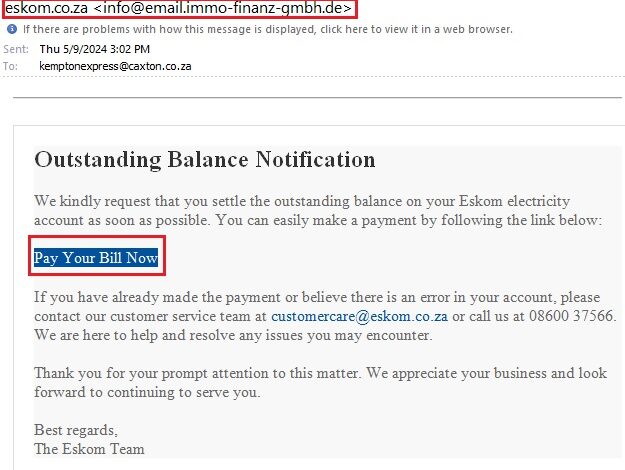
Eskom says it was not aware of an email sent to Kempton Park residents informing them to pay their outstanding Eskom electricity bills.
Kempton Express also received the scam email.
“We immediately sent the email on to representatives at Eskom for verification,” says the newspaper’s editor, Charmaine Slater.
Eskom Gauteng spokesperson Amanda Qithi confirmed that the email was a scam.
She says residents must disregard the email and not click on the link. The public must also not make any payments requested in the email.
“Payments to Eskom should be made as reflected on the customer’s statement from Eskom, into Eskom’s First National Bank or Absa account.”
Scams can be reported to Eskom’s toll-free crime line at 0800 11 27 22 or via email to forensic@eskom.co.za.
Eskom is aware of the e-mail sent to Kempton Park residents informing them to pay their outstanding Eskom electricity bills.
Residents are advised to disregard the email and not to make any payments in line with the e-mail.
Payments to Eskom should… pic.twitter.com/mYzj7fmd16
— Eskom Hld SOC Ltd (@Eskom_SA) May 10, 2024
Protect yourself against fraud and scams
Fraud continues to increase, with consumers falling victim to phishing scams and fraudulent adverts, and having their identities stolen.
According to Momentum Metropolitan’s Cyber Security Team, information in the wrong hands is a huge threat as it makes it easier for criminals to impersonate people and companies.
This form of identity theft can often go unnoticed by the victim, who might only find out when unpaid accounts are due, or money is lost.
Other scams to be aware of:
Business email compromise: A recent Interpol report found that Africa accounts for 0.75% of the global fraud committed using business email compromise, where fraudsters send an email and make it appear that it came from someone else. They also intercept email communication and change vital information, such as banking details.
Phishing attacks: There has also been a steady increase in phishing attacks over the years, where an email is sent to a victim pretending to be from a legitimate source while trying to elicit sensitive information from the victim or trying to install malicious software on their device. It’s estimated that worldwide phishing emails account for 90% of data breaches.
Cryptocurrency myth: Cryptocurrency scams exploit the increased popularity of cryptocurrencies and offer inflated investment opportunities using fake wallets and fake exchanges. Don’t be fooled by the myth of massive returns from fake investment opportunities.
Employment scams: With a low cost of entry and wide reach, scammers use popular social media platforms to prey on job seekers by using fake job advertisements and seemingly impossibly lucrative contracts. Never go to interviews in unprofessional spaces, such as private homes or hotel rooms.
What you can do
Fraudulent interactions should be reported to the SAPS.
- Keep sensitive information, such as how and where you store passwords, private.
- Never click on links unless you know where the link is from and where it will take you.
- Be wary of Hotmail or Gmail addresses that are supposedly from established companies.
- Avoid accessing sensitive services, such as email or internet banking, when using public WiFi networks.
Read original story on www.citizen.co.za

