
South Africans love beer and brandy: Is poverty part of the problem?
A Brown University study linking hunger to alcohol cravings raises questions about poverty and harmful drinking in food-insecure South Africa.
Every weekend, when Magrit Choma, a domestic worker from Pretoria, travels home to KwaMhlanga in Mpumalanga, she passes several shebeens.
She sees drinkers stumbling around or fighting, cheap Zamalek (Black Label) beer bottles in hand. A quart costs R28 or less, she says.
Most are men between 30 and 60 who do piece jobs or rely on their Sassa grants.
She knows many of them and says that some of their families go hungry. She sees their thin bodies and believes that money spent on alcohol could instead help put food on the table.
It leaves her with a difficult-to-ignore question: Why do some breadwinners spend money on alcohol when their families lack the basics?
South Africa faces high levels of poverty and food insecurity. Statistics South Africa’s latest poverty-trends report found that 23.2 million people, or 37.9% of the population, lived below the lower-bound poverty line in 2023.
Of these, 10.8 million lived below the food poverty line, meaning they could not afford enough food to meet their basic energy needs.
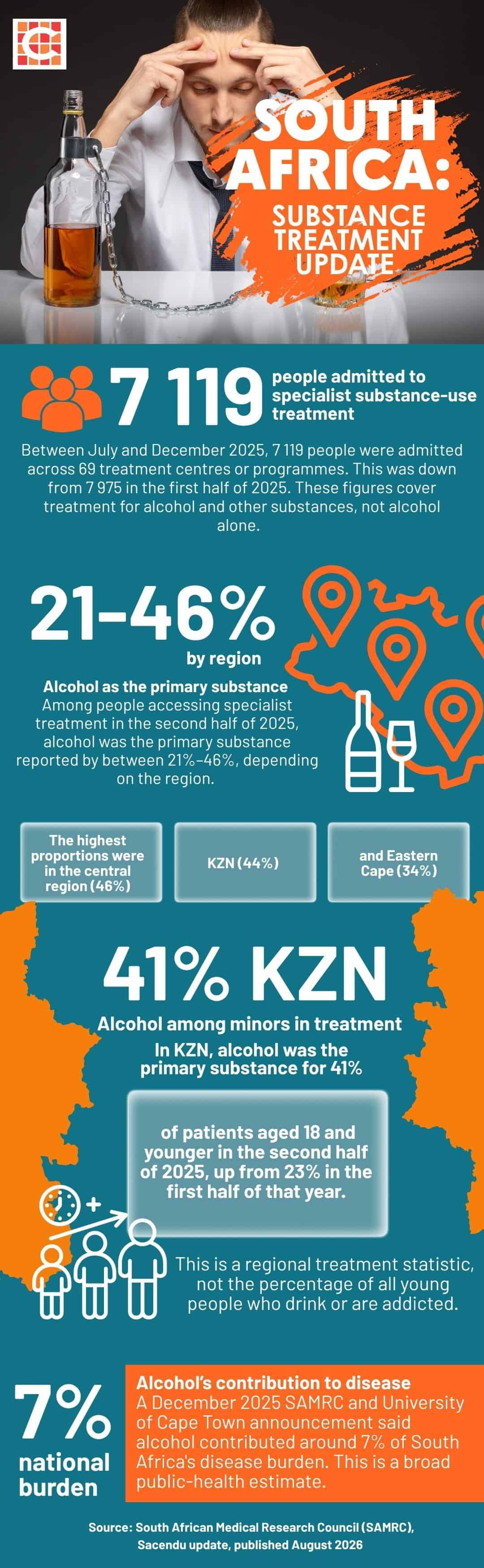
At the same time, thousands of people seek help for substance-use problems. According to the South African Medical Research Council’s Sacendu report, specialist substance-use treatment centres recorded 15 094 admissions during 2025. This figure reflects admissions, not the number of unique people treated nationwide.
But does poverty drive people to drink, or does alcohol offer temporary relief from the daily struggle to survive? And why do people across all income groups continue to drink, even when it damages their health, relationships and finances?
Relationship between hunger and alcohol cravings
A study by researchers at Brown University in the United States offers a possible clue to the relationship between hunger and alcohol cravings. Scientists studying fruit flies found that hunger influenced how their brains formed memories linking alcohol to a rewarding experience. Hungry flies were more likely to develop a preference for alcohol.
The study does not prove that hunger causes alcohol addiction in humans. However, it raises questions about how physical needs and difficult circumstances may influence the brain’s response to alcohol.
Could alcohol become a substitute for food when people are hungry? And could the temporary relief it offers make someone more likely to keep drinking when life becomes difficult?
Harmful drinking more complicated than poverty
Dr Tertia Oosthuizen, a counselling and industrial psychologist and academic at North-West University, says harmful drinking is more complicated than poverty alone. Stress, emotional distress, biological factors and learned behaviour can all contribute to the problem.
Oosthuizen says alcohol could become a way for people to cope with anxiety and difficult circumstances.
“A person struggling through difficult life circumstances begins to convince themselves that alcohol can help numb the pain and give them courage to face challenges.”
She explains that drinking can become associated with feeling more relaxed or in control. Over time, this learned association may contribute to a pattern of harmful drinking.
But can alcohol actually satisfy hunger?
Alcohol contains calories, but it does not provide the nutrients the body gets from a balanced diet and cannot replace food.
Although drinking may temporarily change how a person feels, it does not address the effects of food insecurity. Alcohol can also increase appetite and food intake in some circumstances, rather than suppress them.
The Brown University study did not investigate whether people drink alcohol to satisfy hunger. Instead, its findings suggest that hunger may influence how the brain forms memories that link alcohol to reward.
Oosthuizen says the desire to drink could also be reinforced by the behaviour people observe around them. She points to films and soap operas in which characters reach for a drink after a difficult day, reinforcing the idea that alcohol is a normal way to relax.
Trauma, violence and a lack of support can add to the problem, she believes. Children who grow up in households where alcohol misuse is common may come to see the behaviour as normal and repeat it as adults.
Oosthuizen stresses that alcohol misuse affects people across income groups. Wealthier drinkers may buy expensive whisky or brandy and have access to private rehabilitation, while people with less money may turn to cheaper alcohol and struggle to afford professional help.
According to Oosthuizen, the same bottle of alcohol can therefore mean different things to different people.
“For one person, it may be part of socialising after work. For another, it may be a way to escape stress, loneliness or painful circumstances. In either case, the consequences can become serious when drinking starts to take control of a person’s life.”
Alcohol abuse among Afrikaans speakers
Researchers have also examined the issue within Afrikaans-speaking communities.
Hannes Noëth of Helpende Hand says social norms strongly influence drinking habits. People often struggle with both drinking too much and drinking too often, he says, particularly when alcohol is closely tied to socialising.
He also identifies stress, unemployment and financial difficulties as factors that could contribute to harmful drinking. People do not always recognise when their drinking has become a problem.
“The impact of alcohol on families is devastating,” Noëth says.
Helpende Hand runs rehabilitation, prevention and parenting programmes to support families. Noëth acknowledges that more comprehensive research is needed to establish the extent of alcohol misuse among financially vulnerable Afrikaans speakers.
For families already struggling to make ends meet, getting help can be another challenge.
Private rehabilitation may be unaffordable, leaving people reliant on community organisations and other support services.
The relationship between poverty and alcohol misuse is not straightforward, says Oosthuizen. “Financial hardship and emotional distress may contribute to harmful drinking, while dependence can drain money from household budgets and leave even less for food, transport and other essentials. The result can be a cycle that is difficult for individuals and their families to break.”
Choma sees the consequences when she passes the shebeens on her way home. She sees men drinking while their families may be going without necessities. But what she cannot see is what has brought each person there: The stress they carry, the habits they have learnt or whether they are struggling with dependence.
Breaking news at your fingertips… Follow Caxton Network News on Facebook and join our WhatsApp channel.
Nuus wat saakmaak. Volg Caxton Netwerk-nuus op Facebook en sluit aan by ons WhatsApp-kanaal.
Read original story on www.citizen.co.za

