
Think before you emoji: How digital symbols could land you in trouble
Your favourite emoji might not mean what you think it does. A forensic linguist explains how these seemingly innocent symbols could have legal and social implications.
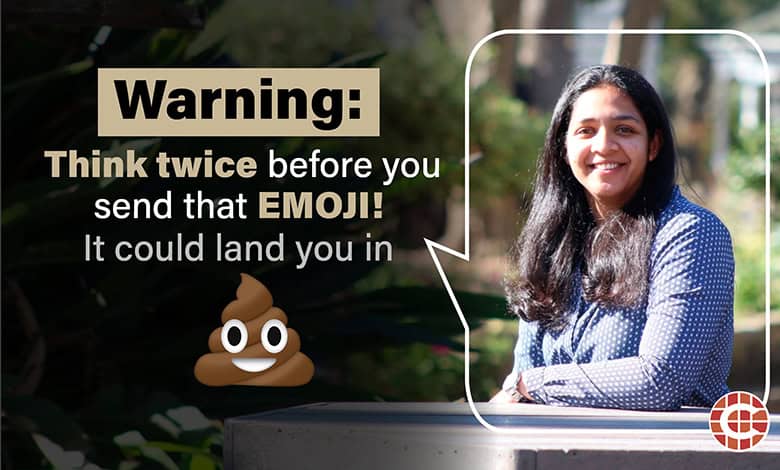
Emojis have become a staple in the way we communicate. They add colour, tone and emotion to our text messages. But could these symbols land you in trouble?
According to forensic and legal linguist Dr Zakeera Docrat, emojis are more than just fun expressions. They can carry unintended legal and social consequences – from workplace misunderstandings to potential cases of harassment, the meaning behind emojis isn’t always as clear as we assume.
Docrat is a current post-doctoral research fellow at the University of the Western Cape. She’s conducted in-depth research into the interpretation of emojis as evidence in South African courts.
Speaking to QuoteThisWoman+, Docrat says emojis have become a significant part of communication in the digital age.
“Sometimes we’ll be writing a text and suddenly think the recipient will think I’m being a bit harsh, even though there’s nothing in my text to indicate this. I’m immediately going to start wondering, should I add an emoji or two?
“But their meaning could be interpreted in a very different way than I intended. Personally, if I’m sending a text to a professional colleague or for work, I’m never going to use an emoji. It’s not relevant.”
The use of emojis in professional and personal relationships
Docrat warns that emojis can constitute an act of harassment or sexual harassment, a threat, and can be a form of gender-based violence.
“If someone is sending me a barrage of unwarranted emojis with sequences that make me feel uncomfortable, I’m being harassed. You don’t need to include any written words. This is especially true in a professional relationship and a context where the receiver of the message has no physical relationship with the sender.”
She says there is a place for emojis in personal relationships.
“Obviously, it’s fine if it’s a family member or very close friend – and note, I use the words ‘very close friend’ because you also need to distinguish between your friends. For example, sending a red heart to a male or female colleague or a new friend might be inappropriate. You might be friendly with them but not to that extent. You must look at it in a specific context. The main thing is to consider the nature of the relationship between the recipient and the sender.
“The second thing is the cultural and linguistic context. We take for granted that, because we may speak English well, we expect the recipient to do so as well. But they may be from a different culture, and it may be culturally taboo to use certain emojis. We need to be aware that we are often communicating across linguistic, cultural and religious lines.”
Different emojis for different platforms
Docrat says it’s important to realise that across different devices and platforms, emojis are different.
“A crying face emoji can appear as a laughing crying face emoji on another device or platform. It may be represented differently on someone else’s device. Facebook, Instagram or X platforms are different. There’s been a lot of debate on whether we should unify them [emojis] across platforms.”
She says, “More and more, stickers are replacing emojis in our messages. We often send a sticker as a response to a message. We think it’s far better than sending an emoji as it expresses more emotion, it’s far bigger and has more going on than just an emoji.”
She adds that the field of augmented reality and bitmojis (avatars) add yet another dimension to communication across devices and platforms.
Emojis can constitute harassment
Docrat says a lot of the discussion on gender-based violence globally centres around digital communication and, of course, emojis form part of that.
“Perpetrators are becoming very skilful. They think if they use emojis to harass a complainant without any text, it won’t constitute harassment.”
She is concerned that those who try to get help from the police when they feel threatened could face this scenario: You walk into a police station and tell the police officer you got a text composed of emojis. They’ll ask, ‘Where’s the threat? This is not abuse, it’s just emojis. There’s no written text or verbal communication’.
“Training is not happening in the police or the justice system to keep up with the developments.”
Beware the monkey emoji
She says that in South Africa, the monkey emoji can be easily misinterpreted and cause offence. We should all be mindful of this, regardless of our race. “If you send it to a colleague, they may be offended. Personally, I just wouldn’t use it.”
Docrat adds, “We know what the ‘speak no evil, see no evil, hear no evil’ monkey emojis indicate, but there are other emojis available that convey a similar message. The closed-eye emoji can also mean shyness, shock or ‘I’m embarrassed’. There’s another emoji, a more playful one that also indicates ‘I’m embarrassed’. There’s also a closed-mouth laughing emoji, or the cat emojis that are available for use. You must have a really good relationship with someone to send them that monkey emoji.”
Emojis might change the meaning of your message
Many of us are often too quick to send off emojis, says Docrat. “We’re using emojis to replace text. It might be shorthand, but the message we think we’re trying to convey may not be the message the recipient interprets.”
There are also different meanings attached to some emojis, like the white heart, for instance. “Some people may think it’s appropriate to send it to someone when there’s been a death. Some think it expresses sympathy, but for me, I think it means pure love. However, in a sequence, when used with the dove emoji and praying hands, it’s clear that it does express sympathy.”
Docrat explains that when experts like her interpret emojis, they use sequencing and patterning.
Some of these emojis and sequences of emojis may have very different meanings to what they look like at first glance. “The aubergine is associated with male genitals. There are a few emojis that depict female genitals – the peach, the cherries, the strawberry and the doughnut. But when you get the aubergine emoji, along with the mouth emoji and tongue emoji or kiss emoji, that’s a sequence. You do not have to use written words in this instance for the recipient to understand what is being said or suggested. Someone can say, ‘I’m just playing around’, but it’s offensive in the sense that the recipient knows exactly what the sender intended to say.
“There’s also a peeled banana which, according to the research I’ve conducted, can signify a circumcised penis.”
Docrat explains that when researchers talk about sequencing, they’re looking specifically at these patterns and how they’ve been used to get a sense of their repetition.
“We’re running a very dangerous path at the moment. Technology is great and emojis are a lovely way to communicate. But we need to use them for the right purpose and not to abuse or harass anyone or make them feel uncomfortable. If anyone is sending an emoji, they need to think twice if it’s appropriate.”
- Quote This Woman+ is an intersectional feminist organisation that aims to transform gender representation in the media landscape by promoting women+ voices and narratives that reflect African demographics and perspectives. They curate a database of experts and journalists to help journalists find the women+ voice they need to add value to their stories. Docrat is one of these experts.
Read original story on www.citizen.co.za

