
Watch: Firefly Blue Ghost Mission 1 launches to the Moon
Firefly Aerospace’s Blue Ghost lunar lander will spend around 45 days in transit to the Moon before landing on the lunar surface in early March.
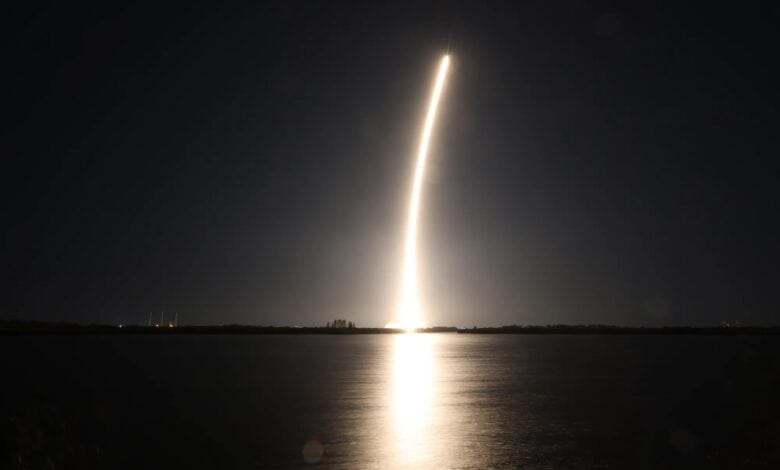
Liftoff! Nasa has sent a suite of cutting-edge science experiments and tech demos to the Moon on a commercial spacecraft. This historic mission marks a new era of lunar exploration, paving the way for future human missions and scientific discoveries.
According to Nasa, the aim is to provide insights into the Moon’s environment and test technologies to support future astronauts landing safely on the lunar surface under the agency’s Artemis campaign.
Firefly’s Blue Ghost lander is targeted to land near a volcanic feature called Mons Latreille, within Mare Crisium, a more than 482km-wide basin located in the northeast quadrant of the Moon’s near side.
The mission will enable Nasa to gather valuable scientific data and help pave the way for the first Artemis astronauts to explore the lunar surface later this decade.
Carrying science and tech on Firefly Aerospace’s first Commercial Lunar Payload Services (CLPS) flight for Nasa, Blue Ghost Mission 1 launched this morning aboard a SpaceX Falcon 9 rocket from the Kennedy Space Centre in Florida. The company is targeting a lunar landing on March 2.
Watch: Nasa’s official broadcast of the Firefly Blue Ghost Mission 1 Launch to the Moon:
“This mission embodies the bold spirit of Nasa’s Artemis campaign – a campaign driven by scientific exploration and discovery,” says Nasa deputy administrator Pam Melroy.
“Each flight we’re part of is a vital step in the larger blueprint to establish a responsible, sustained human presence on the Moon, Mars and beyond,” she adds.
Firefly Aerospace’s Blue Ghost lunar lander is now flying free as teams in Mission Control are awaiting acquisition of signal through a ground station in Hawaii.
Watch live: https://t.co/STouhL6HTi pic.twitter.com/WVhJb2Xp3w
— Spaceflight Now (@SpaceflightNow) January 15, 2025
Lunar drilling technology put to the test
Once on the Moon, Nasa will test and demonstrate lunar drilling technology, regolith (lunar rocks and soil) sample collection capabilities, global navigation satellite system abilities, radiation tolerant computing and lunar dust mitigation methods.
The data captured could also benefit people on Earth by providing insights into how space weather and other cosmic forces impact our home planet.
“Nasa leads the world in space exploration, and American companies are a critical part of bringing humanity back to the Moon,” says Nicola Fox, associate administrator of the science mission directorate.
“We learnt many lessons during the Apollo Era that informed the technological and science demonstrations aboard Firefly’s Blue Ghost Mission 1 – ensuring the safety and health of our future science instruments, spacecraft and, most importantly, our astronauts on the lunar surface. I am excited to see the incredible science and technological data Firefly’s Blue Ghost Mission 1 will deliver in the days to come.”
Understanding planetary processes and evolution
As part of Nasa’s modern lunar exploration activities, CLPS deliveries to the Moon will help humanity better understand planetary processes and evolution, search for water and other resources, and support long-term, sustainable human exploration of the Moon in preparation for the first human mission to Mars.
Ten NASA payloads are flying on this flight:
- Lunar instrumentation for subsurface thermal exploration with rapidity: This will characterise heat flow from the Moon’s interior by measuring the thermal gradient and conductivity of the lunar subsurface.
- Lunar PlanetVac: Designed to collect regolith samples from the lunar surface using a burst of compressed gas to drive the regolith into a sample chamber for collection and analysis by various instruments. Additional instrumentation will then transmit the results back to Earth.
- Next Generation Lunar Retroreflector: Serves as a target for lasers on Earth to precisely measure the distance between Earth and the Moon. The retroreflector that will fly on this mission could also collect data to understand various aspects of the lunar interior and address fundamental physics questions.
- Regolith Adherence Characterisation (RAC): This will determine how lunar regolith sticks to a range of materials exposed to the Moon’s environment throughout the lunar day. The RAC instrument will measure accumulation rates of lunar regolith on the surfaces of several materials, including solar cells, optical systems, coatings and sensors through imaging to determine their ability to repel or shed lunar dust. The data captured will allow the industry to test, improve, and protect spacecraft, spacesuits and habitats from abrasive regolith.
- Radiation Tolerant Computer (RadPC): This will demonstrate a computer that can recover from faults caused by ionising radiation. Several RadPC prototypes have been tested aboard the International Space Station and Earth-orbiting satellites, but now will demonstrate the computer’s ability to withstand space radiation as it passes through Earth’s radiation belts and on the lunar surface.
- Electrodynamic Dust Shield (EDS): An active dust mitigation technology that uses electric fields to move and prevent hazardous lunar dust accumulation on surfaces. The EDS technology is designed to lift, transport and remove particles from surfaces with no moving parts. Multiple tests will demonstrate the feasibility of the self-cleaning glasses and thermal radiator surfaces on the Moon. In the event the surfaces do not receive dust during landing, EDS can re-dust itself using the same technology.
- Lunar Environment Heliospheric X-ray Imager: Will capture a series of X-ray images to study the interaction of solar wind and the Earth’s magnetic field that drives geomagnetic disturbances and storms. Deployed and operated on the lunar surface, this instrument will provide the first global images showing the edge of Earth’s magnetic field for critical insights into how space weather and other cosmic forces surrounding our planet impact it.
- Lunar Magnetotelluric Sounder: Will characterise the structure and composition of the Moon’s mantle by measuring electric and magnetic fields. This investigation will help determine the Moon’s temperature structure and thermal evolution to understand how the Moon has cooled and chemically differentiated since it formed.
- Lunar GNSS Receiver Experiment (LuGRE): This will demonstrate the possibility of acquiring and tracking signals from global navigation satellite system constellations, specifically GPS and Galileo, during transit to the Moon, during lunar orbit, and on the lunar surface. If successful, LuGRE will be the first pathfinder for future lunar spacecraft to use existing Earth-based navigation constellations to autonomously and accurately estimate their position, velocity and time.
- Stereo Camera for Lunar Plume-Surface Studies: Will use stereo imaging photogrammetry to capture the impact of rocket plume on lunar regolith as the lander descends on the Moon’s surface. The high-resolution stereo images will aid in creating models to predict lunar regolith erosion, which is an important task as bigger, heavier payloads are delivered to the Moon near each other.
Two lunar lander missions — Firefly Aerospace’s Blue Ghost Mission 1 & ispace’s HAKUTO-R Mission 2 — are headed toward the Moon following their launch from Florida’s Space Coast at 1:11am ET this morning! pic.twitter.com/rO7BbdG8vj
— John Kraus (@johnkrausphotos) January 15, 2025
Sansa payload takes flight at SA’s new rocket gantry
In a landmark event for South Africa’s aerospace sector, the South African National Space Agency (Sansa) successfully tested its specialised payload on a suborbital sounding rocket launched on Sunday at a newly unveiled rocket gantry, located at the Denel Overberg Test Range facility in Arniston.
According to Sansa, the payload captured precise magnetic data during its suborbital journey, which lasted for about 400 seconds.
The new rocket gantry’s development was funded by the Department of Science, Technology and Innovation and implemented by the Aerospace Systems Research Institute (ASRI) at the University of KZN.
Ahead of the Deputy Minister of Science, Technology and Innovation, Ms Nomalungelo Gina, unveiled a suborbital sounding rocket launch facility at the Denel Overberg Test Range in Arniston on 3 December 2024. ASRI and @SANSA7 held a #STEM day. Read more: https://t.co/7VW6ephqpM… pic.twitter.com/2LL7gxNhXs
— DEPARTMENT OF SCIENCE,TECHNOLOGY & INNOVATION (@dstigovza) January 6, 2025
“This gantry is a national asset that will be used to launch suborbital rockets built by ASRI,” says Nomalungelo Gina, the deputy minister of Science, Technology and Innovation.
“It can also accommodate much larger solid-propellant vehicles of the type operated by space-faring nations, including other potential international clients on the continent and worldwide.”
The launch gantry allows for 360-degree horizontal rotation and vertical elevation adjustments. This ensures pinpoint accuracy and adaptability for factors such as wind direction on launch days.
What are suborbital rockets?
Unlike orbital launch vehicles that can steer themselves, suborbital rockets are unguided and must be launched off a gantry that can be accurately aimed, depending on the required flight trajectory, mission requirements and safety risks.
The new facility was put through its paces, successfully launching the sounding rocket Phoenix-1D on December 2 and Phoenix-1E on December 4.
Prof Mike Brooks, the director of ASRI, says the facility is equipped for advanced rocket testing, propulsion system development and flight-testing new technologies. It also supports research in aerospace innovation, ensuring safe and efficient operations.
The gantry and the rockets performed well during testing, reaching altitudes of 16.6km and 11.9km, respectively. One of the vehicles transmitted magnetometer data sampled during the flight back to the ground via a telemetry link, giving Sansa scientists an additional method of sampling the Earth’s magnetic field.
The Sansa-designed payload was developed in collaboration with the Department of Measurement at the Czech Technical University in Prague.
Read original story on www.citizen.co.za

