
Watch: SA-first surgery: Rottweiler gets artificial foot
A young dog has been given a new lease on life following innovative, ground-breaking prosthetic surgery to make him fully mobile again.
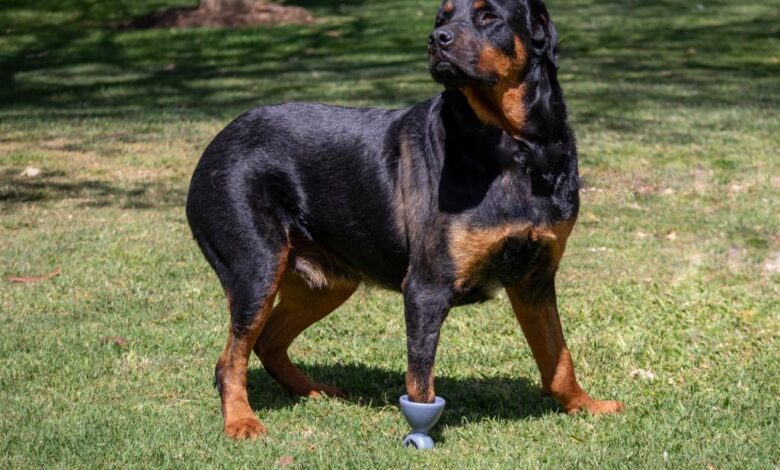
Covid, a three-year-old Rottweiler, is on his way to recovery after successful surgery that enabled the attachment of an artificial foot to give him the maximum quality of life.
This, the first known successful intraosseous transcutaneous amputation prosthesis (ITAP) surgery in South Africa, was performed by the University of Pretoria’s (UP) Onderstepoort Veterinary Academic Hospital.
Covid is upbeat and has returned to his playful self. His relieved owners say he is walking and running with their other dogs and does not appear to be in any pain.
Covid arrived at Onderstepoort, which forms part of UP’s Faculty of Veterinary Science, with a severe and debilitating injury to his right paw. It was a nerve-wracking time for everyone because the conventional treatment for such an extensive wound would normally be amputation. In Covid’s case, despite initial hopes of saving the limb, evidence of compromised blood supply indicated amputation would be necessary.
Lead surgeon Dr Klaas-Jan van de Wetering, in discussion with Covid’s owners, knew this would not be the optimal solution because of challenges faced by large breeds with only one front limb. They thus looked for a solution that would ensure Covid maintained his quality of life.
After intense discussion and research, a decision in favour of partial amputation was made. This made Covid an ideal candidate for ITAP surgery.
The surgery involved creating and printing a prosthetic implant that integrates with the amputated limb, enabling the attachment of an artificial foot. Simply put, an implant was placed in Covid’s bone and exited the skin where a prosthetic foot could be attached. But first, the wound was closed for healing.
While the wound was recovering, the hard work began, and a CT scan was conducted to aid in planning the implant. Orthopaedics company Orthodesign assisted with the images, which were used to create a custom-fitted implant.
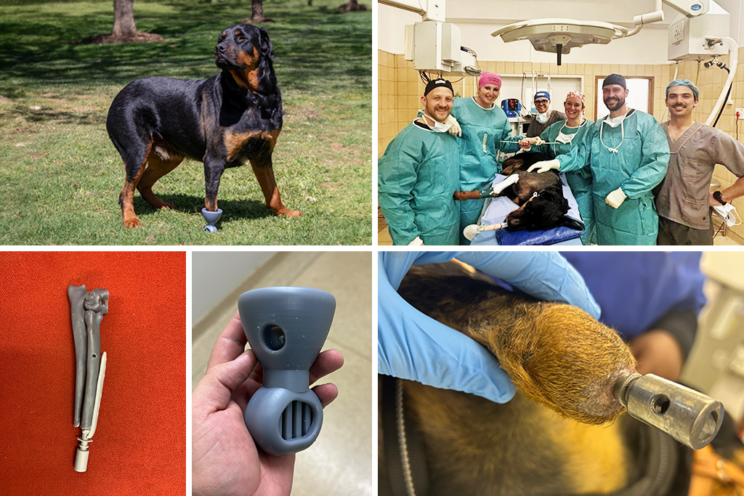
Getting the perfect fit was imperative, so a 3D implant was printed in plastic for evaluation on a printed model of the limb. After minor adjustments, the final implant was 3D-printed in titanium.
Once Covid’s wound healed, the implant was inserted during an operation that took place eight weeks after the initial surgery.
Van de Wetering says Covid demonstrated recovery and strength during his hospital stay.
“Post-operative infection was a concern, but fortunately it did not occur. Continuous monitoring for infection is ongoing, and periodic replacements of the prosthetic foot are performed as needed.
“We have replaced Covid’s prosthesis twice in four months, but we are designing a more robust one that will hopefully last longer,” says Van de Wetering.
He is positive about the future: “The fact that the surgery was a success makes it a possible surgical treatment for other patients that need amputations but would not cope with an amputation. For instance, a double amputee and large breed dogs that struggle with only three legs.
“This case marks the first known successful ITAP surgery in South Africa, showcasing the collaborative efforts of the surgical team, biomechanical engineer, and support staff. The ground-breaking procedure not only saved Covid’s limb but also provided valuable insights into the feasibility and success of ITAP surgery in veterinary medicine.”
The success of the surgery was made possible by the dedicated efforts of the surgical team.
Van de Wetering planned and performed the surgeries with the assistance of his Faculty of Veterinary Science colleagues Dr Elge Bester and Dr Adriaan Kitshoff, as well as the expertise of biomechanical engineer Tim Peach from Orthodesign. Theatre nurse Adele Rossouw and anaesthetist Justin Grace also contributed their skills.
Read original story on www.citizen.co.za

