
Where snow could fall as icy weather grips South Africa
Heavy rain, strong winds and snow are expected across several provinces, although forecasters caution that conditions could still change as the system develops.
While earlier weather models hinted at the possibility of snow over Gauteng next week, the latest forecasts have removed that prospect. However, forecasters warn that residents should still prepare for a significant cold outbreak expected to affect much of South Africa from Sunday, reports Pretoria Rekord.
Vox Weather forecaster Michelle du Plessis said the latest model runs once again demonstrate just how quickly forecasts can change when a cut-off low pressure system is involved.
“The latest forecast models no longer indicate snow over Gauteng, which once again highlights just how quickly forecasts can change when a cut-off low is involved,” said du Plessis.
“While confidence is increasing that a significant cold outbreak will affect much of South Africa from Sunday, the exact distribution of rain and snow remains uncertain. Even a small shift in the system’s position or strength could significantly alter where snowfall occurs. One thing is becoming increasingly certain, though – a bitterly cold spell is on the way.”
According to Vox Weather, a strong cold front supported by a ridging high-pressure system is expected to reach the south-western parts of South Africa on Sunday, August 9.
The system is forecast to bring widespread rain, strong winds and much colder conditions to the Western Cape, Eastern Cape and parts of the Northern Cape before spreading eastwards towards the Free State, Lesotho and KwaZulu-Natal.
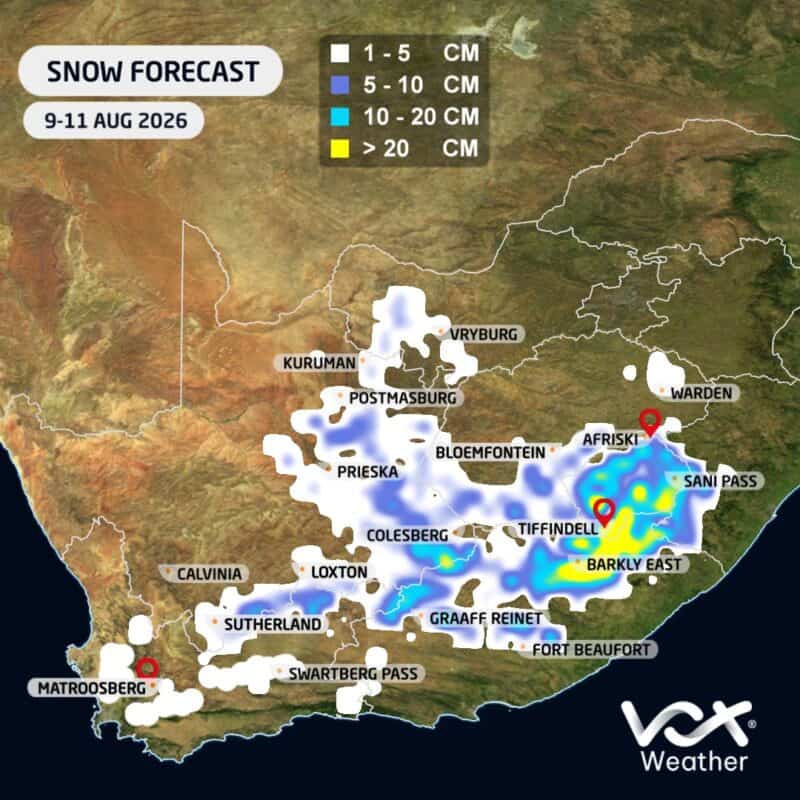
Snow is expected over several mountain ranges, including the Cederberg, Matroosberg, Hottentots Holland, Boland and Swartberg mountains in the Western Cape.
Heavier snowfall is possible around Sutherland and across the high-lying areas of the Karoo, including the Nuweveld and Roggeveld mountain ranges. Snow could also spread into the northern Eastern Cape, Lesotho and the southern Drakensberg.
On Monday, August 10, forecast models indicate that a cut-off low could develop over the country, bringing widespread rainfall across much of South Africa, except in the far western parts of the Western Cape and Northern Cape.
Snow is expected to continue over the Nuweveld Mountains, the Sneeuberge, northern parts of the Eastern Cape, the southern Drakensberg and Lesotho. Current model guidance also suggests the possibility of snowfall over the eastern Northern Cape and parts of North West Province, although this remains highly dependent on the exact movement and intensity of the cut-off low.
By Tuesday, August 11, some areas could receive more than 50 mm of rain within 24 hours. At present, the highest rainfall totals are expected over the eastern Northern Cape and parts of North West, although forecasters stress that these projections could still change.
For Gauteng residents, the latest forecast means snow is no longer expected. Nevertheless, the province is still likely to experience a sharp drop in temperatures as the icy air spreads inland.
Du Plessis urged the public not to place too much confidence in individual weather model images circulating on social media several days before an event.
Snow forecasts are particularly sensitive because snowfall requires cold air, moisture and precipitation to occur in the same place at the same time. A slight change in temperature, freezing levels or the track of the weather system can mean the difference between snow, rain or no precipitation at all.
With several days still remaining before the system reaches South Africa, meteorologists will continue monitoring every model update.
While the snowfall forecast may continue to evolve, one aspect of the forecast is becoming increasingly clear: South Africans should prepare for one of the coldest spells of the winter season.
Breaking news at your fingertips… Follow Caxton Network News on Facebook and join our WhatsApp channel.
Nuus wat saakmaak. Volg Caxton Netwerk-nuus op Facebook en sluit aan by ons WhatsApp-kanaal.
Read original story on www.citizen.co.za

