
White crosses in Trump video: ‘Not mass grave’ explains KZN farmer who took footage
A KZN farmer says the long rows of crosses were laid by the community in memory of a couple killed in a farm attack.
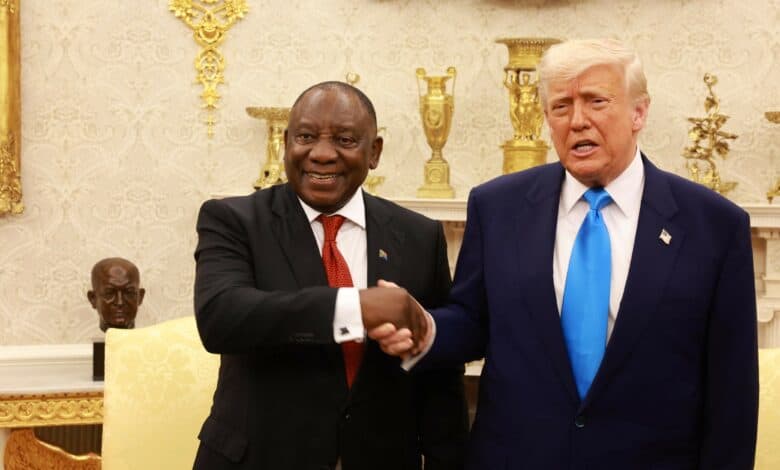
The farming community in KwaZulu-Natal has pushed back against claims that video footage of white crosses — shown during a high-profile meeting between U.S. President Donald Trump and South African President Cyril Ramaphosa — depicted mass graves of murdered Afrikaners.
The Witness reports that farmers have clarified that the images were from a symbolic memorial held in 2020 for victims of farm attacks.
During last week Wednesday’s televised meeting at the White House, Trump confronted Ramaphosa with video footage which, he claimed, proved there was a genocide against Afrikaners in South Africa.
The footage showed long rows of white crosses, prompting controversy and international attention.
Farmer who took footage of crosses explains
Farmer Rob Hoatson, who filmed the original video, explained that the footage captured a large memorial event for Glen (63) and Vida Rafferty (60), who were murdered on their Normandien farm, near Newcastle, in 2020.
“I have been personally affected by farm murders in the local community, including those of my neighbours, Glen and Vida Rafferty in 2020, and my close friend Tollie Nell in 2024.”
“But the truth is that all farming communities in South Africa have been profoundly affected by this problem.
“I am grateful that farm murders have risen to international prominence, and I sincerely hope that they receive the attention they deserve,” said Hoatson who clarified the facts around the video in an interview with the BBC.
Crosses laid before memorial of couple killed in farm attack
The Raffertys’ deaths sparked widespread grief. The couple was well-known and liked by the community.
In 2022, Doctor Fikane Ngwenya and Sibongiseni Madondo were convicted and sentenced for the murder, while a co-accused, Siyabonga Macu, died before testifying.
“The aerial video showing thousands of people along a twenty-kilometre stretch was taken by me, a farmer in the area myself,” Hoatson said.
“The large spontaneous attendance at this community event bears testament to the scale and seriousness of the problem.”
DA ward 2 councillor Bebsie Cronje also recalled the community’s response.
“The entire town attended and paid respects at the crosses which the community laid before their memorial service,” she said.
It was expected that white genocide issue would surface during White House visit
Dr Oscar van Heerden, an expert in diplomacy, suggested that Trump’s decision to raise the white genocide issue during the meeting was inevitable.
“He simply had to bring a matter to a conclusion on the white genocide issue and why he brought the refugees to America,” said Van Heerden, referring to the recent granting of refugee status to 49 Afrikaners by the U.S. government.
The meeting has drawn mixed reactions, with some viewing Trump’s confrontation as proof that tensions still exist between the two nations.
Police minister says more black than white victims in farm attacks
Meanwhile, South African authorities have rejected the genocide narrative.
Police Minister Senzo Mchunu, presenting the latest crime statistics, said six farm murders occurred in the first quarter of 2025, with only one involving a white farmer.
“The genocide conspiracy is totally unfounded and totally unsubstantiated,” said Mchunu, noting that black farmers and workers have historically been most victims.
Most murder victims in SA are ‘poor, unemployed young black males’
Gareth Newham, head of the Justice and Violence Prevention Programme at the Institute for Security Studies, reiterated that farm violence in South Africa was not solely directed at white farmers.
“If there was any evidence of either a genocide or targeted violence taking place against any group based on their ethnicity, the ISS would be among the first to raise alarm and provide the evidence to the world,” said Newham.
He added that most murder victims in South Africa are poor, unemployed young black males.
“Murder victimisation is far more linked to class, gender and location rather than race,” he said.
Read original story on witness.co.za

