
Your weekly Covid-19 stats update: Cases drop, but deaths rise
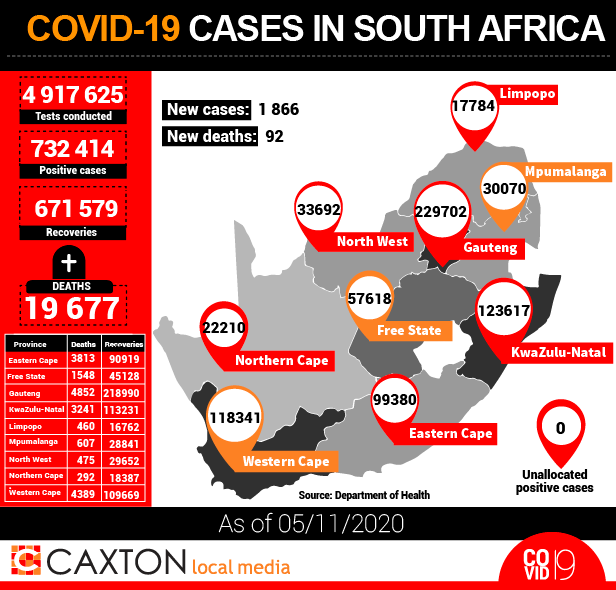
This week saw the country record 401 new cumulative deaths, bringing the total number to 19 677 as of 5 November.

Despite a decline in new Covid-19 cases as compared to last week, there has been an increase in Covid-19 related deaths in South Africa.
This week saw the country record 401 new cumulative deaths, bringing the total number to 19 677 as of 5 November.
In the week of 26 to 30 October, South Africa recorded 263 new deaths, meaning there was an increase of 138 deaths.
The Eastern Cape remains a province of concern, with an average of 26,4 deaths per day this week, accounting for 132 out of the 401 deaths. Gauteng remains a close second with 131 deaths this week, accounting for 107 deaths alone on Monday.
Limpopo and Mpumalanga remain the lowest in terms of deaths recorded, with two deaths recorded respectively, for the week.
The Western Cape saw a decrease in deaths, having recorded only 28 deaths this week compared to 32 last week.
The country has seen a decline in new cases, despite government’s concern of the number of new cases reported daily. Last week, a total of 7 814 cases were recorded between Monday and Friday as compared to the 6 962 cases recorded in the same period this week.
At an average of 1 392 cases per day, government has urged South Africans to continue adhering to health protocol, to practising social distancing, wear masks and wash hands with water and soap or an alcohol-based sanitiser.
The National Coronavirus Command Council is expected to meet next week after which President Cyril Ramaphosa is expected to address the nation. Cabinet Spokesperson, Phumla Williams said during a virtual Command Council meeting on Wednesday, that cabinet expressed concern over the “reckless and irresponsible behaviour of South Africans who behave as if Covid-19 doesn’t exist”.
“Our responsible actions will ensure we minimise the rates of infections while we continue to rebuild the economy,” Williams said.
Over concerns about a second wave of cases, General Practitioner Dr Mark Holliday, said a resurgence could “either be a tsunami or a ripple effect, depending on the behaviour of South African citizens”.
Holliday gave reasons as to why there could be a second wave. He noted that the World Health Organisation estimates that 10% of the world’s population has been exposed to the virus which means that 90% have not been exposed.
“We have to get through those people first before we can get some kind of general herd immunity,” he said.
Secondly, there would be a rise in cases due to an increase in socialising following the lockdown, he said. “We have seen that increase in many countries and we are seeing that in South Africa now.” He added that it took Europe on average 55 days before they saw a surge in cases following the lockdown, but that may not be the case in South Africa.
“We have a much warmer climate and are not compelled to have air-conditioners and heaters in our homes and schools, so it might occur later in our country, however, it is expected and we need to take cognisance of that,” he said.
Overnight, the country recorded 1 866 new cases, bringing the total to 732 414.
*Notice: Coronavirus reporting at Caxton Local Media aims to combat fake news Dear reader, As your local news provider, we have the duty of keeping you factually informed on Covid-19 developments. As you may have noticed, mis- and disinformation (also known as “fake news”) is circulating online. Caxton Local Media is determined to filter through the masses of information doing the rounds and to separate truth from untruth in order to keep you adequately informed. Local newsrooms follow a strict pre-publication fact-checking protocol. A national task team has been established to assist in bringing you credible news reports on Covid-19. Readers with any comments or queries may contact National Group Editor Irma Green (irma@caxton.co.za) or Legal Adviser Helene Eloff (helene@caxton.co.za).
Read original story on reviewonline.co.za

