Road test: Jetour X70 Plus 1.5T Deluxe
The very latest Chinese brand to enter the local SUV scene is Jetour, and its X70 Plus offers seven seats and premium features for under R500 000…but do you get what you pay for?
It seems that every other month, there’s a new Chinese brand that’s infiltrated the South African new car market. Many of them have been crossovers and SUVs, and the latest addition to the fray follows the same formula. Jetour is a subsidiary of Chery Automotive (yes, another one), and the X70 is one of two models with which the brand will try and obtain some market share.
Related: Did Red Bull Miss Out On Something By Signing Lawson?
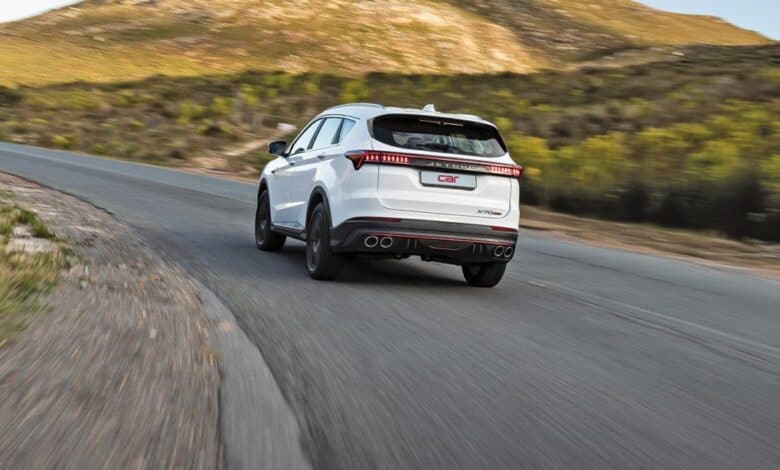
With such a massive company behind them, there many familiar elements inside and underneath the Jetour X70’s sheet metal. What is a welcome surprise, however, is the fact that the overall design is unique to the brand, even though a couple of items seem like they have been lifted from the Chery parts bin. The grille for example, is of the same octagonal design seen on vehicles from the umbrella company, but the jewel-like trim inside is unlike anything else we’ve seen, and the wraparound taillamp array, barring its bulkier-looking end sections, looks very similar to that of the Jaecoo J7, down to the placement of the brand name.
The boomerang-shaped headlamps and vertically stacked daytime running lights, along with the red trim bordering the front end does add a healthy dose of visual aggression. The red trim continues along the profile in the side sills and eventually creates a diffuser type effect along with a set of quad faux tailpipes.
Jetour X70 Plus 1.5T Deluxe Fast Facts
- Price: R484 900
- 0-100 km/h: 11.89 seconds
- Top speed: 180 km/h
- Power: 115 kW
- Torque: 230 N.m
- CAR fuel index: 9.36 L/100 km
- CO2: 179 g/km

This range-topping X70 Plus Deluxe sets itself apart from its Momentum sibling through the inclusion of such features as automatic wipers, a six-speaker audio system (instead of four), a steering wheel wrapped in leather, panoramic glass roof with shade net, memory function for the electrically adjustable driver’s seat, auto-dimming rear view mirror and illuminated door sills.
On the safety front, there’s an impressively wide array of standard items, including driver and passenger front and side airbags, tyre pressure monitoring, 360-degree parking cameras, hill-hold function and auto-locking doors, but our Deluxe test unit benefits from two extra curtain airbags, blind-spot monitor, lane change assist, rear cross traffic alert, and door opening warning.
Inside, there’s a strong sense of familiarity in the X70. Readers who’ve been in a Chery Tiggo 7 or Tiggo 8 will recognise the two-tier facia layout with large screen in front of the driver and centre for instruments and infotainment, respectively. That same red trim stripe from the exterior also makes itself found in the HVAC vents across the facia, in the stitching on the door panels and centre console, as well as on the piping that outlines the faux leather seats.
There’s contrasting silver trim in the cabin, that notably make up the front speaker covers and some of the switchgear, and though we get the sense that this was to create an upmarket ambiance, some of them feel disappointingly cheap and flimsy. On the plus side, there are four USB A ports (two up front and two underneath the second row HVAC vents), a 50W wireless charging pad and two 12V sockets for A criticism we’ve shared across the board with Chinese vehicles is that we don’t feel that the driver’s seat drops low enough, despite the generous amount of headroom, but you can get reasonably comfortable thanks to a rake and reach adjustable steering column.
The second-row occupants are well catered for, with plenty of legroom and even reclining seatbacks, albeit at the expense of space for those seated in the rearmost row. Speaking of those seated at the very back, while the headroom is manageable for smaller adults, our measured 485 mm of legroom in the third row means it will likely remain the preserve of younger family members.
Practicality is quite important for a seven-seater, and with the rearmost row in the upright position, you’ll only be able to fit 56 litres worth of items in the boot. Thankfully, that number grows to a far more respectable 292 litres when that last row is folded. Despite the X70 having a 10 mm longer wheelbase and 4 mm of extra overall length than the Tiggo 8, owing to its sloping roofline, we only managed to measure 960 litres of utility room with the second row of seats folded.
The X70 uses the familiar 1.5-litre turbopetrol four-cylinder engine we’ve previously sampled in pre-facelifted Tiggo 4 and Tiggo 7 models – although it has been tuned to produce a more palatable 115 kW of power and 230 N.m of torque. drive is sent to the front wheels via a six-speed dual-clutch transmission. Although Jetour claims an average fuel consumption figure of 7.8 L/100 km, our testing returned a figure slightly higher than the CAR fuel index of 9.36 L/100 km. Add a full complement of passengers, and you can expect this number to reach the low 10s.
As you may have gathered from a number of tests we’ve conducted, the issues of throttle and brake calibration is a common complaint with Chinese cars, and the Jetour is no exception. When pulling away from a stop, we found the throttle’s modulation to be somewhat unbalanced – being initially dull at the top of the pedal’s travel, then becoming overly sensitive in the blink of an eye. It’s almost as if the electronics are figuring out how much to give, and then giving everything, especially because the peak torque band is quite wide. The overall sensation is disconcerting, especially as overtaking manoeuvres must be planned with the delay considered. We also found the brake pedal was overly sensitive, causing the anchors to bite hard with little provocation.
Related: Road Test: Aston Martin Vantage Coupé
Along with that see-saw pedal calibration, the driving experience isn’t helped by vague and unresponsive electric power steering. Thankfully, despite rolling on 19-inch wheels as standard, the X70’s ride quality is fairly composed.
Although we fundamentally understand why Jetour is making a play for the 7-seater market with both of its X70 models available at under R500 000, we don’t think that the price and specification alone make it better than the entry-level Hyundai Grand Creta Executive (we’ve chosen the automatic model as a rival) or mid-spec Mahindra XUV700 2.0T AX7. Both models have superior levels of ride comfort and driving dynamics.
Jetour is also marketing the X70 models with a 10-year/million km engine warranty in addition to the 5 year/150 000 km vehicle warranty, but fine print does make it clear this the former is only made available to the initial owner.
Although it is a Chery product, we’re not yet entirely convinced by the Jetour X70 Plus. While it is packed with niceties and safety features, it’s not especially enjoyable to drive, nor all that practical. If all you can do is stretch to the base X70 Plus Momentum model at R454 900, perhaps it would be best to look at used options from Europe, Japan, or Korea for real value.
Find the full feature in the February issue of CAR Magazine.
Browse thousands of new and used vehicles here with CARmag!
The post Road Test: Jetour X70 Plus 1.5T Deluxe appeared first on CAR Magazine.