
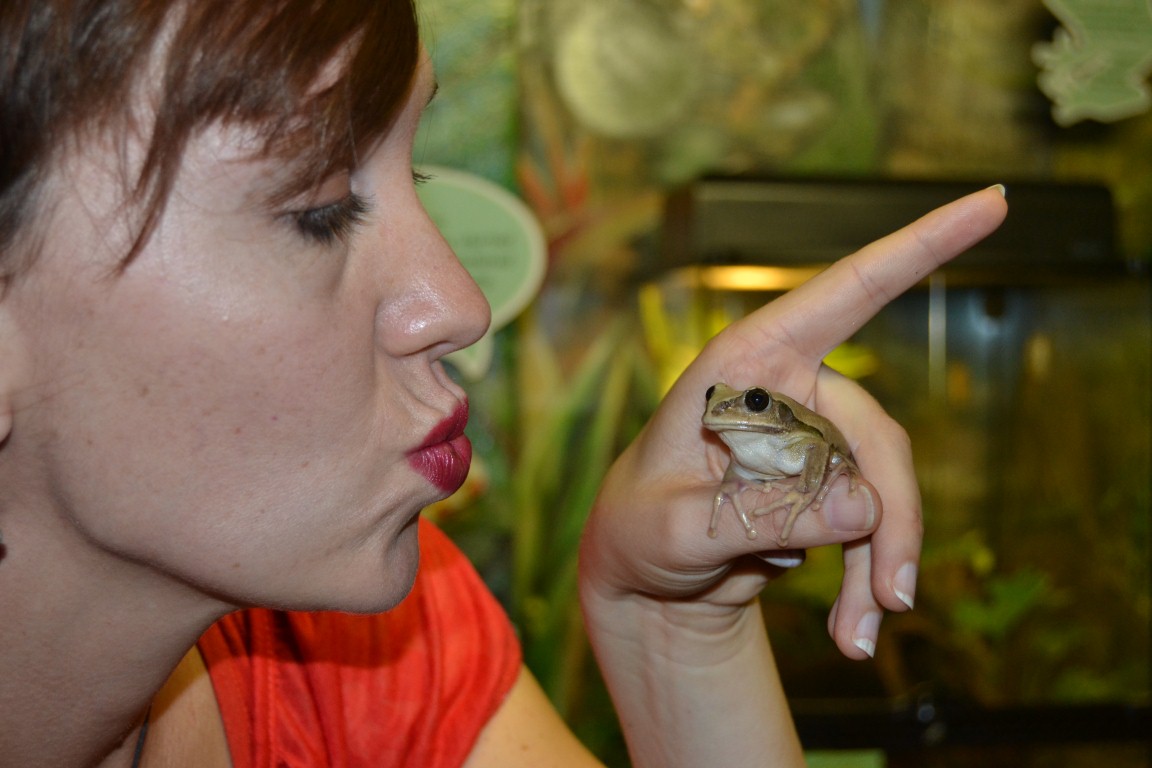
A frog almost became a prince last Friday when Dr Jeanne Tarrant took a leap of faith and puckered up at the Ushaka Marine World.
Her affection for frogs goes further than a Valentine’s day fling though as she champions the cause for their conservation in KZN.
However the frog that has truly captured her heart is not the Brown Backed Tree Frog we caught he kissing but rather the Dolphin Coast’s critically endangered Pickersgill’s Reed frog.
Tarrant heads up the Endangered Wildlife Trust’s Threatened Amphibian Programme. She has a PHD in zoology and her primary research focus is the Pickersgill, which is only found in isolated wetland pockets on KwaZulu-Natal northern coastlines. The species was discovered fairly recently, in 1978, and was named after a Banker, Martin Pickersgill who spent a lot of time in Africa. He found the first Pickersgill’s Reed frog in Mount Edgecombe.

Since then the critically endangered species has only be found in 20 different sites, of which only two are within protected areas. The Pickersgill has been found in the Simbithi Eco-Estate as well as Zimbali and those populations are being monitored. They were also found in Tongaat and Stanger, although those spots have not been checked for some time.
“The rest of these pockets are under threat of disappearing at any moment,” said Tarrant.
In order to conserve the Pickersgill’s Reed frogs and other threatened species the trust are setting up monitoring programmes, which will keep tabs on the distribution and population of the frogs. In addition, a biodiversity management plan is in the process of being implemented. Genetic sampling and relocation of adolescent Pickersgill’s and rehabilitation and protection of their natural habitats form part of the plan.
With the help of Ushaka Marine World as well as the Pretoria and Johannesburg Zoos, the Pickersgill’s has been the first threatened species in South Africa to be involved in a captive breeding programme.
Tarrant highlighted five things you can do to be more involved in frog conservation.
“Become aware of the fact that frogs are threatened, get to know what type of frogs are in your area, build a frog pond at home, use less pesticides and chemicals in your home and garden and lastly, do not buy plastic bags, they damage water systems,” she said.
The upcoming ‘Leap Day for Frogs’ on Friday, February 28, aims to raise awareness about the plight of frogs in South Africa and around the globe. Visit www.leapdayforfrogs.org for more information about the day and how you can get involved.
Stay in the loop with The North Coast Courier on Facebook, X, Instagram & YouTube for the latest news.
Mobile users can join our WhatsApp Broadcast Service here, or if you’re on desktop, scan the QR code below.