

Peaking plant: frightening or enlightening?
There's a positive and a negative side to the power plant being constructed near Shakaskraal.
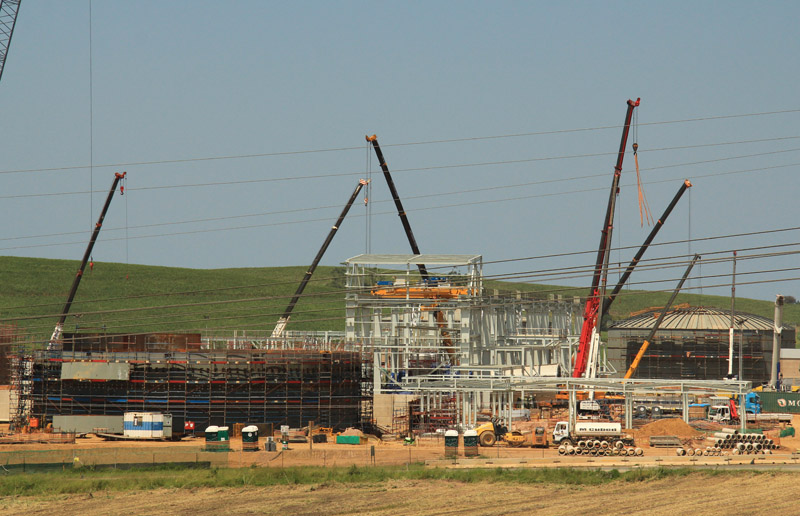
With Eskom in no position to keep the lights on, putting a peaking power plant in our own backyard seems like a bright idea that could save us from the claws of darkness.
But there are those who feel that the Avon peaking power plant, currently under construction near Shakaskraal, will be no better than a real-world Mordor, burning copious amounts of fossil fuel, gulping up our limited water supply, and putting school children’s lives at risk, not to mention the incessant noise from the massive “generator”.
A peaking power plant is designed to augment electricity supply during peak times and emergency situations.
But with the country’s ongoing energy crisis, Eskom almost always finds itself in an emergency situation and one can’t help wondering if the envisioned 20 to 45 operating hours per week will be enough.
The Courier reported in 2013 that the plant was literally a “gas guzzler” as, once built, it will run four massive gas turbines that will burn 225 tonnes of diesel every hour.
“That is 17 fuel tankers delivering a full load for every four hours of operation,” said member of the provincial legislature, representing the Democratic Alliance, Ann McDonnell.
She said building the peaking plant at Hammersdale (near Pietermaritzburg), the alternative site that was considered, would have been better for transportation of diesel as the site was located just off a rail line.
Salt Rock resident, Carol Church, said it was too dangerous to have so many heavy trucks driving up and down the road past schools and through residential areas where people and animals frequently cross the road.
McDonnell highlighted the strain the plant will put on our already stressed water supply, saying the plant will consume a million litres of water per day just to wash the diesel before it can be used.
According to Avon’s community management and monitoring committee (CMMC) member, Di Jones, the water will not come from Hazelmere Dam as rumored but from the Lower Thukela bulk water supply scheme (LTBWS) that is due to be commissioned in early 2016, in time for when the peaking plant is expected to come on line between March 24 and June 29, 2016.
The cost factor to the consumer is another point of concern to McDonnell.
“The plant is expected to produce power at an estimated cost of R8 per kilowatt per hour which is a giant leap up from the current average rate of R1.15 per kilowatt per hour paid by the consumer,” she said.
McDonnell added to her list of gripes that not only will the peaking plant feed into the national grid and not benefit the Dolphin Coast directly but it will also not lead to any long-term job creation as the plant will require very little staff to run.
Meanwhile, the CMMC has been hard at work contributing to the execution of proposed mitigation measures.
Road safety and social responsibility
An Avon Peaking Power presentation, dated September 14, 2014, revealed that a road safety awareness campaign had been conducted at Etete primary school and Trinityhouse, Palm Lakes.
The report also said that ongoing repairs of potholes in the public road has been undertaken and discussions have been held with the department of transport to install rumble strips close to the local schools and leading up to the plant.
On the social responsibility front, Avon has made its first community service initiative (CSI) to Summerhill House, a children’s home close to Shakaskraal.
In the presentation it is also said that the plant’s layout design allows for future conversion to combined cycle technology.
Combined cycle technology uses waste energy from the turbines, recovered by a heat recovery steam generator to power a conventional steam turbine in a combined cycle configuration.
As CMMC member, Jones said the monitoring, efficiency and safety standards of the project were first class.
“The only problem I have with the plant is that it will be running on fossil fuel that is not renewable,” said Jones.
Generally the issue of sustainability of fuel for peaking power plants is a common concern.
The Avon peaking power plant is owned by a consortium of French multinational energy company GDF Suez (38%), Japanese Mitsui (25%), a broad-based black economic empowerment trust (10%) and Legend Power Solutions, a majority black owned South African company (27%) and will sell its power to Eskom for an initial period of 15 years.
GDF Suez will operate and maintain the plant during this period.

Stay in the loop with The North Coast Courier on Facebook, X, Instagram & YouTube for the latest news.
Mobile users can join our WhatsApp Broadcast Service here, or if you’re on desktop, scan the QR code below.