

La Mercy plant: what about the environment?
Recycling water is not sustainable and those who oppose the desalination plant don't understand the bigger picture.
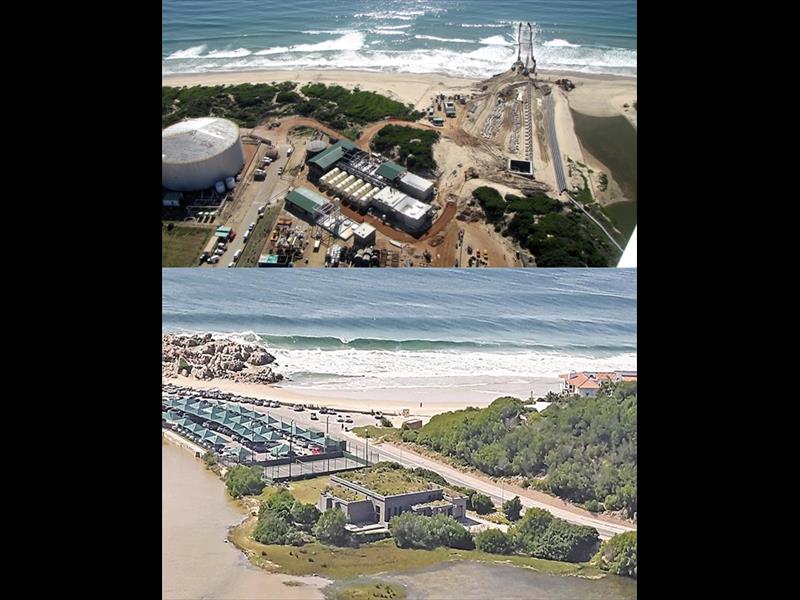
Umgeni Water’s proposed La Mercy desalination plant appears to tick all the environmental boxes except for power usage.
The 150 mega litre per day (Ml/d) plant and its accompanying infrastructure would draw 40 MVA from the Eskom grid and need a substation to reduce the voltage to 11kV.
If built, the La Mercy plant will be substantially bigger than the Plettenberg Bay, Mossel Bay and Knysna plants as each only produce between two and ten Ml/d.
According to the draft EIA document that appears on the website of the Council for Scientific and Industrial Research (CSIR), to reduce the intake of small fish, water will be pumped at a low inflow velocity of 0.15 metres per minute at a depth of 20 metres through an intake pipeline that stretches 650 metres offshore.
The intake pipeline will follow a tunnel under the surf zone, beach, coastal forest and M4 to a seawater pump station located 11 metres below sea level, which allows for gravitational intake.
An intake of 333 Ml/d will produce 150 Ml/d of drinking water and 183Ml/d of brine to be let back into the sea.
A brine discharge pipeline will run back to the sea under the M4, coastal forest, and beach to a brine diffuser 350 metres offshore where brine will be released in an upwards direction, into the sea through multiple small outlets to ensure good mixing.
Combined with heavy offshore currents and generally rough seas, the brine is predicted to disperse quickly.
The salt levels of plumes are expected to reduce to less than three percent above the normal seawater salt level within ten metres of the diffuser.
The arid Middle East relies heavily on desalination but due to much calmer seas and weaker currents combined with a more simplistic method of brine dispersal they have experienced heavy seafloor brine accumulation.
Noise during construction is inevitable but the distance between the plant and the town of La Mercy and Tongaat beach and the location of the plant next to the busy M4 should eliminate the bulk of the noise factor. It is possible to mitigate the low level and low frequency noise that the plant will produce during operation and a specialised noise impact study will be done to determine the best course of action.
Environmental activist, Allimunthu Perumal of Tongaat said desalination was inevitable because of South Africa’s water shortages.
“Recycling water is not sustainable and members of the public who oppose the desalination plant don’t understand the bigger picture,” said Permural.
The La Mercy desalination plant is by no means a done deal. With only the draft Environmental Impact Assessment report having been released, a lot of water still needs to flow into the sea before any final decisions are made.
A public meeting to discuss the plant will be held at the Tongaat town hall on Wednesday, April 13, at 6pm.
Do you want to receive news alerts via WhatsApp? Send us a WhatsApp message with your name and surname to 061 718 4438.
Please read our WhatsApp broadcast list disclaimer.
Join us on BBM at 59015786
Join the conversation on Facebook, Twitter and Instagram.
Stay in the loop with The North Coast Courier on Facebook, X, Instagram & YouTube for the latest news.
Mobile users can join our WhatsApp Broadcast Service here, or if you’re on desktop, scan the QR code below.