
Hunting for marine secrets
Despite a few early worries that the vessel might be connected to gas exploration through seismic studies, residents became quite excited once it was learnt that this was not the case.
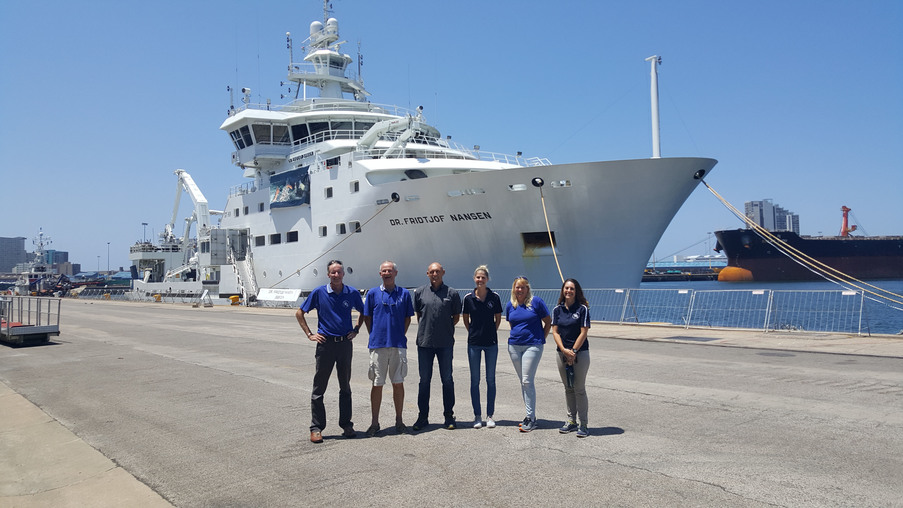
Salt Rock and Sheffield locals were treated to a rare sight last week when a Norwegian research vessel, the “Dr Fridtjof Nansen” came close to shore while performing its studies.
Despite a few early worries that the vessel might be connected to gas exploration through seismic studies, residents became quite excited once it was learnt that this was not the case.
The Nansen is a brand new vessel, the third of its name, designed to carry out fisheries, marine biology and oceanographic research at sea, mainly in the inland waters of third world countries.
The purpose of the research is to help develop an understanding of what natural marine resources and biodiversity we have in our national waters.
Although Norwegian, the vessel is operated by the United Nations Food and Agricultural Organisation as part of a joint venture with Norway. The project has been operating since the early 1970s.
Also read: ANCYL threatens to bring new private hospital to a standstill
According to South African Association for Marine Biological Research (SAAMBR) CEO Dr Larry Oellermann, this is the first time a research vessel of this capability has been made available for research in KZN waters.
“All aspects of what occurs in our waters are being researched, from the zooplankton to the larger organisms living in the water column, as well as the bottom-dwelling creatures living on and in the reefs and sandy bottom,” Oellermann told the Courier.
“They are also recording various oceanographic features and water quality as well.”
The primary focus of the project is to find out if there is “anything new down there” as Oellermann said, in terms of marine organisms and structures such as reefs.
“The information will eventually be used to help us make various management decisions regarding our marine environment, such as biodiversity hotspots and the best location for marine protected areas.”
In contrast, the plan to begin exploration for fossil fuels embedded deep in the earth’s crust not far off the KZN coastline is very much a commercial project.
This gas and oil seeking project forms part of government’s Operation Phakisa (hurry up), which aims to develop and utilise our ‘blue’ economy as quickly as possible in order to tap into the economic potential of the ocean.
This project was being led by Italian multinational gas and oil company: Eni, who published a report late last year before withdrawing it soon after.
Fortunately, according to Eni’s environmental consultant Environmental Resources Management (ERM), the project was put on hold within a week of the report as a result of backlash about possible consequences of offshore drilling for oil and gas on both deep-sea and coastal ecosystems.
Dolphin Coast Conservancy chair Di Jones said the possibility of eventual drilling was not the only worry, as the exploration itself would make use of seismic surveys to help locate oil and gas reserves, which themselves could disrupt marine life.
Oellermann said the Nansen had no capability to carry out seismic testing and that such tests have no bearing on the type of information being collected.
“In fact, we are trying to do the opposite: prove that KZN’s remarkable marine biodiversity is worth protecting from unsustainable exploitation.
“We hope that this intensive two week research cruise is going to provide us with a treasure trove of new information on KZN’s already remarkable marine biodiversity.”
The South African leg of the Nansen’s scientific studies is being led by Oceanographic Research Institute (ORI) senior scientist Dr Sean Fennessy.
The cruise is a joint venture between the Ecosystem Approach to Marine Fisheries (EAF) Nansen project and a number of South African research institutions, including the Oceanographic Research Institute (ORI), the national Departments of Environmental Affairs (DEA) and Agriculture, Forestry and Fisheries (DAFF), the CSIR, University of KwaZulu-Natal, the South African National Biodiversity Institute (SANBI) and the South African Institute of Aquatic Biodiversity (SAIAB).
The type of equipment used on board the Nansen includes pelagic (middle depth) and demersal (bottom) sampling nets, vertical nets used to collect samples of zooplankton, tethered underwater still and video cameras, benthic (sediment and sub-surface layers) grabs, a remote underwater vehicle, and various oceanographic and water quality related sampling equipment.
“One of the most exciting capabilities of the ship is its ability to map the ocean floor in 3D, which should help us find new underwater features,” Oellermann said.
>> Ready to say ‘I Do’ on the Dolphin Coast? Meet the team ready to advise, help and deliver on your big day.
>> Visit our Education feature for a collection of all the best schools, tutoring systems, and even some colleges and training facilities on the North Coast.

Do you want to receive news alerts via WhatsApp? Send us a WhatsApp message (not an sms) with your name and surname to 061 718 4438.
Please read our WhatsApp broadcast list disclaimer.
Join us on BBM at 59015786
Join the conversation on Facebook, Twitter and Instagram
Stay in the loop with The North Coast Courier on Facebook, X, Instagram & YouTube for the latest news.
Mobile users can join our WhatsApp Broadcast Service here, or if you’re on desktop, scan the QR code below.