

Pillow talk: How to sleep and how not to sleep
If your neck and shoulders do not get sufficient support, or are propped at an angle that causes twisting, craning, or crunching, this puts your spine and body in a poor alignment; leading to strain and discomfort in your neck, shoulders, and back, as well as sleeplessness.

We all know that a good night’s sleep is good for you!
Sleep promotes good heart health, boosts the immune system, improves memory, reduces stress and inflammation and allows the body to repair itself.
A good quality mattress is vital for sleep quality, but your pillow is just as important! Your pillow supports your head and neck for 7-8 hours every night; that’s more than 2 500 hours in a year.
It would therefore make sense to invest in a comfortable, good quality pillow that supports your neck and head in a well aligned posture while you sleep.
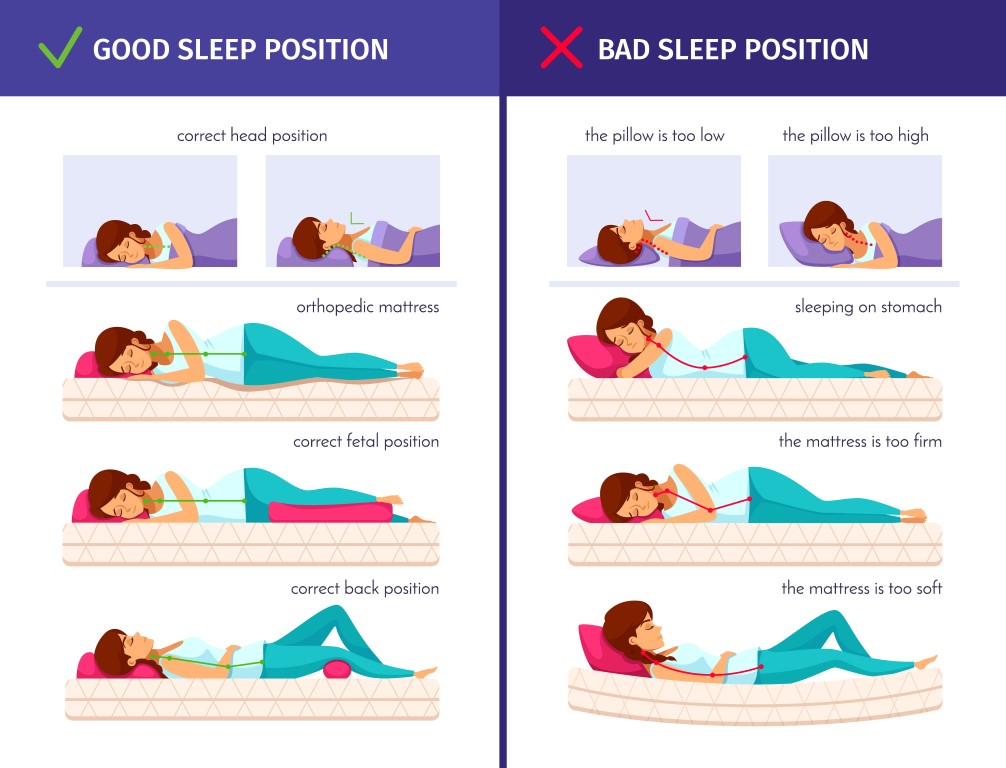
If your neck and shoulders do not get sufficient support, or are propped at an angle that causes twisting, craning, or crunching, this puts your spine and body in a poor alignment; leading to strain and discomfort in your neck, shoulders, and back, as well as sleeplessness.
Here are a few tips:
• The main objective is that your spine remains in the most neutral position possible while the neck and head are well supported.
• If you are sleeping on a worn-out pillow or scrunching and folding it up every night to get comfortable, that is a sign that’s it’s time to update your pillow.
• The type of pillow will differ according to your sleep position and the filling is personal preference although feather and synthetic pillows tend to be lighter while latex and memory foam are heavier pillows.

• Side sleeper: This is a good sleep position as it’s neutral for your middle and lower back, but your neck needs a lot of support in this position.
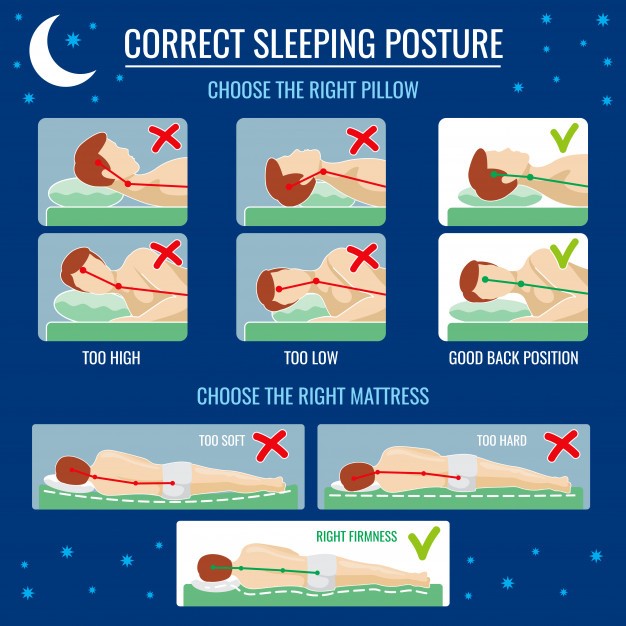
Ensure the pillow is not too low (neck curves towards the bed) or too high (neck bends towards the ceiling). The neck needs to be in line with the rest of the spine. Side sleepers can also benefit from a contoured pillow. It is also advisable to tuck a pillow between your knees to reduce tension in the lower back.
• Back sleeper: This is a great sleep position. Ensure that the pillow supports the head in such a way that the ear and neck are in a straight line. Should you be battling with lower back pain then place a pillow under the knees to reduce stress on the lower back.
• Tummy sleeper: This is not the best position as it places a lot of strain on your lower back and the neck is forced to turn to 90 degrees so you can breathe. Ouch!
If you often land up in this position, try to put a pillow under your torso and pelvis to prevent you from fully rolling onto your tummy.
• If you are a restless sleeper, try a memory foam pillow as this can mold as you change positions and avoid the contoured pillow.
Should you need assistance on sleep posture or pillow choice, contact your physiotherapist or chiropractor.
Salt Rock resident Tarryn Graham has a BSc in Physiotherapy from Stellenbosch University, and has a special interest in and further training in women’s health physiotherapy.
She has 10 years’ experience in women’s health and pelvic floor physiotherapy.

Stay in the loop with The North Coast Courier on Facebook, X, Instagram & YouTube for the latest news.
Mobile users can join our WhatsApp Broadcast Service here, or if you’re on desktop, scan the QR code below.