

The perfect storm: unpacking the Tongaat twister
These violently rotating columns of air are not as uncommon in South Africa as people think.
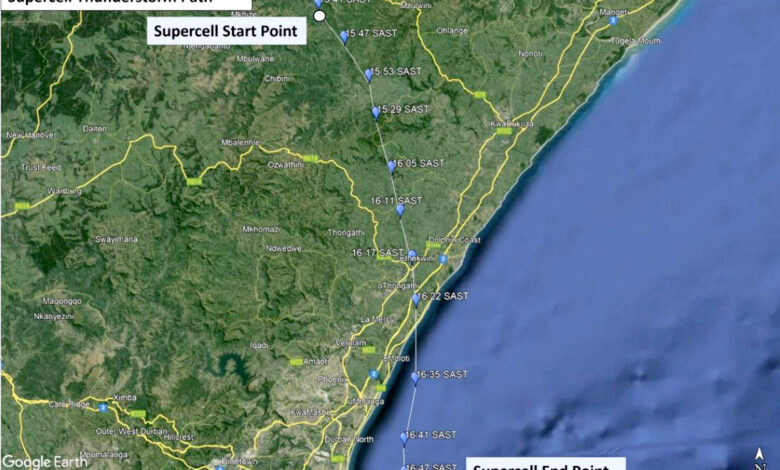
Winds measured at over 225 km/h were at the heart of the tornado that knocked Tongaat for a six two weeks ago.
Tornados are the most formidable windstorms on earth and most of them develop from the cloud base of severe thunderstorms called “supercell” thunderstorms.
However, contrary to popular belief, these violently rotating columns of air are not as uncommon in South Africa as people think, explained the South African Weather Service (SAWS) in a report by SAWS senior forecaster, Wayne Venter and the University of Pretoria’s Christina Liesker.
Although the probability of tornados occurring in South Africa is very low, there have been a few, most of them weak and touching down in Gauteng and KwaZulu-Natal.
The SAWS confirmed two tornados in KZN on Monday June 3 and a third that, fortunately, failed to fully develop.
Tongaat was ravaged by an EF3 rated “wedge” tornado – a twister that is wider than it is tall.
The Enhanced Fujita Scale rating (ranging from EF0 to EF5) is based on estimated wind speeds inferred from observed damage. Most tornados in South Africa are rated between EF0 and EF2. One of the most severe tornados in South African recorded history ripped through Welkom on March 20, 1990.
It was rated an F4 on the old Fujita Scale and damaged 4 000 homes.
Venter and Liesker explained how a series of atmospheric events converged to create the perfect storm resulting in the Tongaat twister that produced winds of between 225 and 265km/h in its destructive path.
A combination of wind sheer (change in wind speed and direction with height) and atmospheric instability created by warm, moist air near the ground overlaid by cooler, drier air above, gave rise to the tornados.
This is how it happened: While cold, dry air swept in from the western part of the country to the central interior, the eastern parts, particularly KZN, experienced warm and moist atmospheric conditions.
A line of thunder storms developed along the border of the Free State and KZN ahead of a well-developed cut-off low-pressure system situated over the western interior of the country.
Ahead of the line of severe thunderstorms, strong low-level wind shear prevailed over the coast and interior of KZN. The stage was set for a catastrophic collision.
“This process of shifting winds in the lower levels of the atmosphere, as the line of severe storms moved across parts of the province, was one of the primary contributing factors in the development of the supercell thunderstorms and tornadoes in KZN,” said Venter and Liesker.
The supercell features of the Tongaat twister lasted less than an hour, developing from about 3.30pm and dissipating by about 4.40pm before moving out to sea just south of La Mercy’s Seabelle Hotel.
The aptness of the colloquial term “tornado alley” is obvious as the tornado caused significant damage over the eastern parts of the Tongaat area towards the coast while leaving areas next to its path unscathed.
Stay in the loop with The North Coast Courier on Facebook, X, Instagram & YouTube for the latest news.
Mobile users can join our WhatsApp Broadcast Service here or if you’re on desktop, scan the QR code below.

Stay in the loop with The North Coast Courier on Facebook, X, Instagram & YouTube for the latest news.
Mobile users can join our WhatsApp Broadcast Service here, or if you’re on desktop, scan the QR code below.