1994, and the 1st election in Vryheid
THEY WERE heady days, exciting days, historic days. On April 27 1994, 20 years ago, the country held its first democratic, truly democratic, election. Vryheid was as excited as any town in the country. There had been lots of speculation as to whether or not the Inkatha Freedom Party (IFP) was going to take part in the election or not, and the party held some …
THEY WERE heady days, exciting days, historic days.
On April 27 1994, 20 years ago, the country held its first democratic, truly democratic, election. Vryheid was as excited as any
town in the country. There had been lots of speculation as to whether or not the Inkatha Freedom Party (IFP) was going to take part in the election or not, and the party held some huge rallies and protest marches in town.
A businessman spoken to, who ran a liquor outlet in Stretch Crescent in 1994, remembers the one march when thousands of IFP supporters marched from Bhekuzulu into town. In the run-up to the election, some marches elsewhere in the country had deteriorated into riots with vandalism and looting of shops, with bottlestores being particularly vulnerable. These were graphically broadcast on the television news. The businessman was assured by his IFP-supporting customers that it wouldn’t happen here, that his premises were safe, and so it proved. There was no trouble.
There was no voters’ roll. Cecil Emmett Hall was the main voting station in Vryheid and that’s where people queued to vote, for the first time, black and white together in the same queue, one man (or woman), one vote.
It was astounding. The queue came out of Cecil Emmett Hall, snaked down past the Bowling Club entrance to Utrecht Street, then continued along Utrecht Street towards East Street. There, at the corner of East and Utrecht streets, it snaked to the right up East Street towards the hospital, over the railway bridge, and right into Bree Street.
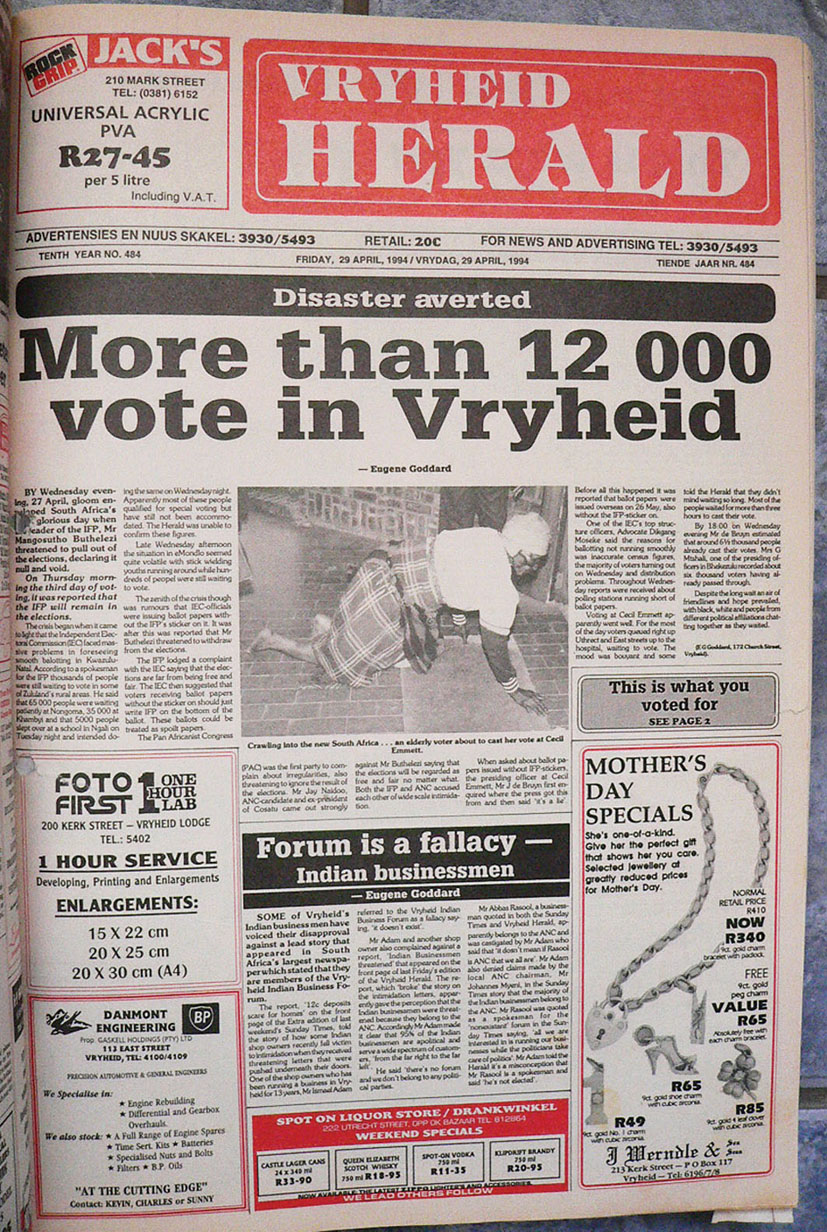
The Vryheid Herald of 29 April 1994, had as its front page picture an elderly woman crawling into Cecil Emmett Hall to cast her vote. Who she was, it doesn’t say. How long she had stood in the queue, it doesn’t say. It does say that more than 12,000 people voted in Vryheid, most of them probably unaware that behind the scenes the IFP was threatening to pull out of the election and declare it null and void.
According to the Vryheid Herald report, the crisis began when it came to light that the IEC faced massive problems in ensuring
smooth balloting in KZN. According to an IFP spokesperson at the time, thousands of people in Zululand’s rural areas were still waiting to vote, 65,000 alone at Nongoma, 35,000 at Khambyi. the Herald was unable to confirm the figures.
Late on that Wednesday afternoon, April 27, 1994, the situation in Mondlo seemed quite volatile with stick-wielding youths running around while hundreds of people were still waiting to vote.
The IFP’s late entry into the election had meant that the IEC, which had already printed the millions of ballot papers, had to resort to physically sticking the IFP’s name to the bottom of the ballot paper. The crisis on the day arose when it was reported that the IEC officials were issuing ballot papers without the IFP sticker. When this was reported, the IFP leader Buthelezi threatened to
pull out of the election.
Apparently, when the IFP lodged a complaint, the IEC suggested that voters receiving a ballot paper without the IFP sticker should write “IFP” at the bottom of the paper. Whether this happened or not, and whether these papers were subsequently treated as spoiled votes (as would be the case today), is not known.
When asked about ballot papers issued without the IFP stickers, the Presiding Officer at Cecil Emmett, Mr J de Bruyn, asked where
the press had got this idea and then said, “It’s a lie”. But apparently it was also reported that ballot papers issues overseas on May 26, 1994, also were without the IFP stickers.
Because of various hitches, voting in the first election of 1994 extended over three days, some of the reasons being inaccurate census figures, distribution problems and the fact that the majority of voters turned out on the Wednesday. Throughout that day, the IEC received reports that polling stations were running short of ballot papers. Without a voters’ roll, and without a previous election as a guide, it must have been very difficult to predict how many voters would turn up at each polling station.
Voting at Cecil Emmett on April 27, 1994, apparently went well, with a queue for most of the day and a three-hour wait in that queue. It was reported that the “mood was buoyant”. The Herald reported, “Despite the long wait, an air of friendliness and hope prevailed, with black, white and people of different political affiliations chatting together as they waited.”
By 6:00pm on that Wednesday, it was estimated that 6,500 people had voted at Cecil Emmett, and a Mrs G Mtshali, one of the Presiding Officers in Bhekuzulu, recording that about 6,000 voters had passed though her voting station.
And this week, 20 years later, we

voted again.