Vryheid Hospice takes the fight to TB
TUBERCULOSIS is the leading cause of death in South Africa. This was announced at the beginning of this month by the Government’s Department of Communications on behalf of Stats SA. And yet, living in Vryheid, you might not give tuberculosis, or TB, a second thought. Vryheid Hospice does. Vryheid Hospice has a TB team (and …
TUBERCULOSIS is the leading cause of death in South Africa. This was announced at the beginning of this month by the Government’s Department of Communications on behalf of Stats SA. And yet, living in Vryheid, you might not give tuberculosis, or TB, a second thought.
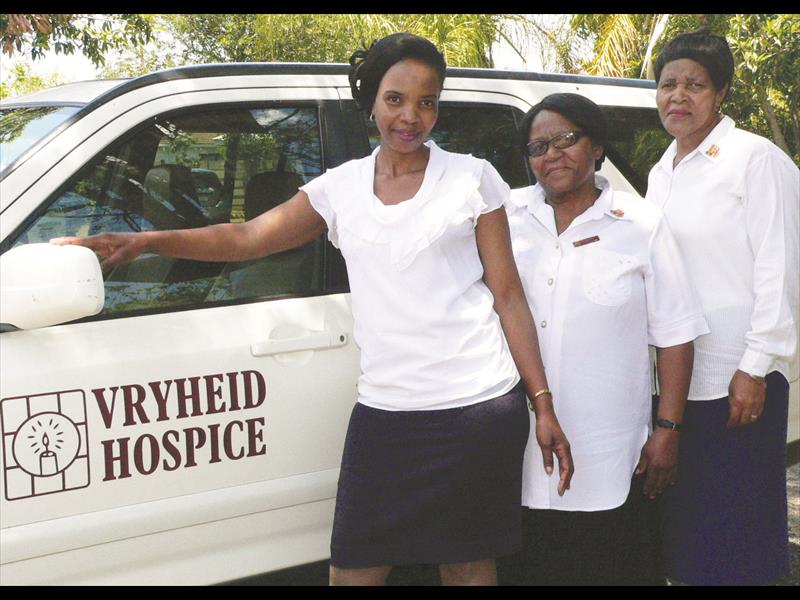
Vryheid Hospice does. Vryheid Hospice has a TB team (and Vryheid Hospital has two more) which is dedicated to the care of TB patients in and around Vryheid. Every day, seven days per week, the team climbs into its SUV vehicle, and visits 37 patients who have multi-drug resistant (MDR) TB. Of those patients, 13 have to have a daily injection. They have to have it!
The team travels about 165km per day doing these visits, some of the patients living in deeply rural areas, at the end of primitive roads. The patients will have been referred to Hospice by the Hospital, and it is from the Hospital that the Hospice team gets the drugs and syringes. The vehicle running costs and the salaries of the Hospice TB team come from a donation from US Aid.
This daily contact with TB patients has allowed the team to establish close relationships with the communities in which the patients live. They are well known and recognised within those communities. Their biggest job, they say, is education, explaining the disease and its consequences, and also counselling patients and families. And encountering all manner of social problems, literally at “grass roots level”, the team is also a conduit between the people, the patients, their families and other government departments such as Social Welfare.
The team can talk about patients who have succumbed to TB, but can also about patients who have beaten TB. It may be the leading cause of death, but it is a treatable disease.
Vryheid’s Dr Heinz Niebuhr provided this information about TB, “an infectious disease, caused by the bacterium Mycobacterium tuberculosis. TB typically affects the lung (pulmonary tuberculosis). It can also affect other organs, then called extra-pulmonary tuberculosis.
“People with TB cough and sneeze, expelling millions of bacteria into the air. These bacteria are inhaled by people around them and can infect them. In general, a relatively small number of people infected with TB will develop TB disease. People infected with HIV have a much higher probability of developing TB disease. An HIV negative person has a 10% chance of being infected in his/her lifetime. In HIV infected individuals this rises to a 10% chance per year.
“The common symptoms for TB are: Coughing for more than two weeks, weight loss, fever and drenching night sweats. People with these symptoms need to be seen by their healthcare provider for tests. Tests done for diagnosis are: Sputum investigations (GeneXpert) and/or chest X-rays. With GeneXpert, TB can be diagnosed within two hours, and be tested for susceptibility for the common TB drugs. Drug susceptible TB is treated for six months, with a very high cure rate. Contrary to this, untreated TB has a death rate of more than 70%.
“A new challenge in TB care is drug-resistant TB. This is classified as MDR-TB (multidrug resistant TB) or XDR-TB (extreme drug resistant TB). For MDR-TB treatment is for 24 months, including daily injections for six of the 24 months. For XDR-TB it is even longer.
“How common is TB? According to the WHO (World Health Organization – 2012), TB is the second leading cause of death from infectious diseases – HIV and AIDS is number one. In 2012 the incidence of TB in South Africa was reported by the WHO as 1000/100 000 population, which is very high.
“Compare this to other high burden countries, such as Mozambique (552/100 00) or the lowest, Brazil (46/100 000). Of these, 3.7% of new TB cases will become MDR-TB and 20% of cases which are being treated for TB for the second time will become MDR-TB cases. 9% of MDR cases will become XDR-TB.
“It is therefore no wonder that TAC (treatment action campaign) is calling drug resistant TB a public health emergency.
“Since the advent of anti-retroviral drugs the incidence of TB has decreased.
“Numbers given by the NHLS (National Health Laboratory Services) in South Africa give the peak incidence of TB in 2008, as 854/100000. By 2012 the incidence had decreased to about 700/100000. The decrease in the TB incidence is clearly due to the increase in anti-retroviral drugs.
“According to the WHO any incidence higher than 250/100000 is an epidemic, meaning South Africa, in spite of progress still has a long way to go. The TB incidence in AbaQulusi in 2014 is 655/100000.
“The MDR-TB unit at Vryheid Hospital currently looks after 235 patients on MDR treatment, 48 of whom are on daily injections, given to them at their homes by mobile injection teams. One of these teams is funded by Hospice, Vryheid.”