
Birds of a feather flock together
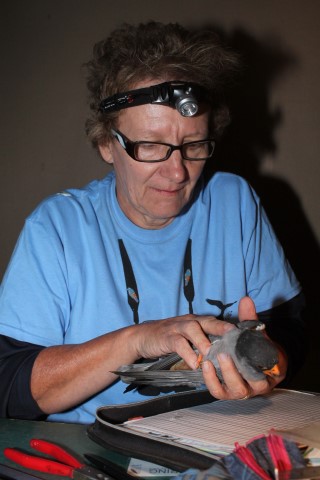
Rina Potgieter, National Coordinator for Migrating Kestrel Projects, along with students from New Zealand and Holland spent two nights catching and ringing some of these birds to enable fellow birdwatchers overseas to track the movements of these birds.
Nestled among the branches of trees growing at Farmers Hall rests the largest roost of Amur and red-footed falcons in Southern Africa.
These small predatory birds migrate an amazing distance of just more than 14 000 kilometres every year to areas of Mongolia, Hungary, Russia and Kazakhstan.
Rina Potgieter, National Coordinator for Migrating Kestrel Projects, along with students from New Zealand and Holland spent two nights catching and ringing some of these birds to enable fellow birdwatchers overseas to track the movements of these birds.
“At the last count, there were 38 000 falcons,” she said. “It is the only roost where these birds are caught and tagged.”
Mrs Potgieter, along with Shane McPherson, a New Zealand national currently doing research for his PhD in Ecology, as well as his volunteer assistant, Kate Beer, a Zoology and Wildlife Management graduate also from New Zealand, spent two nights at the Farmers Hall roost. Tim van der Meer from Holland who is currently doing his his Masters Degree in Ecology, as well as Tammy Caine who works with the Raptor Rehabilitation Centre in Pietermaritzburg, joined the fun.
Explaining the process of ringing and the administrative work relating to the process, Mrs Potgieter provided an interesting insight into the motivation behind the work.
“All the rings are numbered uniquely, and a central database is kept by the University of Cape Town. The work we do here is valuable, because it enables us to keep record of the movements of these birds.”
Even though the falcons roost together when they reach their migratory destinations, they will divide into breeding pairs, each with their own small territory. According to Mr McPherson who has travelled in Mongolia, finding them close together is quite rare.
The Amur falcon feeds mostly on insects, regurgitating the undigested bones at night. Driving past Farmers Hall on most afternoons, residents will be able to hear the cries of these birds of prey as they jostle for position on the branches. During the day, the birds will fly to the grassland areas surrounding Newcastle and other areas in Northern KwaZulu-Natal, where they will hunt.
In 2010 a group of bird watchers visited Newcastle from Hungary, and fitted tracking devices to some of the birds. Even this process, Mrs Potgieter explained, was not an easy one.
“You can only fit a tracking device on these birds if they are above a certain weight, so getting hold of suitable birds is quite a task.”
Ringing of birds is closely controlled. Permits are needed in each province for the different types of birds that may be caught and ringed.
“We must thank the Amajuba District Municipality. Without their funding, this project and other ongoing projects would not have been possible,” concluded Mrs Potgieter.