Sculptures a source of beauty and conversation
The public sculptures at the entrances of the Newcastle Mall introduce people to contemporary art and ideas. They reach people in different ways – daily contact with workers, occasional contact with shoppers and indirect contact through the media.
Commentary by Judy Jordan
Public art is any art that is exhibited or performed in an open space – the reason being to reach an expanded audience. The public sculptures at the entrances of the Newcastle Mall introduce people to contemporary art and ideas. They reach people in different ways – daily contact with workers, occasional contact with shoppers and indirect contact through the media. All three sculptors are well known and highly acclaimed in South Africa.
The works were commissioned by Zenprop, the owners of the Newcastle Mall not only to celebrate the opening of the establishment, but also to create interest, beauty and conversation. Artists would have been invited to submit ideas to Zenprop and a committee would have selected the most appropriate ideas for the site.
Harriet F Senie, author of numerous books on public art said in a keynote address in the USA in 2003 that the best time to write about public art is not when it is first installed but after it has ‘settled in’. It is important to see how the public react to the art.
She uses three criteria to judge public art on a universal basis:
1. Is it a good work?
2. Does it improve or energize the site?
3. Are the public engaging with the artworks?
Little information is provided to audiences on public art and some knowledge about the artist’s concept improves understanding and appreciation.
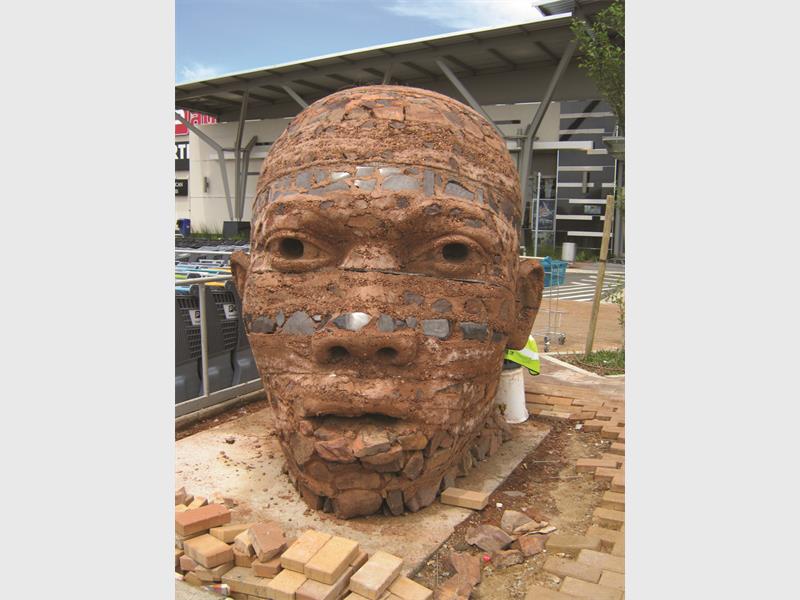
Angus Taylor graduated from the University of Pretoria and won the PPC Young Sculptor Award. His sculptures may be seen in numerous South African towns. This sculpture is of large scale African head titled Layers of Mind and Metal. It rises directly from the ground without a plinth and is made of natural materials (earth, mud and stone), which have no commercial value. In the older Western tradition busts were made with valuable materials such as marble or bronze; they have necks and shoulders and are placed on a plinth above the surface of the ground. Taylor’s choices are deliberate and are intended to take away from the ‘preciousness’ associated with Western sculptures. He wanted portray an African identity and spirit – something connected and ‘grounded’ into the land.

The work is moulded in different layers with contrasting smooth and rough textures. This layering echoes the different strata found in the earth’s crust and the centuries gone into building the earth. It also reflects on the identity of Africa and the different cultures on the continent.
Marco Cianfanelli graduated from Wits University in l992. He won the Absa Atelier Award in 2002 and is widely known for his public sculptures which include the famous portrait of Mandela at Mandela’s Capture Site. This is visited by hundreds of people every day.
His piece of a larger than life woman is made from mild steel. Modern technology is used to create the work. The shapes have been cut by a laser beam which burns away areas leaving a very clean and sharp edge. The figure is built up from repeated silhouettes of smaller figures of different shapes and sizes, possibly alluding to the different types of shoppers that visit the Mall.

In his works the artist explores different class and social structures and despite the differences all people and cultures are connected in some way to each other. The empty spaces between the human forms make expressive patterns and this is an important element in the artist’s work.
Mohau Modisakeng graduated from Michaelis School of Fine Art. He won the Sasol New Signatures Award in 2011. He is a multi-disciplinary artist and is also known for his photography, performance and video art.
This work is a semi-abstract sculpture made from steel. It is a representation of a Zulu shield (culturally symbolic) and an oversized shirt button. A button secures two pieces of fabric together; this one is in two pieces. The Zulu shield has also been split in two. Buttons are mass produced items and are a reflection on our economy and manufacture of clothing. The Zulu shield is a handmade object used for protection and it reflects Zulu culture and identity.

This artist’s concerns are that people in South Africa need to work together; differences need to be resolved but at the same time the past cannot be ignored. Henry Moore once said that all art has a mystery and it is necessary for people to reflect and ponder the meaning.
Newcastle is privileged to have three sculptures by such well respected artists in our town.
Public sculpture creates better places, provides enjoyment, insight and maybe even hope to its viewer.