Why is Educational Robotics part of Curro St Dominic’s Academy’s Curriculum?
Worldwide research has shown that knowledge alone is not enough to prepare pupils for working and living in the 21st century.
A study conducted by the Partnership for 21st Century Skills (people from the business community, education leaders and policymakers) defined a set of essential skills which is now known as the 21st century skills.
They are as follows:
– Three Rs: Reading, wRiting, aRithmetic.
– Four Cs: Critical thinking, Creativity, Communication, Collaboration.
– Two Ms: Meta-cognition (thinking about your own thinking), Motivation.
While the three Rs have always been taught in schools, very little attention has been paid to developing the other six skills.
On top of that, more and more people believe coding is a new language and every child should be fluent in it.
Educational Robotics comprises educational activities that support and strengthen specific areas of knowledge and develop skills through the design, building, assembly and programming of robots, commonly referred to as coding.
How do we do it?
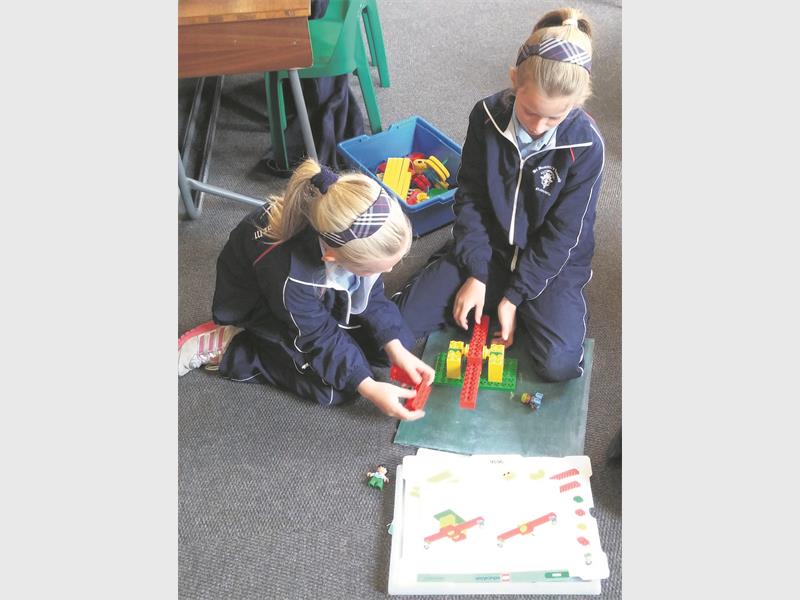
In Grades R and 1 the school introduces pupils to the LEGO Early Simple Machine sets.
All mechanical machines are made up of a combination of six simple machines and by using these sets our pupils are introduced to real life concepts like gears, wheels and pulleys.
In Grade R, pupils build models from instructions and in Grade 1, design their own machines, enhancing creativity and critical thinking, as well as communication and collaboration as they work in groups.
This is done to prepare them for the Robotics programme that is introduced in Grade 2 and 3 where the LEGO WeDo sets are used. This set is a simple-to-use tool that enables students to learn and construct with LEGO sized bricks and then bring their models to life by programming them, using the child friendly WeDo software.
The WeDo software language
These sets include a motion and tilt sensor which allows the models to be programmed to obtain information from the environment and ‘make decisions’ based on this information.
Pupils work in pairs and use a laptop and WeDo set allowing them to build, programme and discover at their own pace.
Grade 3 pupils also design and programme their own models.
In one of the lessons, pupils design cars that can go faster and slower, using their knowledge about gear ratios. They programme the cars in such a way that the angle at which the car is driving, determines the speed.
When our pupils reach the intermediate phase, we change to the more advanced LEGO Mindstorms sets which include more intricate motors and a variety of sensors.
In a systematic way, pupils are introduced to a more advanced ‘language’ in order to programme their robots to function automatically.
Pupils will build a robot from instructions, but as they progress they are challenged to solve problems where they need to design the models and programme them to solve a given problem.
The pupils are also encouraged to take part in one of three regional Inter-Curro Robotics competitions every year. They will also compete in the World Robotics Olympiad which has regional, national and international competitions hosted in a different country every year.
By exposing pupils to child-friendly technology and programming from a young age, the school believes they will master the much needed 21st century skills as well as the confidence to face the challenges they will face in the competitive world they are growing up in.