Opinion
Some thoughts about sparklers
ONCE upon a time I was a veld walker, it was one of my favourite occupations. Thatwas a long, long time ago because nowadays a simple fi shing expedition to somewhere as close and as unremote as Klipfontein Dam, can cost you your life. If I think about it, the last time I went walkabout …

If I think about it, the last time I went walkabout was back in the 1970s. Between Eshowe and Melmoth you pass through the Nkwaleni Valley, and the Valley is nothing like Eshowe nor Melmoth. Nkwaleni is almost like the Bushveld being in the rain shadow of the Eshowe hills, and you’ll notice there’s a lot of irrigation going on
there.
Back in the 1970s, I used to drive to the Nkwaleni Valley, and where it was most like Bushveld, park on the side of the road, climb through the fence and go walkabout. Seriously, just to check birds, check the trees, the aloes (I never saw any game), and I never got lost.
I liked best stopping near a culvert under the road, climbing through the fence and following the stream, which
in Nkwaleni were almost always dry. I like dry river beds. I like the crunch of the coarse sand under my feet, I like the geology of exposed rock, the lips of waterfalls and the tops of future kopjies, and I like the stones and pebbles that collect where summer storms drop them, quite often on the inside of bends. I still have a couple of river stones (odd ones – they look volcanic) that I picked up in river beds at least 50 years ago. (I think they call them igneous rather than volcanic.)
This is not to say that I know anything about rocks. I don’t. And I wonder how many times, in all my walkabouts
in riverbeds, I walked passed a stone, either exposed or just under the surface, requiring just a prod with a
sharp stick, but a stone that was more than a translucent nugget of agate. In fact, how many diamonds did I overlook, especially when I went wandering around the veld near the Botswana border.
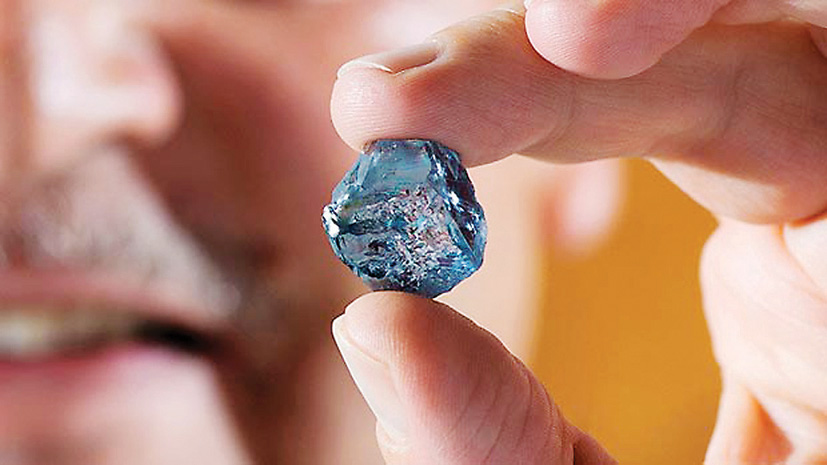
The reason I’m thinking about this was the announcement in January that the famous Cullinan mine near Pretoria
had yielded a rare blue diamond of 29.6 carats. I realise that this million dollar diamond was mined, but I have heard that a number of diamonds, and there’s no reason why they shouldn’t be blue, have been found in rivers – alluvial diamonds. How many have I missed?
This little “acorn”-sized gem they’ve found will collect a pretty penny when it is eventually cut and auctioned. Previously and quite recently, 2009, a 26.58 carat diamond from Cullinan was cut and yielded a seven-carat sparkler which went for nearly $9.5 million US, a sum not to be sneezed at.
I’ve got to tell you, I don’t understand diamonds. I think I’m a believer in everything being created for a purpose, everything, but I have diffi culty in believing that diamonds were solely created for man’s, or more often woman’s delight and/or vanity. They tell me that diamonds were (perhaps stillare?) created around 160 kilometres under the earth’s surface, and they’re carried up by volcano activity. The diamonds we find today were, they say, created a couple of billion years ago – actually as much as 3,3 billion years ago. But why?
And why should carbon, ordinary old carbon, graphite, the stuff coal’s made of, the black stuff that collects
on a glass held above a candle, why should it have also this astounding ability to form a structure that is the
hardest natural substance on earth. What did our Creator intend when He gave carbon atoms this astounding
property?
And that’s all a diamond is – carbon, in some cases with traces of other elements to give it a colour. But if you heat a diamond suffi ciently in the presence of air, you’ll end up with carbon dioxide, yep, the same gas that makes your Coca Cola gassy. If you heat a diamond in a vacuum, it will disintegrate and you’ll be left
with a smudge of soot. Diamonds are not necessarily for ever.
Diamond, the word, comes from the Greek word adamas which means “unconquerable and indestructible”. I presume that this is where we get the word adamant, when you dig your heels in and won’t change your mind or allow any concession.
I’ve read that diamonds were first discovered in India (Indian mythology had it that diamonds had the power
to defl ect evil) although apparently the biggest producer of diamonds today is Botswana. The other thing I’ve
learned is that 80% of diamonds are unsuitable for jewellery.
How they know this I have no idea, but the experts say that there are stars in space, white dwarf stars, that have a diamond core. This ties in with an ancient Greek belief that diamonds were splinters of stars that had fallen on the earth, and presumably been buried by time. But the experts say that there is in the universe a white dwarf diamond cored star that weighs 2.27 thousand trillion trillion tons. That’s 10 billion trillion trillion carats, or a 1 followed by 34 zeros. I don’t suppose I’d understand how they knew this if they explained their reasoning to me.
My days of going walkabout are long over, so I’ll never stumble across a diamond of any size, shape or colour
in a dried up riverbed. Oh well, I don’t feel any poorer for that.
At Caxton, every story is written by humans. We use AI only to perform quality checks - never to generate the news. Happy reading!