
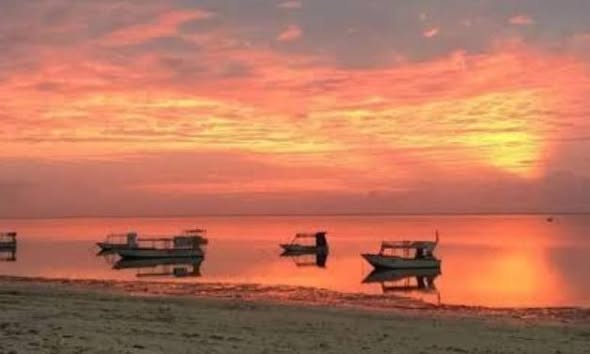
Ever since I visited Mozambique several times as a student on skindiving trips, the East Coast of Africa has fascinated me with its limitless horizons toward the East. The breathtaking sunrises over a golden ocean seemed to promise infinite discoveries.
Standing on those beaches at dawn, looking out across the Indian Ocean, it always struck me that this coastline must once have opened Africa to worlds very different from the later ambitions of Western colonialism with its mercantile rivalries, chartered companies, conquest and capitalist greed.
And indeed, what has steadily emerged from archaeology and historical research is that Africa and the East were deeply and seriously engaged in trade for centuries before European domination of the continent.
It is exciting to think of all the possibilities that this “African Silk Road” offered – but there is also a much darker side to this story as it unfolds.
Long after my student years I began developing a speculative but increasingly evidence-based idea that southern Africa once possessed something resembling its own Silk Road — not a paved imperial highway like Eurasia, but a chain of trade corridors linking the deep interior of southern Africa to the East African coast and onward to Arabia, Persia, India and even China through the monsoon trade winds of the Indian Ocean.
The route, as I currently imagine it, may have stretched from the Tswana interior around Kaditshwene in today’s North West Province, through the Limpopo corridor to Mapungubwe, onward to Great Zimbabwe. It included related stone-built kingdoms such as Thulamela and Khami, before descending through caravan routes to East African ports like Sofala, Kilwa, Zanzibar and eventually the wider Swahili trading world reaching as far as Dar es Salaam.
This is not fantasy. Archaeologists have found Chinese porcelain, Persian ceramics, Indian beads and imported luxury goods at inland African sites hundreds of kilometres from the sea. At Mapungubwe — South Africa’s first known sacred-commercial kingdom — elite graves contained gold artefacts and imported objects linked to the Indian Ocean trade system.
At Great Zimbabwe, Chinese celadon and Arabian trade goods have been unearthed. At Thulamela in the Kruger region, glass beads, porcelain and evidence of long-distance commerce point again toward Indian Ocean connections.
Think about what that means.
A person living near the Limpopo River in the thirteenth century could possess an object made in China, traded through Arab and Swahili merchants, carried across oceans by monsoon winds and then moved inland through African caravan systems and networks of exchange.
Southern Africa was not isolated. It was connected to one of the oldest commercial systems on Earth.
The exports from the interior probably included ivory, skins, gold, copper, iron, salt, rhino horn and possibly medicinal products and ostrich feathers. In return came beads, cloth, ceramics, porcelain, metal goods, ornaments and prestige objects that transformed status, kingship and culture. Beads in particular became markers of wealth and political authority.
The darker side to this story is that the East Coast was not some peaceful multicultural paradise untouched by violence.
Competition for gold and ivory grew intense. Arab-Swahili traders, African rulers and later Portuguese adventurers fought to control the trade routes. Forts appeared on the coast. Alliances shifted constantly.
River mouths and caravan routes became strategic prizes.
Then came slaving on a devastating scale.
The Portuguese did not create slavery in Africa, but they inserted themselves violently into existing systems and helped militarise them. Coastal alliances, armed raiding and commercial rivalries increasingly destabilised the older inland trade networks. Entire societies were drawn into cycles of war, tribute and human capture.
What may once have been a relatively stable exchange system gradually hardened into a brutal struggle over commerce, labour and political control.
The old Indian Ocean trading world was transformed.
What fascinates me is that southern Africa may once have been oriented psychologically and economically toward the East rather than the West. The Atlantic world and European colonialism later overwhelmed that orientation and redirected African economies toward imperial extraction centred on Europe. Yet perhaps traces of the older world remain buried beneath our historical memory.
Even today there are curious echoes of this ancient eastern orientation emerging again through BRICS, Chinese investment, Indian Ocean shipping lanes and Africa’s growing commercial engagement with Asia. The Indian Ocean is once more becoming a central highway of world trade.
History has long rhythms.
The deeper I investigate this possible African “Silk Road,” the more it seems that southern Africa was never merely an isolated tribal hinterland waiting for Europeans to “discover” it. It was already participating — in its own complex and uneven way — in a vast Afro-Asian world of commerce, ambition, danger and cultural exchange.
The sunrise over the Indian Ocean was perhaps not the edge of the world at all. It was a doorway.
* This draft forms part of my history of the Vredefort Dome meteorite crater in South Africa.
- The Tswana city of Kaditshwene 1, now a ruin of tumbled stone walks, is situated in the Dome Bergland. Called Askoppies (ash heaps)by archaeologists, Kaditshwene means “the place of monkeys”.
- Kaditshwene 2 is better known and near Groot Marico.
- Join me for a Dome tour or self drive briefing. Prof Graeme Addison, +27 84 245 2490. Https://vdome.co.za