For a long time, on the tours that I run, people who visit the Vredefort Dome have been asking why it is associated with the meteorite impact.
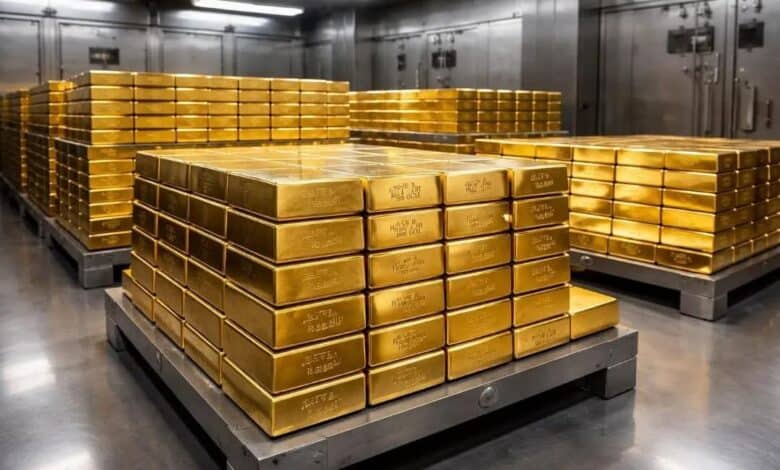
Short answer: the asteroid did not bring the gold. It was here already. But the impact tipped over the gold reefs, bringing some towards the surface and burying the rest.
But ask a geologist a question and the answer will take a long time! I’m not a geologist. I write about popular science, so here goes with a short, long answer.
One very intriguing thing about the gold is that any number of accidents happened to concentrate it over a huge span of time. These chance happenings, taken together, resulted in the Witwatersrand system becoming the most extraordinary concentration of the precious metal ever discovered.
It is a system in the sense that systems theorists apply. They might say the Witwatersrand emerged as a self-organised system. This does not imply there was any deliberate plan, but that what emerged has the features of one system that is more than its constituent parts.
Look at the diagram that I got ChatGPT to draw for me. It didn’t manage it all at once but took several prompts and edits before it more or less met my specifications. It assembles what I have come to understand as the great periods of gold concentration.
First, the Kaapvaal Craton had to survive. This ancient block of crust is one of the oldest stable pieces of continent on Earth. If it had been recycled back into the mantle, the story would have ended before it began.
Then came the greenstone belts, including Kraaipan and Barberton. These ancient volcanic and sedimentary terrains contained gold-bearing rocks. Kraaipan is especially interesting because it lies on the western side of the old craton and still has gold deposits today.
Next came mountains and erosion. Gold was released from older rocks, not in glittering nuggets, but mostly as tiny particles carried with sand, gravel and mud.
Then rivers did the work of transport. They moved sediment across the ancient landscape. The gold could easily have been scattered forever, but instead much of it was repeatedly carried into the Witwatersrand basin.
The basin itself – a great inland lake – was crucial. It kept subsiding, creating space for more sediment. This made it a geological trap, or attractor, drawing material into one long-lived system.
In the West Rand Group the basin was mainly a collector. Huge volumes of sediment accumulated and were preserved.
In the Central Rand Group the system became more energetic. Braided rivers and fan deltas sorted the sediments, concentrating heavy minerals such as gold, pyrite and uraninite into reefs.
There may also have been a biological twist. Some of the richest carbon-rich reefs appear to be associated with ancient organic material, possibly microbial in origin. In simple terms, early life may have helped trap or fix gold in some places.
Then came burial and preservation. The deposits were protected underground instead of being stripped away by erosion.
Finally, about two billion years ago, came the Vredefort impact. The asteroid did not create the gold. It rearranged the architecture of the goldfields.
Some reefs were tilted, folded and brought nearer the surface. Others were buried deep. This helps explain why areas such as the old Johannesburg goldfield could be mined from near-surface workings, while the Western Deep Levels became among the deepest mines on Earth.
So the gold of the Witwatersrand was not one miracle. It was a long chain of geological accidents in which loss was repeatedly avoided.
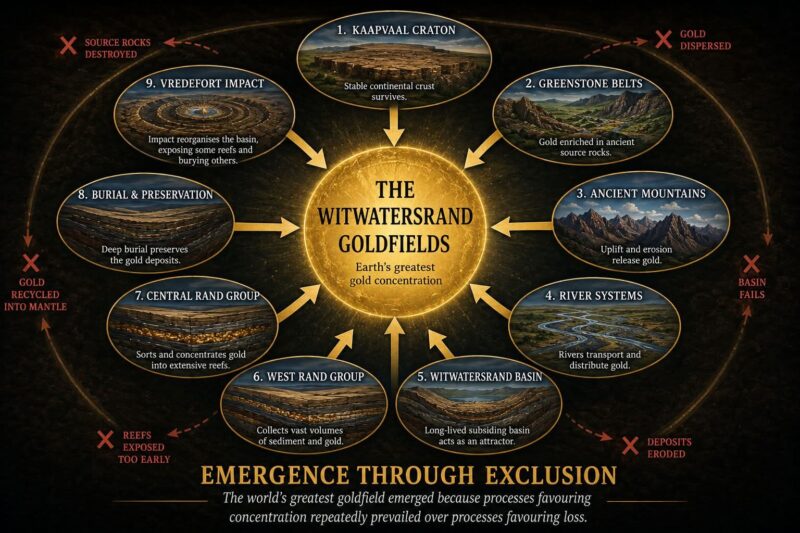
The source rocks were not destroyed.
The gold was not dispersed beyond recovery.
The basin did not fail.
The reefs were not completely eroded away.
Again and again, possibilities that would have wasted the gold were excluded.
At last I have put together a comprehensive way of explaining this to visitors: the Witwatersrand goldfields emerged because processes favouring concentration repeatedly prevailed over processes favouring loss.
Quite by chance, the Vredefort impact happened right at the end to put the final stamp on an amazing train of coincidences.
For more information on a Dome self drive briefing or guided tour contact 084 245 2490.