For much of geological history, large circular structures on Earth were assumed to be volcanic. A round depression? A ring of deformed rock? Surely a collapsed volcano – a caldera.
Because Pilansberg, game park north of Pretoria, with Sun City nestling in its folds, is a caldera, it was assumed that the Vredefort Dome must be one too.
No. It’s the world’s biggest known impact crater. Situated in central South Africa just south of Johannesburg, the crater is around 300km across. It was caused by an asteroid that struck here two billion years ago.
How do we know that? The rocks have been dated, but more to the point, the landscape was formed by shock, not volcanism.
Only in the twentieth century did scientists realise that some craters were not born of fire from below, but of violence from above. Distinguishing a meteorite impact crater from a volcanic structure requires very specific evidence — above all, signs of shock metamorphism.
Shock metamorphism is rock altered not by slow burial or tectonic squeezing, but by an almost instantaneous, extreme pressure pulse. When a large extraterrestrial body strikes Earth, it generates pressures measured in gigapascals (GPa) — far beyond those produced by normal geological processes.
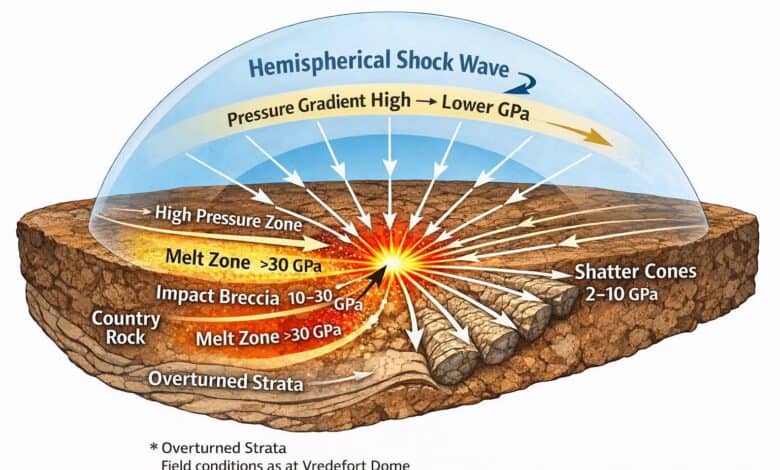
These pressures travel outward as a hemispherical shock wave from the point of impact. Rocks caught in that wave are transformed in very clear ways that tell us a tremendous shock happened here.
The discovery of such evidence transformed our understanding of major structures like the Chicxulub crater in Mexico, linked to the dinosaur extinction; the Sudbury Basin in Canada; and South Africa’s Vredefort Dome, the largest confirmed impact structure on Earth.
Among the most striking of those features are shatter cones — conical fractures in rock that point back toward the source of shock. They are not surface ornaments. They form underground, within solid “country rock,” as the shock wave propagates outward. They are exposed by erosion over time.
How they form is a fascinating story of physics – or put more simply, mechanical forces.
The sequence begins with impact. In microseconds, enormous energy is transferred into the crust. A compressional shock front radiates hemispherically from the impact point. In this phase, mineral grains are rapidly compressed; pressures may reach 5–30 GigaPascals. In such, zones shatter cones form.
As the shock front passes, pressure drops abruptly. This unloading generates tensile (pulling) stresses within the rock. It is during this release phase that fractures initiate.
Because the stress field is radial — spreading outward from a point source — fractures localise along conical surfaces. The result is brittle conical failure: shatter cones whose apexes point back toward the original shock source.
Shatter cones typically form in the outside the central crater. The core is a melt zone where rocks liquidise from heat.
On a microscopic scale, quartz grains may display planar deformation features (PDFs) — closely spaced, shattering that can only be seen under an electron microscope. Together, shatter cones and PDFs provide a powerful diagnostic toolkit.
No ordinary volcanic eruption produces this combination.
Even so, the science continues to evolve. Improved satellite imagery, geophysical surveys and microscopic analysis are revealing subtle impact signatures previously overlooked.
We look for shatter cones because many impact structures have been eroded, buried or tectonically deformed beyond easy recognition. It is likely that numerous ancient craters remain undiscovered.
Each new find refines our understanding not only of planetary collisions, but of Earth’s own deep history. The scars are there — written in stone — waiting to be read.
* Prof Graeme Addison is known for his talks and tours in the Vredefort Dome and can be contacted on 084 245 2490.
At Caxton, every story is written by humans. We use AI only to perform quality checks - never to generate the news. Happy reading!