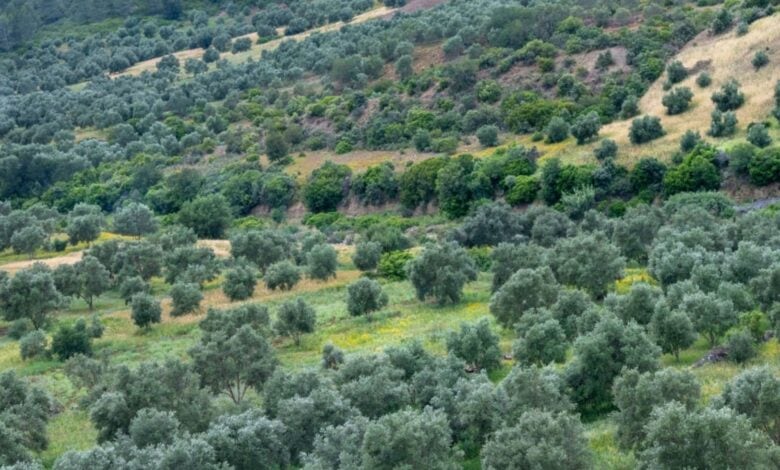
There is a forest in the Vredefort Dome that most people drive past without ever quite realising what they’re looking at.
Not plantation, not invasive thicket, not riverine woodland — but a true indigenous stand of African wild olive, Olea europaea subsp. africana, spreading across the rocky ridges of the Dome Bergland in a way that is both improbable and quietly magnificent.
In a country where fire and frost favour grass, this is a forest that should not really exist — and yet it does.
This is another draft section of my book, Crater of Gold, about the world’s biggest known meteorite impact site.
The Bankenveld landscape is a place of tension. Grassland presses in from the Highveld. Bushveld waits to the north. Fire sweeps through in winter. Frost settles in the valleys. Under those conditions, trees are usually scattered, cautious, held in check.
But climb onto the ridges of the Vredefort Dome and something changes.
The rocks come to the surface — ancient, fractured, and often quartzite — forming hard, dry ridges with thin, reluctant soils. These are not lush places. Water runs off quickly. The slopes are exposed, sun-beaten, and seemingly inhospitable.
And yet, this is exactly what the wild olive prefers.
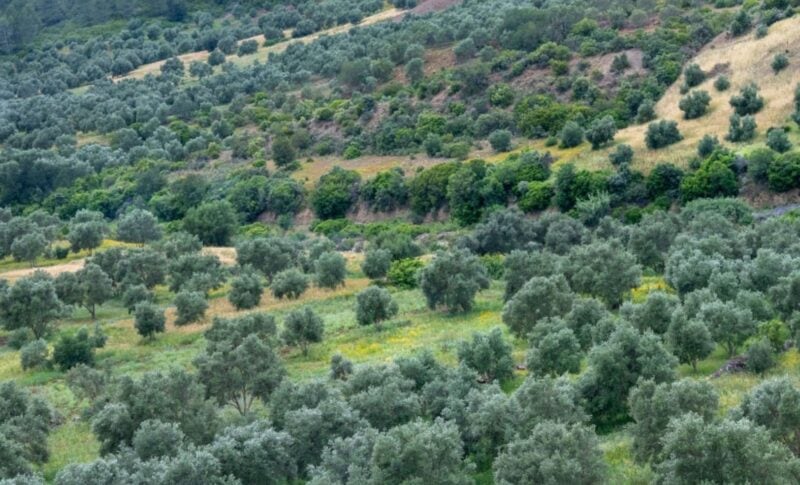
While many trees seek moisture and shelter, the African wild olive finds its advantage on these dry quartzite ridges, where fire cannot easily take hold and grasses thin out. Here, on the rather waterless slopes, it escapes competition — and quietly builds dominance.
The result is extraordinary.
Not scattered trees, but a continuous, self-sustaining woodland, dense enough to form shade, structure, and its own internal ecology. It is, by far, the largest natural African wild olive forest in South Africa — not planted, not managed, simply grown over centuries in the quiet logic of geology and climate.
And yet — remarkably — it is not formally protected as a national heritage site under South African Heritage Resources Agency. It lies within a World Heritage landscape, yes, but the forest itself carries no specific monument status of its own.
Many conservationists regard that as an oversight.
Walk into it and you feel the shift immediately. The light softens. The air stills. Birds move differently. The ground carries leaf litter instead of open grass. You have stepped out of grassland and into something older, more enclosed — a forest that has taken hold not in spite of hardship, but because of it.
This is not a Mediterranean grove in the Atlas Mountains of Morocco and Algeria, where wild olives also spread across vast landscapes shaped by millennia of cultivation. Those are human-tended systems.
The Dome is different.
This is olive woodland that has emerged on its own, in a land that does not easily permit forests. It survives because the rocks allow it. Because water drains away. Because fire is broken. Because frost is softened.
Because the Earth, two billion years after a cataclysmic impact, still quietly dictates what can live where.
That is the real story here.
Not just a forest of trees — but a reminder that ecology follows geology, and that even in a grassland world, given the smallest advantage — even a dry, stony ridge — a forest will find a way.
Prof. Graeme Addison is a national tour guide, trainer/assessor of guides and a Dome site guide. He can be contacted on 084 245 2490 for a briefing or tour and drive to see the crater.