Bad news regarding antibiotics and germs
'Mounting resistance of germs to antibiotics is a growing global concern,' warns neonatologist.
The mounting resistance of germs to antibiotics is a growing global concern that requires much greater attention and vigilance, not only within healthcare but from every level of society, if we are to successfully combat this threat in the future.
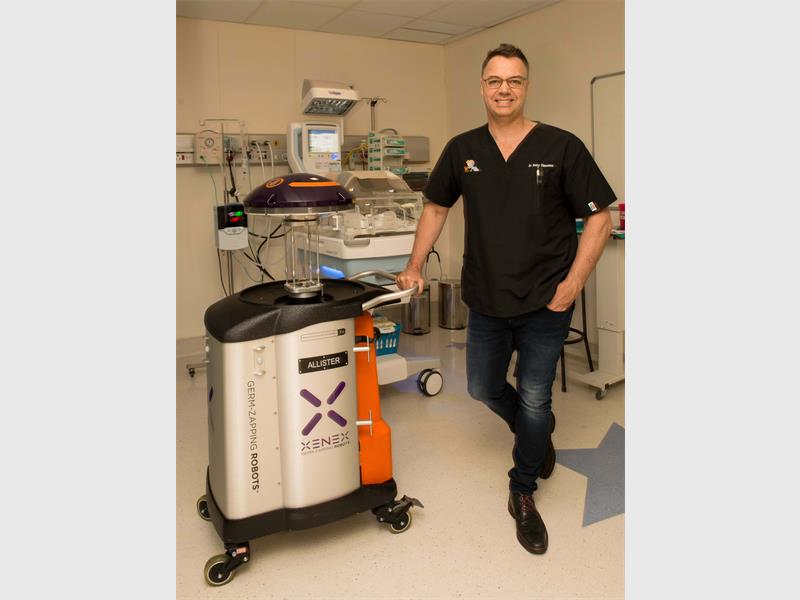
This is the warning expressed by Dr Ricky Dippenaar, a Cape Town neonatologist based at Netcare Blaauwberg Hospital who is well known in South Africa for his pioneering work with micro-premature babies.
“We are currently losing the battle against these rapidly evolving germs, which are now becoming resistant to our antibiotics faster than we are able to develop and produce new drugs to combat them,” he noted.
For Dr Dippenaar, who has been part of a local study to investigate the effectiveness of the use of a new Pulsed Xenon (PX) disinfecting ultraviolet (UV-C) robot to assist in destroying these germs, including bacteria, viruses and fungi, within the hospital setting, “The prospect of humankind running out of the means to combat these increasingly drug-resistant microorganisms is frightening, and we all need to play our part to assist in combating this very real peril.
“We require much greater vigilance with regard to the use of antibiotics, or antibiotic stewardship, not only in South Africa, but across the African continent, where in some countries these types of drugs are easily available, even on the streets,” emphasised Dr Dippenaar.
He said the correct use of these important medicines is critical if we are to maintain their effectiveness and protect ourselves from antibiotic resistance. This involves the use of antibiotics only when absolutely necessary, and the correct medicines and doses to match the condition involved.
“Patients can and must play their part by taking their medicines exactly as prescribed and always be sure to complete their course of antibiotics.
“They should also resist the temptation to pressurise their clinicians to prescribe antibiotics for every medical condition they may suffer from.”
According to Dr Dippenaar, innovative infection control programmes, technologies and medicines do bring hope of solutions to the ever-developing problem, particularly within the hospital setting, where many ill patients have weakened immune systems and are particularly susceptible to infection.
Dr Dippenaar has been a part of an ongoing study on the use of the Pulsed Xenon UV disinfecting robot within an expressed human milk (EHM) feed preparation unit at the Netcare Blaauwberg Hospital, and recently presented the team’s findings at the third Biennial United South African Neonatal Association (USANA) Conference.
Using the Pulsed Xenon UV light-emitting robot, which is distributed locally by pan-African pharmaceutical and medical technology company, Kiara Health, within the hospital’s sensitive expressed human milk feed preparation area, an impressive 90 per cent reduction in surface bioburden, or the number of microbes living on a particular surface, was achieved.
Do you perhaps have more information pertaining to this story? Email us at randfonteinherald@caxton.co.za (please remember to include your contact details in the email) or phone us on 011 693 3671.
For free daily local news on the West Rand, also visit our sister newspaper websites
Remember to visit our Facebook, Twitter and Instagram pages to let your voice be heard!