How to perform CPR during health emergencies
Paramedics believe that a lot of lives would have been saved if residents knew how to perform CPR.
Local paramedics believe that teaching residents how to perform cardiopulmonary resuscitation (CPR) during health emergencies could save the lives of a lot of people.
According to Best Care Emergency Medical Services spokesperson Xander Loubser, bystanders need to know how to perform CPR because it buys the patient time.
Loubser said CPR generates artificial chest compressions, and heart flow and generates blood for vital organs such as the heart, lungs and brain.
He said residents need to know how to perform CPR because it’s not only a lifesaving intervention but also a life-re-gaining intervention. It gives the patient, who has been declared clinically dead, a second chance at life.
“CPR is performed on a patient who is clinically dead or suspected to be dead.
“Bystanders should perform CPR on a patient they suspect to be dead until a qualified healthcare professional arrives and determines if the patient has irreversible death,” he said.
Loubser does, however, understand that bystanders might be afraid to perform CPR for fears of hurting or worsening the patient’s condition. He urged residents to not hesitate when CPR has to be performed.
“Remember, the patient is clinically dead so anything you do will only get better from that point,” Loubser said.
Speaking to Rekord, spokesperson for Volunteer Emergency Medical Response Unit, Casper Visser, said raising awareness to residents about CPR and the steps to take when performing CPR is important.
Visser said CPR is, however, performed differently depending on the age of a person.
He said the steps to take when performing CPR on an adult are not the same steps to take when the patient is a child.
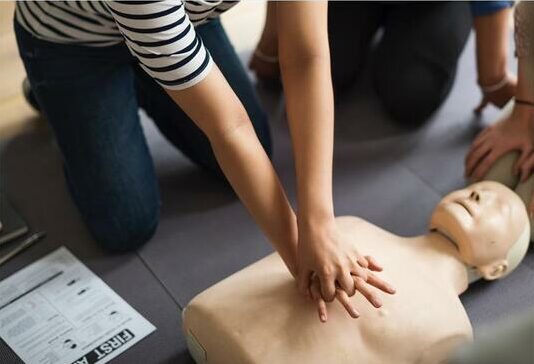
How to perform CPR on an adult and children above the age of eight:
– Make sure that the patient is on their back and lying on a hard surface.
– Place the heel of one hand in the centre of the chest.
– Place your other hand on top of the hand that is on the chest and interlock the fingers.
– Lock your elbows and perform 30 chest compressions at a rate of at least three compressions at least every two seconds.
– Place your arm on their forehead and gently tilt their head back. With your other hand, gently lift their chin forward to open the airway.
– Check for normal breathing.
– Keep their airway open and pinch their nostrils shut and then cover their mouth with yours.
– Give two gentle breaths into their mouth.
– Each breath should last one full second.
– Look to see if the chest rises with each breath.
– Repeat each compression and breath cycle up to five times or until the person begins breathing.
Do you have more information about the story?
Please send us an email to editorial@rekord.co.za or phone us on 083 625 4114.
For free breaking and community news, visit Rekord’s websites: Rekord East
For more news and interesting articles, like Rekord on Facebook, follow us on Twitter or Instagram