Tshwane budget modified as revenue collection falters
Tshwane in the adjustment budget report highlighted that modifications were needed to curtail overspending and concern over unmet revenue targets.
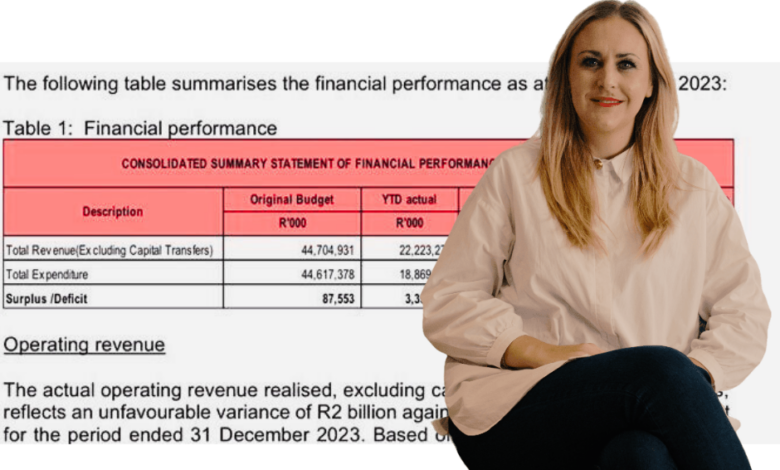
Tshwane has had to adjust its 2023/24 budget due to an unfavourable R2-billion deficit.
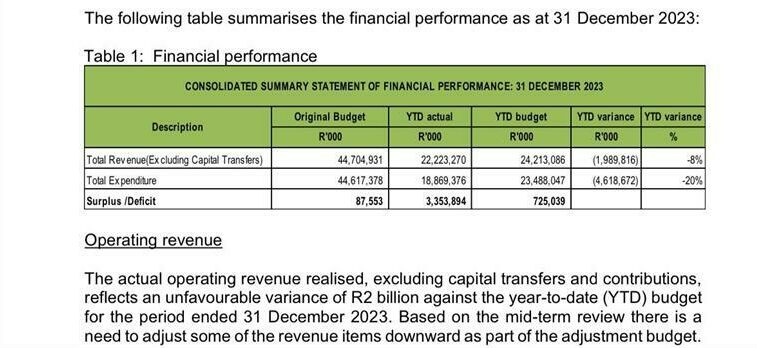
Due to a R1.9-billion collection shortfall, the operating revenue stands at R22.2-billion while the budget is at R24.2-billion.
By December 31, the metro’s financial dealings signalled that its cash resources were insufficient to cover short-term obligations and fixed monthly operating expenditures.
This caused the metro to adjust its expenditure and revenue targets and the council approved the adjusted budget on February 29 by 110 votes with the Republican Conference of Tshwane, EFF, ANC and Patriotic Alliance (PA) against it.
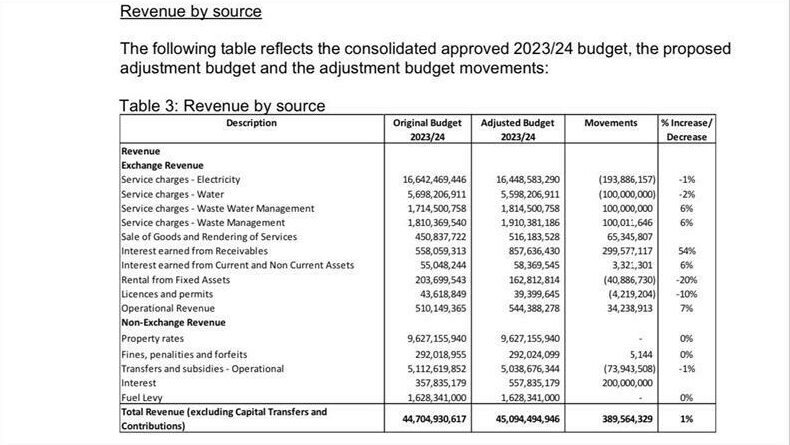
According to the proposed adjustment, revenue has grown from R44.7-billion to R45-billion and expenditure from R44.6- billion to R45-billion.
“The total operating revenue – excluding capital transfers and contributions – increased by R389.6-million, mainly on interest earned from receivables.
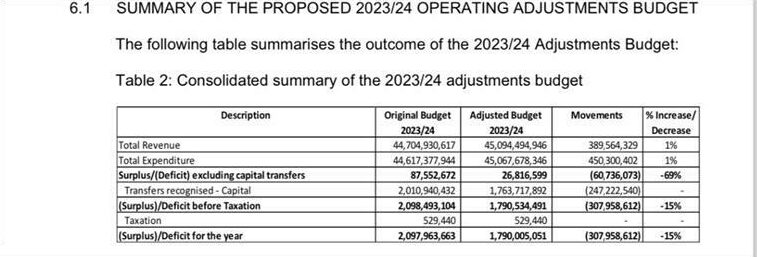
The total operating expenditure increased by R450.3-million.”
The report indicated that Tshwane’s cash and short-term investments as of December 31, 2023, amounted to R2.2-billion, however, the amount was not enough arsenal to ameliorate other financial constraints.
“The actual operating revenue realised, excluding capital transfers and contributions, reflects an unfavourable variance of R2-billion against the year-to-date (YTD) budget for the period ended December 31, 2023.
The low-cost coverage ratio of 0.78 signals that the municipality’s cash resources are insufficient to cover short-term obligations and fixed monthly operating expenditures in terms of the norm.
It is therefore critical that Tshwane continues to intensify its initiatives to improve revenue,” the report stated.
According to the report, based on the financial performance by December, the budget required adjustment “to address the impending shortfall on revenue items as proper assessments must be made on whether the revenue targets will be met”.
Other factors in the adjustment were to curtail possible overspending, appropriate rolled-over grants approved during the financial year to gazetted funding as well as adjust expenditure in line with anticipated revenue and the capital budget due to unsecured external loans.
The following service charges were adjusted:
– electricity was adjusted downward by R193.8-million due to an unfavourable performance occasioned by the decline in consumption and load-shedding.
– waste management was adjusted upwards by R100-million due to favourable performance on solid waste removal fees.
– water was adjusted downwards by R100-million, mainly due to an unfavourable revenue result in the first half of the year.
– sanitation fees increased by R100-million due to a favourable performance and cross-border sewerage mid-year.
The report highlighted that adjustments made to the operating expenditure were due to re-prioritisation processes on employee-related costs, mainly on personnel cost plan items, electricity bulk purchases and other identified savings mechanisms.
“Bulk purchases decreased by R368-million due to a 3.8% decline in demand between 2022/23 and 2023/24. The underlying root cause of the decline in demand can be attributed to factors such as load-shedding and embedded energy generation.
Inventory consumed decreased by R106.4-million due to the implementation of identified savings, mainly on bulk water purchases. The savings were reallocated to other items within water and sanitation.”
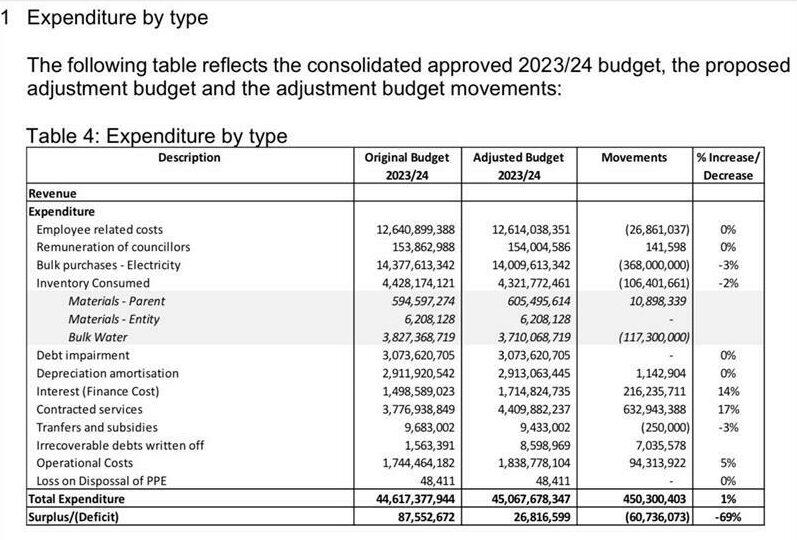
Tshwane’s finance costs also increased by R216.2-million during the mid-year operations.
Interest on overdue Eskom accounts increased by R352.2-million.
The report stipulated that Rand Water’s interest on overdue accounts increased by R7.7-million, while interest on VAT debt increased by R71.4-million.
“The allocations were partly funded from savings of R220-million identified on interest on loans,” read the report.
Contracted services increased by R632.9-million mainly on:
– Water tankers (water and sanitation): R54-million;
– Water credit control and audit of meters (connections and disconnections): R22-million;
– Electricity credit control (connections and disconnections): R50-million;
– Legal costs: R55-million;
– Legal costs (labour disputes) R24-million;
– Household refuse removal: R75-million;
– Illegal dumping: R20-million;
– Urban management: R15-million;
– Watchman services: R305.6-million;
– OHS-related expenditure (air conditioning, firefighting equipment and repair and maintenance of buildings): R8.5-million and
– Rooiwal water care (chemicals and waste-water purification): R25 million to be funded by DBSA grant.

Finance MMC Jacqui Uys said the adjustment would improve service delivery and stabilise finances.
“We have done thorough work and assessed our performance during the first half of the financial year, based on service delivery and revenue collection targets.
I am pleased to report that our multiparty coalition government successfully passed the adjustment. This is a significant development that will help drive service delivery and improve our financial stability.
The adjustment process provides a municipality with an opportunity to make key revisions to the approved original budget.”
Do you have more information about the story?
Please send us an email to bennittb@rekord.co.za or phone us on 083 625 4114.
For free breaking and community news, visit Rekord’s websites: Rekord East
For more news and interesting articles, like Rekord on Facebook, follow us on Twitter or Instagram