ConCourt strikes down healthcare restrictions law
Sections 36–40 of the National Health Act were ruled unconstitutional, ending the Certificate of Need regime. The ruling affirms practitioner freedom, confirms a 2024 High Court judgment, and orders costs against the Health Minister.
South Africa’s private healthcare sector has secured a decisive constitutional victory after the Constitutional Court invalidated key provisions of the National Health Act.
The Constitutional Court has unanimously struck down Sections 36 to 40 of the National Health Act, declaring the Certificate of Need regime unconstitutional. It permanently removed provisions that would have allowed the state to control where healthcare professionals work and where facilities are established.
The ruling, delivered on May 18, confirms a 2024 High Court judgment and marks the end of a protracted legal battle.
The battle was led by the South African Private Practitioners Forum (SAPPF), with Solidarity as the first applicant and support from the Alliance of South African Independent Practitioners Association, the Hospital Association of South Africa and individual practitioners.
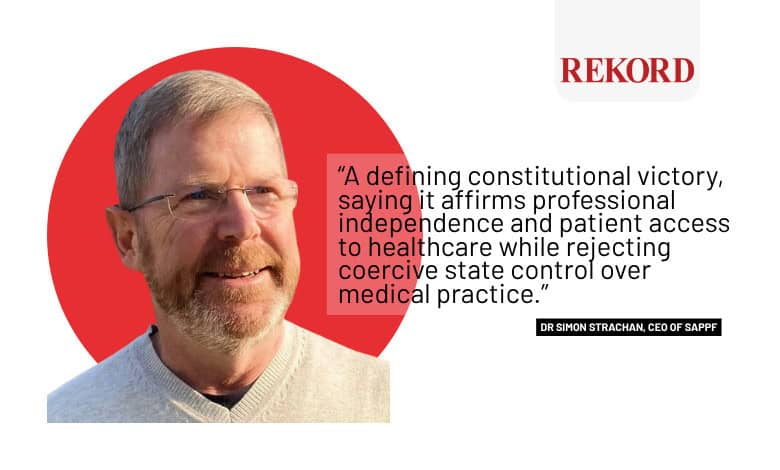
Dr Simon Strachan, CEO of SAPPF, described the judgement as, “A defining constitutional victory, saying it affirms professional independence and patient access to healthcare while rejecting coercive state control over medical practice.”
He said healthcare reform must not come at the expense of constitutional freedoms, adding that ‘professionals are not instruments of state allocation’ and warning against centralised control of medical mobility.
The Constitutional Court found that the provisions were irrational, imposed unjustifiable limits on the right to freely choose a trade or profession, and granted overly broad discretionary powers to the state.
The Certificate of Need framework would have required doctors, hospitals, and private practices to obtain state approval before establishing facilities, expanding services or continuing operations, effectively giving the Minister of Health control over medical infrastructure planning.
The provisions were first proclaimed in 2014, but implementation stalled amid regulatory challenges, leading to a 2015 Constitutional Court intervention, a High Court challenge in 2021, and the 2024 judgment that ultimately set the stage for the final Constitutional Court confirmation.
The court also ordered that the Minister of Health and the Director-General of the National Department of Health pay the applicants’ legal costs, including the costs of two counsel.
SAPPF said the ruling should now shift healthcare reform toward evidence-based solutions that expand access without undermining constitutional rights, with Dr Strachan stating that “South Africa needs practical, collaborative and constitutionally sound reforms”.
Days after the judgment, reactions from across the healthcare sector have highlighted the significance of the ruling for both public and private service delivery, particularly in addressing long-standing debates over equity, access and professional autonomy.
According to SAPPF, the decision removes a major source of regulatory uncertainty that has affected private practitioners for years, with the organisation arguing that stability is essential to retaining healthcare professionals in the country.
While the judgment settles the constitutional question, it is expected to intensify policy debate over how South Africa should pursue equitable healthcare access without relying on restrictive licensing mechanisms.
The court’s reasoning emphasised that limiting the right to choose a profession under Section 22 of the Constitution requires strong justification. It found that the state had not provided sufficient evidence that the Certificate of Need system would achieve its stated objectives.
Strachan reiterated that “meaningful reform must focus on building capacity within the health system, stating that sustainable improvement depends on infrastructure, staffing and consistent funding rather than restrictive controls on where professionals may work”.
The judgment also highlights the ongoing challenge of addressing inequality in South Africa’s healthcare system, where public facilities remain under pressure and private sector capacity plays a significant role in overall service provision.
Strachan explained in earlier proceedings that the High Court found in July 2024 that the Certificate of Need provisions could not withstand constitutional scrutiny and recommended their invalidation, prompting the referral to the Constitutional Court for final confirmation.
He said the unanimous ruling is expected to have lasting implications for how future health legislation is designed, particularly in balancing state planning objectives with constitutional protections for professional freedom.
“The decision should not be seen as opposition to reform, but rather as a call for evidence-based policy making that prioritises both access and sustainability,” emphasised Strachan.
The case has been closely watched across the health sector as a test of the limits of state authority in regulating private medical practice in South Africa.
Solidarity has also welcomed the Constitutional Court’s ruling, calling it a major victory for healthcare practitioners and patients and a significant setback for state attempts to centralise control of the health sector.
Anton van der Bijl, deputy chief executive of Solidarity, described the judgment as a decisive rejection of state overreach in healthcare planning.
“One of the NHI’s central pillars has collapsed today. The Certificate of Need was far more than merely an administrative instrument. It was an instrument of centralisation and state control,” Van der Bijl said.
'n Groot NGV-pilaar het pas in die Grondwethof geval! Danksy Solidariteit se volgehoue druk mag die regering nie meer vir jou sê na watter dokter jy mag gaan en waar dokters mag werk nie. Anton van der Bijl vertel ons meer. pic.twitter.com/SmjhPXp7oh
— Solidariteit (@solidariteit) May 18, 2026
He added that the ruling reaffirmed that healthcare professionals cannot be treated as instruments of policy implementation.
“The government wanted to move health practitioners around like its own pawns on a chessboard to cover up its own failures. The court said that South Africans are not state property and professionals are not pawns,” he said.
The organisation argued throughout the case that improving healthcare access cannot be achieved through coercion or bureaucratic restriction, warning that such mechanisms risk undermining service delivery rather than strengthening it.
Do you have more information about the story?
Please send us an email to bennittb@rekord.co.za or phone us on 083 625 4114.
For free breaking and community news, visit Rekord’s websites: Rekord East
For more news and interesting articles, like Rekord on Facebook, follow us on Twitter or Instagram or TikTok or WhatsApp Channel