
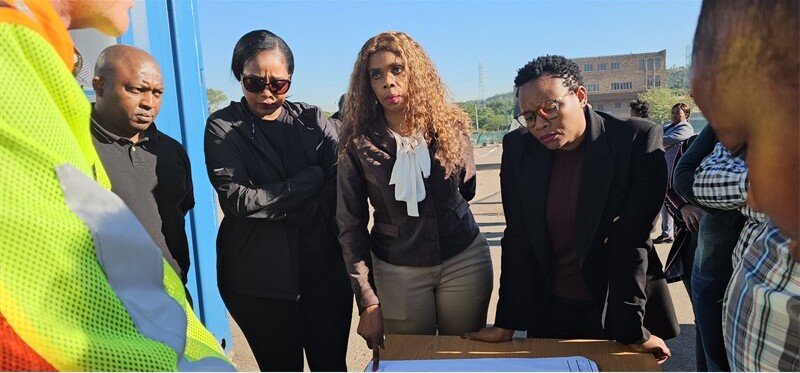
The more than 60 market stalls the Metro set out to build in March are expected to be finished by October, according to Tshwane Mayor Dr Nasiphi Moya during a recent site visit.
On March 11, the Tshwane Metro announced its intention to develop 60 new stalls in a space adjacent to the Tshwane Retail Market, to further formalise trading in Marabastad.
During the site visit, Moya said that additional stalls were added following a community request.
“The stalls will accommodate three restaurants, to be utilised by local women following a request from the community. In addition, there will be 62 trading stalls for fruit and vegetable vendors. The stalls are located adjacent to the Tshwane Retail Market to enable the expansion of trade in the area,” Moya said.
The mayor has taken a firm stance that traders allocated to these stalls must be South African.
The stalls align with the Informal Trading and Township Economy By-law, which Council passed in October 2025.
It aims to regulate, formalise, and support informal businesses, including street vendors, spaza shops, and home-based enterprises, viewing informal business as a key sector in growing the capital’s economy.
“We wanted to diversify the tenants at the Marabastad Market, and we couldn’t accommodate as many people, so we decided to build our own for the traders in Marabastad,” the mayor said.
“We are now dealing with the snags, but by the beginning of October, we need to start seeing this market thriving with the tenants, especially the ones who are already permitted to trade; they will be the first to be moved in.
“We are working very closely with the community and the leadership of the traders so that the transition can be smooth. We want to clean Marabastad. That means taking it upon ourselves to allocate spaces in which they must trade, but also ensuring that the people have the permits to do so,” she added.
In late August, 77 informal traders received their trading permits under the informal economy by-law in Olievenhoutbosch.
The regulations intend to ensure that informal businesses operate in appropriate spaces while receiving support from the municipality.
To qualify for a permit, applicants must attend a free compliance training workshop, be a resident, and, under the new by-law, a South African citizen.
Watch here: https://x.com/nasiphim/status/2094774731538850045/video/1.
Trading For Locals: Today, we returned to Marabastad to inspect the construction progress of market trading stalls.
The stalls will accommodate three restaurants, to be utilised by local women following a request from the community. In addition, they’ll be 62 trading stalls for… pic.twitter.com/cJjOdSsB2h
— Dr Nasiphi Moya (@nasiphim) September 1, 2026
Do you have more information about the story?
Please send us an email to bennittb@rekord.co.za or phone us on 083 625 4114.
For free breaking and community news, visit Rekord’s websites: Rekord East
For more news and interesting articles, like Rekord on Facebook, follow us on Twitter or Instagram or TikTok or WhatsApp Channel