Over half a billion rand spent on water tankers questioned
The ANC-led coalition is being accused of wasteful spending and fueling a ‘water tanker jackpot'. Critics say the city is paying 10 times more to deliver water than to buy it, calling the system unsustainable and open to abuse.
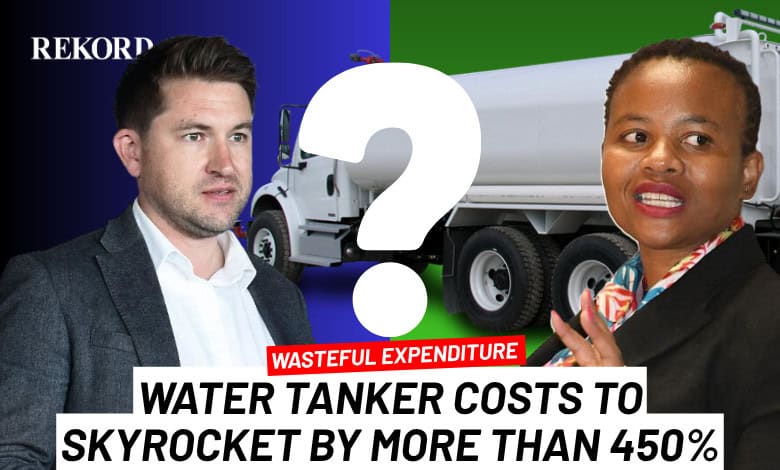
Opposition parties in Tshwane are demanding a full-scale forensic investigation into the metro’s staggering expenditure of more than half a billion rand on water tankers in just over 12 months.
The parties claim that the ActionSA, ANC and EFF coalition have allowed for wasteful expenditure on water tanker costs to skyrocket by more than 450% in just one year, allegedly squandering about R777-million.
DA mayoral candidate Cilliers Brink said, according to a News24 exposé, the city’s expenditure on water tankers ballooned from R140-million in the 2024 financial year under the DA-led coalition to R777-million in 2025, following the takeover by the new coalition.
Brink called for a forensic investigation, what he described as ‘a water tanker jackpot’ – one that has enriched water mafias and contractors while communities continue to face dry taps and water shortages.
He said the first year of Mayor Dr Nasiphi Moya’s administration will be remembered as the year ‘water tanker operators thrived while residents suffered’.
“Between 2024 and 2025, tanker spending increased by a staggering 455%. This period will be bookmarked by massive water losses and ballooning tanker costs,” said Brink.
He pointed out that emergency water supply by tankers, which is meant only for crises such as load-shedding, reservoir failures, or drought, has now become the city’s single largest operational expense in the Water and Sanitation Department.
“It even surpasses capital spending on pipe replacements,” he said.
Brink questioned the metro’s justification for such an increase, noting that there was little to no load-shedding over the past year and Rand Water had actually improved its maintenance performance, reducing supply disruptions.
“The one fundamental change between 2024 and 2025 is that Tshwane is now governed by an ANC-led coalition. Wherever the ANC governs, water comes more from tankers than from taps,” he added.
Brink claimed that even projects like the Hammanskraal water treatment partnership with Magalies Water, which aimed to reduce tanker dependency, have failed to contain the ballooning costs.
He also alleged that Tshwane’s water losses have increased from 34% to 39%, mainly due to unattended leaks caused by reduced maintenance budgets.
“Money that should have been used to fix leaks was diverted to pay for more tankers and security contracts,” Brink said.
He explained that in Moya’s first adjustment budget, spending on watchman security services jumped by 103%, and tanker costs increased by 64%. Even with these increases, the metro still overspent, meaning a large portion of tanker payments could be classified as unauthorised expenditure.
“Some of these invoices could even be fraudulent,” Brink warned.
He said the DA has since written to Tshwane municipal manager Johann Mettler requesting an internal investigation, while also reporting the matter to the Public Protector as a potential case of maladministration.
“There has to be a reckoning for the hundreds of millions that could have been used to give residents clean, reliable water instead, it was spent on tankers,” Brink said.
It costs 10 times more to deliver water than to buy it, said the Freedom Front Plus (FF Plus).
FF Plus councillor Peter Meijer said the city’s tanker operations are ‘financially unsustainable and morally indefensible’.
“Tshwane pays one cent per litre for water, but 10 cents per litre to deliver it by tanker,” Meijer said.
He said, according to the city’s Public Accounts Committee (MPAC), this means that residents are paying 10 times more for delivery than for the actual water, costing more than R530-million per year.
“When delivery costs 10 times more than the product itself, something is seriously wrong,” Meijer stated.
He accused the metro of operating without proper contracts, tender processes or cost controls, creating what he called ‘a breeding ground for the water mafia’.
“We have evidence of double-billing, tankers parked for hours doing nothing, and routes with no proper monitoring. This points to serious malpractice and a lack of financial management,” he said.
Meijer added that no proper record-keeping of tanker contracts has been done since 2021, making the process untransparent and vulnerable to exploitation.
The FF Plus also called for an independent forensic investigation into all water tanker contracts since 2021 and for officials involved in maladministration to be suspended immediately.
“The Freedom Front Plus will not rest until every last cent is accounted for and a new delivery model, one that serves residents, not contractors, is implemented.”
Meijer added that the metro’s heavy reliance on water tankers is not only costly, but also short-sighted.
“Tankers are expensive, vulnerable to breakdowns, and open to abuse. They do not build permanent access to water,” he said.
Meijer called for a comprehensive cost-benefit analysis to compare the city’s tanker spending with long-term infrastructure investment.
“What if a portion of this R777-million budget was redirected toward boreholes with solar pumps, communal standpipes, or small-scale reticulation systems?”
“These options offer lower long-term costs, less risk, and greater dignity for residents.”
He outlined a two-step plan for reform.
Short-term actions involve conducting a full audit of tanker routes and costs, piloting boreholes in high-density settlements and improving tanker scheduling, monitoring, and accountability.
The long-term strategy involves investing in permanent water infrastructure, partnering with national departments for funding support and using geographic information system mapping to identify and prioritise areas most in need.
“Water is a basic right; delivering it by tanker at massive cost, without a plan for sustainability, is not responsible governance. The Freedom Front Plus demands full cost disclosure and a cost-benefit study that shifts the city from emergency delivery to permanent dignity,” he concluded.
Tshwane Mayor Dr Nasiphi Moya is set to address the media on October 23, regarding the serious claims about the
city’s financial management and accountability, and to ensure transparency and provide clarity to residents about the water tanker spending.
Metro spokesperson Lindela Mashigo responded to the claims about the short-term and long-term plans for water security, saying the metro faces a massive service delivery challenge due to the growing number of informal settlements.
He said the city now has 502 informal settlements, up from 210 previously, following years of land invasions and rapid urbanisation.
“The city is constitutionally obligated to provide basic services, including water, to all residents. Where there’s no infrastructure, we rely on mobile water tankers as an interim measure,” Mashigo said.
He explained that 279 mobile tankers, each carrying 10 000 –15 000 litres, currently serve 168 informal settlements four days a week at a total annual cost of about R275.9-million.
Mashigo said all tanker operations are regulated under strict contract conditions, with GPS tracking, timesheets, and unscheduled inspections to prevent abuse or fraud.
“Each contractor is required to provide tracker reports, undergo random spot checks, and ensure tanks are cleaned and disinfected regularly,” he said.
Mashigo dismissed claims of poor record keeping, stating that the metro maintains ‘comprehensive documentation’ for all contracts and payments in compliance with the Municipal Finance Management Act.
“It is not correct that records are lacking. They are well-documented and available for auditing,” he said.
He also confirmed that there are currently no active investigations into tanker operations, though any concerns raised would be ‘immediately investigated and referred to law enforcement if necessary’.
Mashigo said the metro is working on a policy framework for Alternative Water Supply and Sanitation Systems to guide the transition from emergency tanker deliveries to sustainable, permanent infrastructure such as boreholes, communal standpipes, and reticulation systems.
“Rapid urbanisation has placed enormous strain on our infrastructure. The city remains committed to long-term, sustainable solutions that provide reliable water access to all residents,” he said.
Do you have more information about the story?
Please send us an email to bennittb@rekord.co.za or phone us on 083 625 4114.
For free breaking and community news, visit Rekord’s websites: Rekord East
For more news and interesting articles, like Rekord on Facebook, follow us on Twitter or Instagram or TikTok.