Moya’s first year in office rubbished by opposition parties
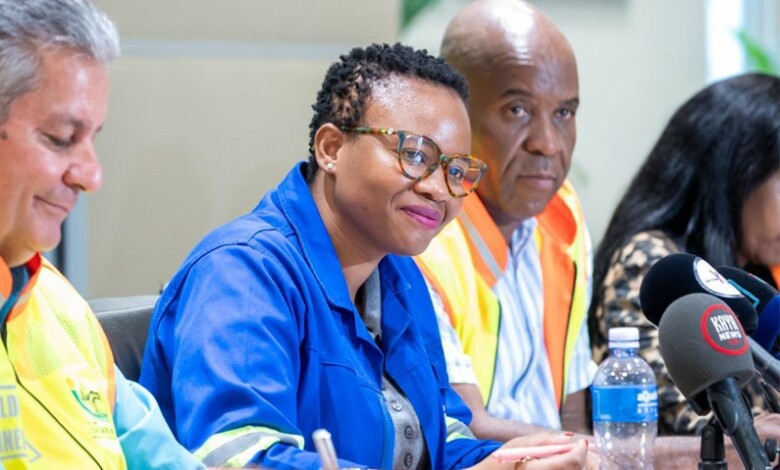
Tshwane Mayor Dr Nasiphi Moya says her multiparty coalition inherited a city at the brink of collapse however they have slowly stabilised Tshwane’s finances, reduced Eskom debt, and rebuilt key services.
Opposition parties in Tshwane have condemned Mayor Nasiphi Moya’s first year in office, labelling it ‘a year of coalition rule that allowed water mafias to thrive, while squandering over R500-million on water tankers’.
They accused the current coalition government of allowing wasteful spending, infrastructure to crumble, and the rise of a ‘water mafia culture’ – allegedly driven by excessive reliance on costly water tanker contracts – within a single year.
This criticism comes after the ANC, EFF, ActionSA, GOOD, and smaller coalition parties recently marked their first anniversary in office after taking control of the metro from the DA-led administration in October 2024.
The coalition celebrated what it called a year of rebuilding and financial stabilisation, but opposition parties have rubbished those claims, describing Moya’s tenure as one of regression masked as recovery.
Former mayor and DA mayoral candidate Cilliers Brink said residents had ‘little to celebrate’ under the coalition’s leadership.
“What we have seen over the past year is not recovery – it’s regression. Residents are still battling power cuts, water shortages, and poor service delivery,” Brink said.
He accused the Moya administration of failing to prioritise key infrastructure projects, including the Hammanskraal clean water project, which he said had stalled despite massive expenditure.
“The city’s water tanker costs have ballooned from R170-million to over R500-million since the coalition took over. This is despite the fact that the Hammanskraal project should have reduced that expenditure,” he said.
“The mayor talks about accountability, yet the same corrupt networks remain untouched. The DA believes the Hammanskraal project can still be completed, but it requires leadership that acts decisively, not politically.”
Brink said the R500-million could have been spent to fix leaks. According to him, Moya’s record was also blackened with ‘more power outages since January of this year than under Eskom load-shedding’.
He added that the coalition would be remembered for ‘trying to make residents cash cows’.
“Their cleansing levy was intended to plug the budget deficit without actually increasing spending on city cleansing. And cadres like Deputy Mayor Eugene Modise who use public resources to benefit themselves without consequence.”
Brink said this was a failure of leadership reflecting “a bigger divide in South African politics between the interests of a cadre elite and ordinary South Africans who expect government to work and deliver value for taxpayers’ money”.
FF Plus councillor Nick Pascoe shared similar sentiments, saying that after a year under the ANC/EFF/ActionSA coalition, Tshwane had ‘reached a new low point’.
“There is an administrative and fiscal collapse due to toxic integrity and constitutional neglect,” Pascoe said. “The coalition is giving a false beacon of hope to residents, while the reality is that service delivery has collapsed.”
Pascoe said Tshwane’s water infrastructure had deteriorated dramatically.
“The water infrastructure across Tshwane is crumbling, water mafias, burst pipes, leaking reservoirs and unreliable supply mean residents suffer, yet the city continues to pour money into crisis management instead of preventative measures,” he said.
He said the metro loses 37% of its Rand Water supply through leaks, theft, and failing infrastructure, and that this is close to 40% if other water sources are included.
“Rate-paying residents face water restrictions, unreliable supply, and have to rely on costly tankers, which are very expensive to maintain,” Pascoe said.
He also criticised the state of the city’s roads and electricity infrastructure.
“Most roads are riddled with potholes, some have collapsed into sections, and abandoned projects are everywhere. It will take more than a billion rand to fix and resurface all roads while some need to be rebuilt.
“In the past 12 months, nothing has been done on electrical infrastructure [but] substations blow, transformers catch fire, and illegal connections thrive,” he said.
Pascoe said the current coalition ‘boasts of stability’ yet is gripped by political interference and ‘toxic governance’.
“Moya and her administration have lost control of the city. Senior experienced officials are reshuffled to serve political appointments, which in the long run causes service delivery failures and a toxic work culture.
“More than R22-million has been spent in two quarters on disciplinary issues and cases, but with no progress. Political deployees are protected when they fail to perform,” he said.
Pascoe said the city’s coalition no longer serves residents but cadres and political figures.
“Residents have submitted hundreds of petitions, yet they are nowhere to be found. They all disappeared under the new coalition, ignoring residents’ demands.”
However, Moya insists that her new coalition inherited a city on the brink of collapse.
Despite the fierce criticism Moya said her administration’s performance, describing her first year in office as one of ‘rebuilding from crisis’ and ‘steady progress toward restoring stability’.
Speaking at her administration’s first anniversary on October 14, Moya said her government inherited ‘a financially strained city’ but had since achieved measurable progress.
“When we took office in October 2024, the City of Tshwane was in a dire financial position. For four consecutive years, it had operated with an unfunded budget, limited cash reserves, and mounting debt to Eskom,” Moya explained.
Moya said the coalition government had stabilised the metro’s finances and restored investor confidence.
“For the first time in years, Tshwane tabled a fully funded budget. The city’s Eskom debt has been reduced from R6.7-billion to R5.6-billion. These are not political points, but measurable steps towards recovery,” she said.
“Moody’s retained Tshwane’s stable outlook in November 2024, and Global Credit Ratings revised the city’s outlook from negative to positive in April this year.
“These point to better fiscal control, easing liquidity risks, and an operating surplus for the second consecutive year. In just 12 months, we have turned what was a collapsing institution into one that is regaining its financial footing.”
She said her administration had begun reversing years of neglect by prioritising service delivery and rebuilding key infrastructure.
“Roads are being resurfaced and repaired, even if not yet at the desired pace. Substations and reservoirs are being secured following waves of vandalism and sabotage.
“The Water and Sanitation Business Unit is leading critical interventions to stabilise supply and address water losses,” she said.
She listed key achievements: a R1.9-billion surplus in the first quarter of the current financial year, R86-billion in pledged investments, and R14.4-billion under investigation for unauthorised expenditure. A total of 220km of roads were resurfaced, 78% of potholes repaired, 3 368 title deeds handed over, 1 850 illegal dumping sites cleared, and R1.4-billion allocated to stabilise the electricity grid.
“We are reclaiming the city, enforcing by-laws, improving collections through Tshwane Ya Tima, and investing in communities that were long neglected. This administration is about results, not rhetoric,” she said.
She added that her government was prioritising neglected areas and improving engagement with residents.
“When we assumed office, we promised that we would serve all residents and remember forgotten communities such as Winterveldt, Soshanguve, and Atteridgeville that had been ignored. Every resident has the right to an improved standard of services.
“We will modernise how we serve residents by improving our customer relationship management systems and strengthening community engagement channels, following the successful launch of the city’s WhatsApp channels earlier this year.”
Moya said her administration was reinforcing financial and administrative controls to improve governance and accountability.
“This work will be supported by ongoing efforts to digitise legal, audit, and contract management systems to ensure efficient, responsive governance,” she said.
“We have a long road ahead, but the direction has changed. For the first time in years, Tshwane is on a path to recovery financially stable, administratively stronger, and committed to restoring service delivery across all communities.”
She concluded by insisting that the city was ‘turning the corner’ after years of mismanagement.
“No one is above the law. We will continue to act firmly and transparently to ensure every cent of public money serves residents, not private interests.”
ALSO READ: Metro faces two water tanker probes
Do you have more information about the story?
Please send us an email to bennittb@rekord.co.za or phone us on 083 625 4114.
For free breaking and community news, visit Rekord’s websites: Rekord East
For more news and interesting articles, like Rekord on Facebook, follow us on Twitter or Instagram or TikTok.