Tshwane residents demand action, pointing to legal letter
Residents in Ward 87 face ongoing electricity and water failures, saying that maintenance is poot and the metro unresponsive. Councillor Freddie Pienaar calls for accountability and infrastructure upgrades.
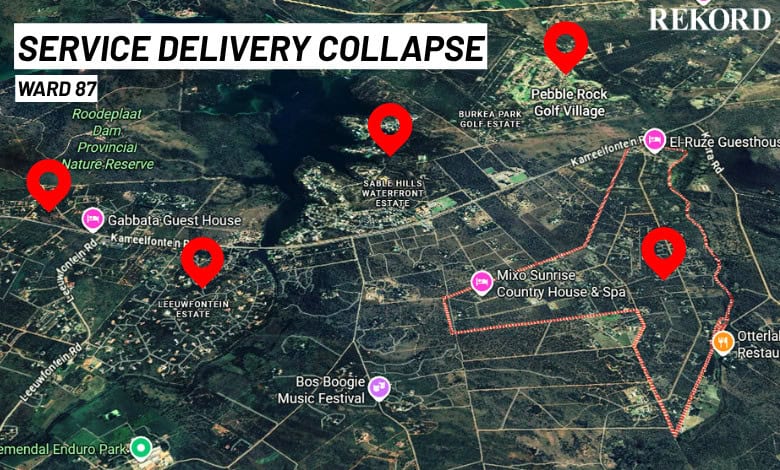
Residents in the Moot’s Ward 87 communities, such as Derdepoort, Pumulani, Kameeldrift East, Roodeplaat, Kameelfontein, Leeufontein and Sable Hills, say they have reached a breaking point.
After years of unreliable electricity and water supply, they are demanding accountability from city officials and immediate intervention to restore essential services.
One resident, speaking on behalf of several communities, described a ‘total collapse of municipal services’.
This region has experienced rapid growth, with the development of new residential estates, smallholdings, and agricultural plots.
The resident, who wants to remain anonymous, explained that the community has been left to fend for itself amid frequent power outages and water cuts stretching into days at a time.
“Our suburbs have been without consistent electricity for months on end,” the resident said. “No maintenance whatsoever is undertaken on our local distribution lines. This includes pruning of trees and general maintenance. Repeated appeals in writing to both the previous and current mayor and the energy and electricity manager for this area, Shaun Boloka, have failed to bear any results.”
The community is especially concerned for elderly and medically vulnerable individuals.
“We have a large community of elderly people in our area. Some of these people rely on oxygen or dialysis machines, which cannot function without electricity. There are also huge security implications for being without electricity for extended periods of time. However, the metro seems not to care,” the resident added.
A legal letter of demand was sent to the metro on February 5, detailing the residents’ concerns and requesting urgent action.
However, the community said eight months later, there has still been no formal response.
Beyond the electricity crisis, water supply remains another major issue.
Residents claim that leaks, pump failures, and ongoing reservoir problems have left many homes without running water for days, and sometimes even weeks.
Ward councillor Freddie Pienaar has been a vocal advocate for these residents and others in the area.
“These residents have been living with persistent and prolonged electricity outages that continue to affect homes, businesses, and critical infrastructure despite repeated calls for intervention and action from the metro,” Pienaar said.
He confirmed that more than 1 000 residents signed a petition earlier this year demanding an investigation into the causes of the recurring power outages.
“However, the response from the regional electricity director was delayed and disappointing, offering little more than confirmation that the problems stem from ageing infrastructure and overgrown vegetation along overhead lines,” Pienaar said.
In the absence of city assistance, the community decided to take matters into its own hands.
“With the help of several residents and CPF, volunteers carried out a large-scale tree-pruning operation to clear vegetation around live power lines. The operation was safely executed and entirely planned at ward level, with no planning support from the responsible regional director, despite this being part of his core technical management duties,” he explained.
He highlighted how recent administrative changes have made it more difficult for councillors to address community concerns.
“The metro has centralised the electricity function, meaning that the regional director for electricity now reports directly to the divisional head of Energy and Electricity, bypassing the regional management structure. This change has limited councillors’ ability to escalate issues, as communication through the regional head, as outlined in the Municipal Systems Act, is no longer possible.”
Pienaar referred to repeated failures on the main electricity line, which supplies power to the Zeekoegat and Roodeplaat plants, as an example.
“These failures have resulted in sewage spills and water contamination incidents,” he said.
While upgrades to the Zeekoegat and Baviaanspoort Wastewater Treatment Works are underway following his Integrated Development Plan (IDP) submissions, Pienaar warned that ‘the reliability of electricity supply to these critical facilities remains uncertain’.
The councillor emphasised that the rapid expansion of the area in both residential and commercial developments is placing additional strain on an already fragile system.
“Development is welcome and necessary,” Pienaar said, “but unless the metro addresses electricity capacity and restores clear lines of accountability, our growth will continue to be overshadowed by service instability.”
In response to the ongoing complaints, Metro spokesperson Lindela Mashigo said reforms are underway within the Energy and Electricity Department to improve service delivery.
“The metro’s Energy and Electricity Department is currently implementing service delivery reforms to fast-track maintenance of electricity infrastructure, including streetlights, high-mast lights, and power lines across all regions, including this area,” Mashigo explained. “The unit has been allocated more resources, such as specialised maintenance vehicles, to improve efficiency. Vegetation clearing and tree trimming along power lines have already been carried out in all wards of this area.”
Addressing concerns about long delays in power restoration, Mashigo said the main cause of past delays was a shortage of specialised repair vehicles, which has now been resolved.
“Residents can expect faster response times going forward,” he said.
Mashigo encouraged residents to report faults and outages through the metro’s official channels.
“Residents are encouraged to report electricity faults and queries through the metro’s official customer service channels either via their ward councillors or by contacting the city’s Customer Care Centre on 012 358 9999. These channels ensure that issues are logged and tracked for quicker attention.”
He also acknowledged the critical needs of residents who rely on medical equipment.
“The metro understands the seriousness of power interruptions for residents who rely on life-saving medical equipment. The ongoing reforms in the Energy and Electricity Department aim to address service backlogs and improve response times. While some faults require specialised equipment and may involve unforeseen budget challenges, the metro always strives to restore power as quickly and safely as possible,” Mashigo said.
He concluded by saying the metro acknowledges past shortcomings.
“The metro acknowledges that limited resources previously affected maintenance and repair times. With the new reforms and resource upgrades now in place, we expect to see a noticeable improvement in service delivery and a reduction in electricity-related complaints from residents.”
Do you have more information about the story?
Please send us an email to bennittb@rekord.co.za or phone us on 083 625 4114.
For free breaking and community news, visit Rekord’s websites: Rekord East
For more news and interesting articles, like Rekord on Facebook, follow us on Twitter or Instagram or TikTok.