Raw deal
As the heavens are bound to open up once the rainy season breaks the prevailing dry spell, scores of people along the Sand River stand the risk of falling prey to infection by life-threatening communicable disease linked to pollution carried by this water source. An escalating threat originating with a festering hellhole on one side …
As the heavens are bound to open up once the rainy season breaks the prevailing dry spell, scores of people along the Sand River stand the risk of falling prey to infection by life-threatening communicable disease linked to pollution carried by this water source.
An escalating threat originating with a festering hellhole on one side of Polokwane is growing reason for grave concern about a health risk posed to settlements and farming operations along the Sand River, as it makes its way to the great Limpopo. The matter is to become the point of departure for a complaint intended for institution with the South African Human Rights Commission (SAHRC) and a subsequent alert to Parliament.
Raw sewage allegedly pumped into the water way is being attributed to a partially dysfunctional sewage pump station located in Seshego. Problems arising from the operation apparently contribute to a looming disaster Polokwane Municipality would have to face if it continues to fail to act decisively. Apart from securing high level intervention, Roelof Lourens who is a Democratic Alliance (DA) Ward Councillor on Polokwane City Council intends to call for an investigation into the matter and the charging of the culprits. He simultaneously expressed worry over the possible impact on future commercial food production by farmers along the river who are banking on the safety of the underground water source and the possibility of human beings contracting water-borne diseases. As far as could be established, the intermittent problem has called for intervention for the past six years already, but the problem of pollution of the Blood River and eventually the Sand River has now reached alarming proportions.

It was learnt that the scenario based on the pollution of the Sand River spiralling out of proportion is being exacerbated by the fact that the Mashinini Sewage Pump Station on the outskirts of Seshego is dilapidated, over-burdened and has only been partially operational the past two and a half years. Having to handle two thirds of Seshego’s sewage bulk as well as that of nearby Blood River, it is situated some 2 km from the Seshego Industrial Area and in close proximity to the Seshego Sewage Purification Plant, which has not been operational for the past three years until three months ago and has to purify the sewage of two thirds of Seshego’s population. Along with the bigger plant in Asbestos Street bordering on Ladine, it has to accommodate the demands of an ever expanding city.
At the same time Lourens raised the issue of the purchase of land for a treatment plant along the Soetdorings Road an estimated 19 years ago, in order to meet the requirements for servicing an ever expanding city and meeting the legal prescriptions of having such a facility within a safe distance of 3 km from any development. With development having encroached on the location of the city’s plant proven too small to cope with the burden the past decade already, Polokwane has been up for another facility for an extensive period of time, it was learnt.
Having traced signs of pollution of the Sand River back to the Mashinini station, Lourens expressed concern about the increasing dangers posed by the ongoing state of affairs. He stressed that the facility was in dire need of upgrading and maintenance, while spare parts were not being acquired to do repair work to the pump station. Blaming the dire situation on cadre deployment, he claimed that the management of Polokwane Municipality did not have knowledge of the operation. With reference to documents made available to Polokwane Observer, he pointed out alleged tender price inflation resulting in wasteful expenditure for outsourced services that jeopardised quality of repairs to the system, which has also been victim of vandals and burglars in the past. Without the necessary upgrading being effected and only one pump currently in operation at the station due to the other two having reportedly broken down, it was unable to cope with high volumes of sewage flowing in, he emphasised. Lourens added that in the process of the station not operating properly by being able to pump the raw sewage to the bigger adjacent plant, the overflow ended up in the river. He pointed out that the pump station was deserted on Sunday night, a facility that had to be guarded while having an operator on duty round the clock. However, the unsafe circumstances contributed to guards refusing to work after hours and an operator seemingly knocking off late afternoon. Past incidents have reportedly resulted in the station being burgled, but the damages not being repaired despite State assets having to be insured, he added.

According to information purified water of which the quality adheres to prescripts is allowed to be pumped into the river, but has to be free of risk to humans and animals. It was a threat he had drawn attention to in a motion in January this year when then Polokwane Municipality Speaker Caiphus Mothiba was approached on discussion of the matter during a scheduled Council meeting, he said. According to him Polokwane Executive Mayor Thembi Nkadimeng had refused to address it and he never received any feedback on it.
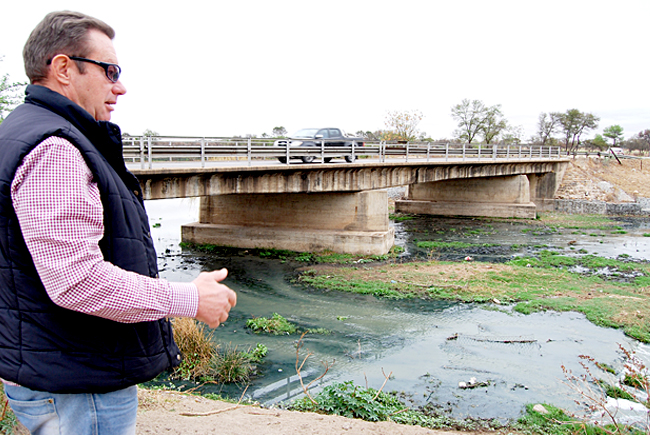
Polokwane Observer accompanied Lourens on oversight visits to the sites on the weekend and beginning of the week. During a visit to the pump station on Sunday evening an arresting stench caused by amassing, clogged up human excrement, urine and elements such as discarded toilet paper and condom wrappers mixed with water cascading down towards Blood River and then on towards the bigger water source was overwhelming. At the junction where the Mogwadi Road crosses the Sand River the ever present odour, discoloration and foam gathering on the surface were highlighted on Monday morning. Were it not for the dangers lurking in the water, it could have created an idyllic scene.
TAU SA-North comment
Turning to Transvaal Agricultural Union SA-North for their perception of the matter its Regional Manager, Drickus Botha indicated that the pollution of Blood River and eventually the Sand River has intensified over time to a point where it has never been as bad. According to him the impact was primarily of an ecological nature. He said no doubt existed that ecoli and polluting bacteria were present in the water. Botha pointed out that the current dry season caused a larger concentration of bacteria. According to him disaster has already struck. He predicted that if the rains came and caused the river to flow, it could result in disease and even death. He referred to the example of the people of Mabudu Village in the area of Spies Dam between Louis Trichardt and Vivo south of the Soutpansberg Mountains being at great risk for they were dependent on the water for their daily use.
Botha advised that the municipality had to go to the source of the problem and be forced to clear the water of bacteria.
AgriLimpopo view

AgriLimpopo Chief Executive Officer Willem van Jaarsveld attributed the situation to the pressure on Polokwane’s sewage system that is in dire need of upgrading. Labelling the magnitude of the problem as unacceptable, he said there was no need to conduct tests on water samples from the Sand River as it could easily be picked up by the naked eye and through smell. Whereas attempts to engage the municipality on the matter have failed in the past, they would have to adjust their methods for achieving results in future, he reckoned. According to Van Jaarsveld they have already entered into discussions with TAU SA-North over water-related matters, considered as a priority after the pressing issue of rural safety.
Polokwane Municipality response
Polokwane Municipal spokesperson Matshidiso Mothapo commented by stating that all sewer treatment plants within the city were fully operational. “(Polokwane) Municipality has three sewer pump stations within the city (i.e. Extension 29, Mall of the North and Mashinini Pump Station). The Mashinini pump station is partially operating currently due to the power failure experienced as a result of infrastructure vandalism that affected the pumps. This damage led to some spillage and the municipality responded by immediately sourcing the damaged parts or spares to ensure that this pump station operate(s) fully. We anticipate that by latest Thursday the pump will be operating fully, also eliminating any smell. All the sewer treatment is done at all treatment plants (Seshego and Polokwane treatment plants).”
Story and photos: YOLANDE NEL
>>observer.yolande@gmail.com
Featured photo: Democratic Alliance (DA) Ward Councillor on Polokwane City Council, Roelof Lourens views a spot of contention where the Mogwadi Road crosses the polluted Sand River some 10 km from Polokwane, trickling down towards the great Limpopo.