
Vodacom showcases new education ecosystem in rural Vhembe
The Vodacom Foundation in partnership with the Department of Basic Education, Nelson Mandela Foundation, United Nations Women and Global Citizen organisations showcased a new education ecosystem at the Divhani Community Crèche and Frank Ravele Secondary School in Nzhelele village in Vhembe District on Wednesday. Divhani Primary School and the Frank Ravele Secondary School’s pit latrines …
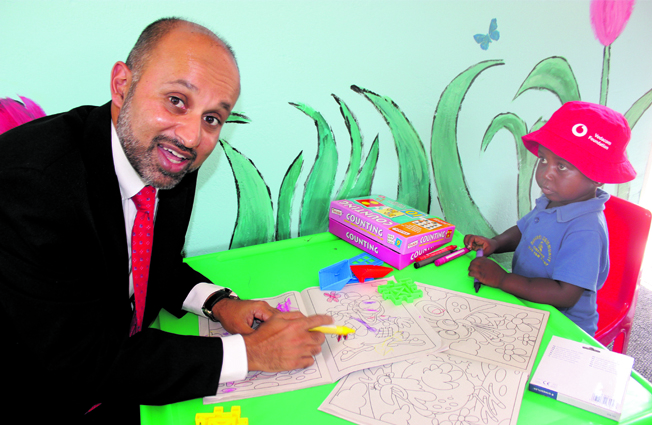
The Vodacom Foundation in partnership with the Department of Basic Education, Nelson Mandela Foundation, United Nations Women and Global Citizen organisations showcased a new education ecosystem at the Divhani Community Crèche and Frank Ravele Secondary School in Nzhelele village in Vhembe District on Wednesday.
Divhani Primary School and the Frank Ravele Secondary School’s pit latrines were also replaced with proper sanitation facilities. The Vodacom Foundation further also provided Frank Ravele Secondary School with a fully equipped and connected computer lab fitted with 60 computers and connectivity.
Divhani Community Crèche is one of 15 early childhood development centres (ECD) chosen for upgrading and renovation by the foundation alongside the Frank Ravele Secondary School thereby covering each phase of educational development.
The Vodacom Foundation also upgraded the infrastructure of the school, eradicating pit latrines and replacing it with appropriate sanitation and a borehole, as well as installed a trolley solution with tablet devices as part of a mobile library.
The institution performed upgrades in the school infrastructure, including eradicating the pit latrine and replacing it with proper sanitation, installing security systems at the school and replacing broken windows and doors and fixing collapsed ceilings.
The secondary school forms part of the Vodacom Foundation Schools of Excellence programme, a concept framed and aligned to the education definition that views these as schools that promote and support academic excellence, thus enabling quality education for the previously disadvantaged communities.
Through the new ecosystem, the Vodacom Foundation will define a comprehensive model of support and corporate social investment in local communities by supporting education from childhood to adulthood and leveraging technological innovations to develop the skills that we need now and into the future.
The new ecosystem will see the foundation intensify its support to its already established 12 schools of excellence, identified in partnership with the Department of Basic Education, and the 15 ECD centres, it is committed to upgrade over a period of three years.
This forms part of Vodacom’ Foundation commitment to bring about quality education for previously disadvantaged communities.
Takalani Netshitenzhe, Chief Officer: Corporate Affairs for Vodacom Group said: “Big corporates such as Vodacom exist as a part of society that is dogged by high levels of inequality and poverty. Therefore it is our obligation to partner with the government and non-governmental organisations to come up with solutions to deal with some of the socio-economic problems plaguing our society today. Our new education ecosystem can be located within the context where we are using our expertise in ICTs to come up with modern solutions to assist the government to achieve its vision and key priorities.
“Through our education ecosystem, we will be addressing many of the socio-economic challenges faced by communities. In many of the marginalized and rural communities, educational institutions and facilities are poorly resourced, the infrastructure is falling apart, and there is no access to technology or any other educational resources. In Vodacom Foundation supported communities we will be working in partnership with government, civil society and the communities to ensure that we address some of these challenges.”
“We do all this because we believe in sustainable education system and good quality education using ICTs. We believe computer labs will facilitate the creation not only of a reading nation but a digitally literate nation. We appeal to the parents and community led by the chief to help us to safeguard all the facilities. These are your facilities not just Vodacom facilities or Vodacom supported facilities,” concluded Netshitenzhe.
Mohamed Enver Surty, Deputy Minister of Basic Education said the new education ecosystem will the learners at the schools to more innovative and creative. “The learners are ready for the 4th industrial revolution and we are happy to give learners education in a way that they want it. We also want to thank Vodacom for digitalising education and for making it exciting,” Surty stated.
Simon Ramabulana, Principal of Frank Ravele Secondary School said the arrival of technology at their school will enable learners to solve complex problems without hindrances. “The laptops will create dynamic learning communities. This will also infuse technology into curricular standard and promote quality of teaching and learning. We want to thank Vodacom and we promise to take good care of the equipment,” he said.
Hulisani Masindi, Manager for Divhani Community Crèche thanked Vodacom for their efforts in ensuring that learners at the Crèche enjoys earning without any difficulties. “They have rescued us. We were in shambles, we did not have a proper infrastructure at all. They have started everything from the scratch, they innovated the classes, the ablution facilities and they also gave us new classroom equipment and we are grateful for that,” Masindi said.
Story and photos: Herbert Rachuene
>>herbert.observer@gmail.com