‘Prioritise spatial planning to avert disaster’ – Wits Prof
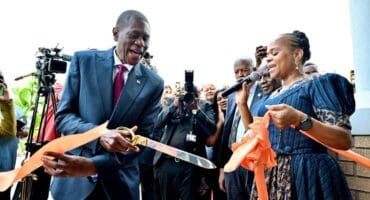
Wits environmental management professor, Prof Mulala Simatele mentions that residential areas were built on top of wetlands, reducing natural flood control measures.

POLOKWANE – Celebrating risk management excellence during a breakfast held at Meropa Casino and Entertainment World by the Capricorn District Municipality (CDM) last week, some experts held the view that local government did not adequately invest in spatial planning, and that this makes the area susceptible to disasters, more than it did before.
Wits environmental management professor, Prof Mulala Simatele specially called for the matter to receive attention from CDM Mayor Mamedupi Teffo, as, he said, sizable farm lands were turned into residential areas which increased food insecurity in the long run while the economic outlook remains bleak.
On top of that, residential areas were built on top of wetlands, reducing natural flood control measures, he mentioned.
“In one case, land beneficiaries who are to be allocated stands at Ext 40 along the Matlala road, allege that this area is a wetland. Unless an approach through which spatial planning and investment is prioritised, the worst is yet to come, and more disasters are coming,” he warned.
His comments came in response to Teffo expressing gratitude to insurance organisations that have helped the municipality improve its reaction to risk and disaster management in the district.

While Simatele’s view sounded harsh, a recent doctorate done at the Tshwane University of Technology (TUT) on government administration in three provinces including Limpopo, supports his assertions.
The study by Dr Madikana Mokgokong found that funding and investment is intensely low in two provinces, namely Limpopo and the North West, while Gauteng fared somewhat better with 1.5% of the Gross Domestic Product (GDP) directed towards research and development investment and funding.
The study, which will be presented to provincial government at a later stage, found that in most cases, “political interferences are hindering progress in planning and development as a result of political appointments of unqualified personnel in critical and strategic positions”.
It also stated that there was a lack of political and administrative will from key decision makers, who were still not keen to inject financial and human resources into the issue.
This raised the question of which research systems informed decisions made in government on basic goods and services such as infrastructure, water capacity, roads and education systems, among other factors.
For crime-solution researchers, there is vagueness in the presentation of national quarterly crime statistics in that these do not break down affected groups, such as the number of those affected in institutions of higher learning, households, workplaces or even gender and race.
This in turn waters down crime responses to specific groups, if a reflection of how much a specific act affects a particular group is not clearly stated in the overall crime statistics, according to an forensic crime investigator who opted not to be named.
The study gave solutions in this regard.
“Enter into functional research collaborations or partnerships with universities, the private sector and civil society. Use uniform and standardised planning approaches rather than having each directorate adopting planning approaches as they see fit. Relax the policy landscape for research and development investment and funding to thrive by allocating adequate financial and human resources,” it suggested.