
How to spot political spin: Africa Check’s guide for voters
Elections are coming, and so is the spin. Here's a simplified version of Africa Check's guide to help voters spot misleading claims.
LIMPOPO – As political parties prepare to campaign, voters can expect a familiar mix of promises, statistics, achievements and accusations.
With South Africa’s local government elections set for November 4, voters are likely to be confronted with claims about service delivery, municipal finances, infrastructure, jobs and the performance of previous administrations.
But how do you know what is fact, what is misleading, and what is simply political spin?
Africa Check, a non-profit fact-checking organisation, has released a guide identifying seven tactics voters should watch for when assessing political claims ahead of the election.
1. Measuring today against the worst of yesterday
A politician may describe a situation as being in a state of “crisis” or “collapse”, with promises of fixing the issue. Conversely, a party may say they inherited an issue at rock bottom, then point to even a small improvement as evidence of a dramatic turnaround.
The problem is that descriptions such as these do not provide a measurable starting point. They can be used as the bedrock of a campaign while not giving their audiences a realistic point of reference.
Likewise, if the baseline is vague enough, then almost any improvement can sound impressive.
2. What does that big number actually mean?
Big numbers grab attention.
A politician might announce that millions were spent, thousands of people benefited, or hundreds of projects were completed, but a number on its own tells you very little.
Africa Check points out that figures need context, including the total against which they should be measured.
3. Can the promise actually be measured?
Election promises often sound impressive precisely because they can be difficult to pin down.
Words such as “transform”, “accelerate”, “massively improve” or “create opportunities” can sound ambitious without specifying exactly what will be delivered.
Without a measurable target, deadline or budget, voters may struggle to determine later whether the promise was actually kept.
4. Is activity being confused with achievement?
A government can tell voters what it did without showing what actually changed.
A project was launched. A meeting was held. Money was allocated. A programme was introduced.
Those things may all be genuine achievements in themselves, but they do not necessarily demonstrate an improvement in people’s lives.
5. Can the municipality actually do what is being promised?
This is particularly important in a local election.
Political parties campaign on issues that matter to voters, but not every issue falls under the direct authority of a municipal council.
When a candidate promises to solve a particular problem, voters should first establish whether the municipality actually has the power to deliver it.
6. Who actually deserves the credit?
An improvement does not automatically belong to the politician taking credit for it.
Projects and policies can span different entities, administrations, levels of government and years.
For example, a municipality might point to more people finding work as evidence that its policies are working. But employment is influenced by many factors beyond the municipality’s direct control, including private-sector hiring.
More people getting jobs does not automatically mean those jobs were created by the municipality.
7. What happened to that promise?
Election promises have a habit of disappearing once the campaign is over.
A bold announcement may dominate headlines and social media during an election, only to receive little attention afterwards.
Looking back at what politicians previously promised can reveal a more complicated record: some commitments may have been delivered, while others quietly disappeared from the conversation.
Limpopo voters have plenty to scrutinise
These questions could prove particularly useful in Limpopo, where local election campaigns are likely to focus heavily on issues residents encounter every day, from water and electricity to roads, housing, municipal finances and service delivery.
The point is not to distrust every political claim. It is to test it. As Africa Check says, “a claim doesn’t have to be false to be misleading.”
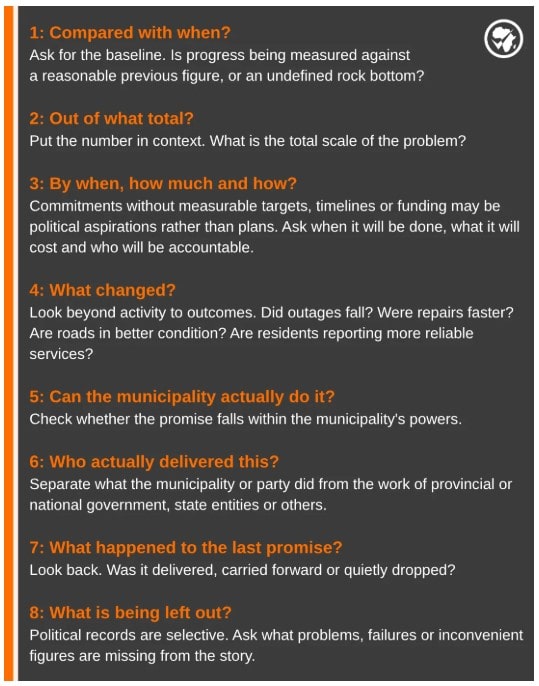
As campaigning gathers pace, voters may want to keep these questions in mind:
This article is based entirely on a guide published by Africa Check. Read the original article here.