White Sasol employees might strike soon. (Photo Moneyweb)
SECUNDA – Members of Solidarity in Secunda voted last week on whether they should strike or not because white people are not included in Sasol’s newest empowerment scheme, Khanyisa.
Sasol announced last year that the Inzalo scheme which ended on 18 May this year, would be replaced by Khanyisa.
The Inzalo scheme failed and members received no money from this scheme.
According to Solidarity’s CEO, Dr Dirk Hermann, 83 per cent of Solidarity’s members working at Sasol voted that they want to strike.
The management team of Solidarity visited Secunda last week and had four meetings in the afternoon and in the evenings to accommodate all their members, including those who were working shifts.
These members voted last week at the meetings, while the Sasolburg workers voted on Monday, 27 August.
Sasol employees are in the process of organising a strike. (Photo Sasol)
“It will be the first time in the history of South Africa that white workers will strike over racial exclusion,” said Dr Hermann.
“Apart from the strike, Solidarity is also planning a protest action nationwide so that other people who want to support the Sasol workers, can also take part.
“We created a special page at www.solidariteit.co.za where the public can support the Sasol employees affected by Khanyisa.
“The support we received so far for the strike action is overwhelming and it shows that our members are frustrated.
“Sasol went too far this time and the rule, especially in the mining industry, is that all employees regardless of race, should be included.
“The message we got from our members was that they have had enough.”
With Khanyisa, black employees of Sasol will receive R500 000 while white employees will receive nothing.
“In practice, it means that a white employee who has been working for Sasol for 30 years, will get no advantage, while another who has been working for Sasol for three months, will receive R500 000.
“Employees who do the same work at Sasol, receive different rewards.
“This decision from Sasol’s side will cause division among workers and will increase racial issues.
“This issue became bigger than just our skin colour.
“With the Inzalo scheme, Sasol initially wanted to give the white people only half of what black people would have received.
“Solidarity was in a big strife with Sasol over this and in the end, they included the white employees as well.
“Sasol shows that they are using a calculator to determine our values and now they are saying to white employees: ‘You are productive times zero,’ and in the end, a line is drawn through your value.
“That is not acceptable and I think Sasol is using their black employees as well just to score points.”
According to Dr Hermann the concept mining charter states that personnel schemes must include all workers regardless of race.
“Sasol’s scheme is against this charter and it is just about getting points for Sasol.
“For Sasol it is not about the empowerment of workers, but for the commercial value on a scoreboard.
“Solidarity also does not agree with Sasol about the handling of the previous scheme, Inzalo, when pensioners were excluded from receiving anything from the scheme.”
Dr Hermann said Solidarity spoke to Sasol about the strike and their disappointment with Sasol for excluding white employees from their scheme.
Sasol said they took note, and did nothing further.
“I told Sasol’s human resources department what their workers are thinking, how they are feeling and how they will react.
“I also explained to them why it is wrong to exclude certain workers based on their race.
“With the strike action, we do not only want to make it a Sasol thing, we want to make it a community thing and we want the wives and children to take part in the action and support the Sasol employees.
“We are going to strike in an orderly manner and within the law.
“We just want to say as a community that we do not accept this and we want to call out a day of protest throughout the whole of South Africa.
“It does not only affect Sasol workers, but every person in South Africa because it is a matter of principle that nobody is allowed to exclude anybody, black or white, because of their race.”
Solidarity began speaking to Sasol about this issue in December last year.
“What we do not want to do, is to disadvantage Sasol, but we do want to force Sasol in a legal and orderly way to correct itself,” said Dr Hermann.
One of the white employees said at one of the meetings he never took part in a strike before, but he will now walk right in front because their futures depend on it.
“Sasol is lying to us, where is our shares of Izalo?” asked another retired Sasol employee.
“When I retired I asked them what about our shares and they said we must wait until September this year, and we want to know what is happening now.”
Dr Hermann said the current minister of mineral resources, Mr Gwede Mantashe, does not support Sasol’s decision to exclude white employees and Solidarity will approach Mr Mantashe soon and ask him to get involved.
Mr Deon de Vries of Solidarity in Secunda, said any member of Solidarity can strike even if they are in management positions at Sasol.
“Sasol employees can, according to law, go on a strike regarding socio-economical issues and this is a socio-economical issue,” said Mr De Vries.
Solidarity is required by law to give Sasol 48 hours’ notice of the strike.
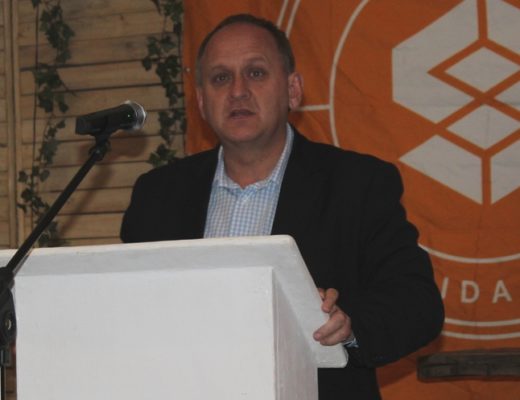
Dr Dirk Hermann (CEO of Solidarity) talks to members about the possibility of striking against Sasol’s Khanyisa scheme that excludes white employees.
Mr Alex Anderson, head of Group Media Relations at Sasol, said on Monday, 27 August they have not yet received a notification of an industrial action by Solidarity.
He further said: “Solidarity originally declared a dispute against Sasol in January this year, objecting to the exclusion of white employees from Sasol Khanyisa Phase 2.
“After a second round of CCMA discussions, the CCMA issued a certificate of non-resolution in May after not being able to reach common ground.
“A certificate of non-resolution does not imply that Solidarity is correct or that Sasol is wrong, it means that the parties could not find any middle ground, and gives permission to Solidarity to withdraw labourand protest in a safe manner.
“We value Solidarity’s relationship with Sasol and will ensure that we keep the lines of communication open between us.”
Mr Anderson explained the Sasol Khanyisa context and said on 1 June this year that Sasol Limited officially launched Sasol Khanyisa after having received shareholder approval on 17 November last year.
“Our intention is to create meaningful financial benefits for approximately 230 000 black shareholders and qualifying employees, and to achieve 25 per cent direct and indirect black ownership of Sasol South Africa Limited (SSA),” said Mr Anderson.
“We are aware of negative reports and sentiment expressed from different quarters of society against Sasol Khanyisa.
“These reports are largely premised on a misunderstanding of elements of the transaction pertaining to employee participation.”
According to Mr Anderson, the employee participants in Sasol Khanyisa phase 1 are all permanent Sasol employees, regardless of race, tenure or seniority, who were participants of Sasol Inzalo and were still actively employed on 1 June this year.
Phase 2 of Sasol Khanyisa is extended to black permanent employees and includes African, Indian and coloured employees as defined by the DTI Codes of Good Practice.
“Qualifying employees in Sasol Khanyisa will receive equal shareholding across the organisation.
“Sasol employees who participated in the Sasol Inzalo Employee Scheme and who were permanently employed on 1 June, will participate in phase 1 and are eligible for R100 000 worth of Sasol ordinary shares, or Sasol BEE ordinary shares which will vest in 2021.
“There were 6 313 white employees and 11 962 black employees in this phase at the beginning of the transaction.
“All black employees who were permanently employed on 1 June and took part in phase 2 are eligible for 1 240 Sasol Khanyisa rights to shares which will vest in June 2028 or the earlier of settlement of funding obligations.
“This means that the rights to shares are fully funded through national vendor financing and any dividends declared over the next 10 years will be used to service the funding obligations and create net value at the end of the empowerment period for participants.
“There were 18 282 black employees in phase 2 at the beginning of the transaction.
“Transformation, in the form of share ownership in Sasol South Africa by previously disadvantaged groups, is an important business, social and moral imperative for Sasol.
“Sasol Khanyisa is not part of Sasol’s employee remuneration or benefit structures.
“It was specifically designed to address the ownership component of the B-BBEE codes and therefore Sasol Khanyisa primarily focuses on the inclusion of black employees.”
White Sasol employees might strike soon. (Photo Moneyweb)
At Caxton, every story is written by humans. We use AI only to perform quality checks - never to generate the news. Happy reading!