Municipal elections: Independent Lekwa Party (ILP) mayoral candidate answers questions
Barbara Sheppard tells voters what she will do if she becomes the mayor.
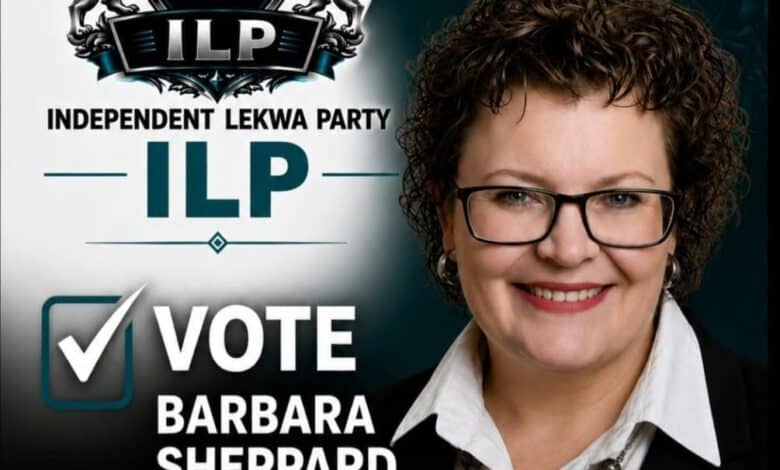
Standerton Advertiser invites mayoral candidates and candidates contesting wards in the upcoming local elections to answer our questions.
Here are the answers of IPL mayoral candidate, Barbara Sheppard:
Q. What is your strategy for protecting existing jobs and attracting new investment to Lekwa?
A. My starting point is simple: you cannot attract sustainable investment into a municipality that cannot reliably provide water, electricity, sanitation, roads and sound administration.
Lekwa must first restore confidence in the municipality. My strategy would therefore have three parts:
First, protect the economic base we already have. Existing businesses, farmers, industries and small businesses must be treated as partners in Lekwa’s economy. We need regular engagement with business and industry to identify infrastructure and administrative obstacles affecting their operations.
Second, create a municipality that is investment-ready. Investment requires reliable bulk infrastructure, clear land-use planning, predictable municipal processes and transparent procurement and administration.
Third, actively market Lekwa’s opportunities. We must engage provincial and national government, development agencies and the private sector to identify realistic investment opportunities rather than announcing projects that have no funding or infrastructure capacity behind them.
I will not promise investors that I can create jobs by political appointment. My responsibility as mayor would be to create the conditions in which businesses can invest, operate and create sustainable employment.
Q. The municipality has faced persistent challenges around water infrastructure, electricity, roads, sewage spills, illegal dumping and ageing municipal assets. Which infrastructure problem will you tackle first, and why?
Water and bulk infrastructure would be my first priority.
There is no point building more houses or attracting major development if the municipality cannot reliably supply water and safely remove and treat sewage.
The municipality’s own planning documents have identified serious financial and infrastructure pressures, while a Presidency-led technical assessment in August 2026 specifically examined constraints affecting water, sanitation and electricity services in Lekwa.
My approach would be to establish a Lekwa Infrastructure Recovery Programme, based on engineering evidence rather than political promises.
It would identify:
- The actual condition and capacity of the water-treatment system.
- Bulk water requirements.
- Wastewater-treatment capacity.
- Electricity distribution constraints.
- Roads and stormwater priorities.
- Critical municipal assets requiring replacement or rehabilitation.
- The funding required and where that funding can realistically come from.
- Water, electricity and sewage are interconnected. Fixing one while ignoring the others will not solve the underlying problem.
Q. Some areas in Lekwa are without basic services. What is your plan to improve basic services while addressing longer-term housing needs, and how do you plan to curb illegal squatting?
A. We must separate the urgent need for basic services from the question of long-term housing development.
Residents should not be denied basic human services simply because an area is underserved. At the same time, we cannot continue allowing settlements and development to take place without checking whether there is sufficient water, sanitation, electricity, roads and stormwater capacity.
My approach would be:
1. Map all underserved areas and existing service gaps.
2. Prioritise emergency basic-service requirements.
3. Align future housing development with the IDP, Spatial Development Framework and available infrastructure capacity.
4. Work with provincial and national government on properly funded housing programmes.
5. Enforce land-use and municipal legislation consistently.
6. Prevent new unlawful occupation through early intervention, proper land management and engagement with relevant authorities.
The answer to informal settlement growth cannot simply be eviction, and it cannot be ignoring the law either. We need lawful, planned and serviced human settlements.
Q. What is your plan to improve the municipality’s financial position and ensure that municipal spending translates into visible service delivery?
A. This is arguably the municipality’s biggest underlying challenge because without financial stability, infrastructure recovery cannot be sustained.
Lekwa’s published planning documents have recorded serious financial pressures, including large creditor balances, liquidity problems and insufficient maintenance funding. In May 2026, national government also reported that implementation of Lekwa’s Financial Recovery Plan had stagnated at Phase 1.
My plan would focus on five areas:
1. Revenue collection
Improve billing accuracy, reduce losses, address illegal connections and improve collection from customers who can afford to pay.
2. Expenditure control
Every rand must be connected to an approved municipal priority, service or legally required function.
3. Eskom and other creditor obligations
The municipality needs a credible, monitored financial recovery strategy rather than repeatedly accumulating debt.
4. Maintenance before crisis
A municipality cannot afford to allow infrastructure to deteriorate until replacement becomes dramatically more expensive.
5. Performance accountability
The budget, IDP and Service Delivery and Budget Implementation Plan must be linked to measurable outcomes.
Lekwa has recently submitted its 2025/26 Annual Financial Statements and Annual Performance Report to the Auditor-General, which provides an important accountability mechanism.
I will not promise that the municipality’s financial problems can be solved in one year. I will promise that financial recovery must be treated as a measurable programme, with residents able to see whether we are moving forward or backwards.
Q. What will you expect your ward councillors to deliver for residents, and how will you hold them accountable for service delivery, community engagement and responding to local problems?
A. I would expect every councillor to represent their residents, communicate with their communities and exercise proper oversight.
But I would also make an important distinction: A councillor is not a municipal employee.
Councillors should not be personally fixing electrical faults, appointing workers, awarding tenders or interfering in administrative appointments. The Constitution places municipal decision-making within the Council, while the administration is responsible for implementation.
My expectations would therefore include:
Regular community engagement.
Proper reporting of service-delivery problems.
Following up on unresolved matters.
Participation in Council and oversight structures.
Monitoring implementation of the IDP and budget.
Reporting back to residents.
Acting ethically and avoiding interference in procurement and appointments.
I would expect councillors to be visible, accessible and accountable, while respecting the legal separation between political oversight and municipal administration.
Q. If we interview you again at the end of the 2026–2031 term, what specific measurable result should we be able to hold you accountable for?
Do not judge me by promises. Judge me by measurable change.
At the end of the term, I would want residents to be able to compare the municipality’s starting position in 2026 with its position in 2031 across five measurable areas:
1. Water:
Improved reliability and measurable progress in restoring and maintaining water infrastructure.
2. Electricity:
Reduced municipal distribution losses, improved infrastructure maintenance and measurable progress in resolving systemic electricity problems.
3. Wastewater:
A measurable reduction in sewage failures and demonstrable compliance improvements at wastewater infrastructure.
4. Roads and municipal assets:
A functioning maintenance programme with documented work completed against approved priorities—not simply emergency repairs after infrastructure has failed.
5. Financial sustainability:
Improved revenue collection, stronger expenditure control, reduced arrears and measurable progress against the municipality’s financial recovery obligations.
The municipality already has formal mechanisms for planning, budgeting and performance management, and those are the mechanisms against which progress should be measured.
My commitment: I will not tell the people of Lekwa that I can fix everything in five years. That would be another empty political promise. What I will commit to is this: every major problem must have a plan, every plan must have a responsible structure, every funded project must be monitored, and residents must be told the truth about progress.
We need to move Lekwa from crisis management to infrastructure recovery, financial discipline and accountable service delivery.
People before politics. Unite for a Better Lekwa.
Disclaimer: The views and opinions expressed in this article are those of the candidate and do
not necessarily reflect the views or positions of the journalists or the newspapers (Ridge Times and Standerton Advertiser) and the company (Caxton) they represent.